Sometimes when I reflect on Scripture I only consider the words before me. I examine their origin, their context, their meaning, and their hidden meanings. In no way do I discourage this as there is a great deal of wisdom and fruit that comes from these things.
Other times I consider myself, the individual who hears these words. I, a student who is in the midst of this semester, who is experiencing beautiful fall weather, and who contemplates a life in service to God and others, hear the words of Scripture in a way unique to myself.
Some live in tropical climates, others live in frigid lands, some live in places at war, while others still live in prosperity. His voice reaches all the ends of the earth. It's incredible to think that I, in this place, with this or that disposition, and at this time, am hearing God's word as He intended me to hear it.
The Gospel is not just the words that are written but the words that are heard. "I am not ashamed of the gospel: it is the power of God for salvation to everyone who has faith" (Rom 1:16). "Stephen, full of grace and power, did great wonders and signs among the people. ... [His detractors] could not withstand the wisdom and the Spirit with which he spoke" (Acts 6:8, 10). A word, spoken in the Spirit and heard in the Spirit, produces in us a profound effect. We rightly reverence those words deemed necessary on revelation, but do we not also reverence those in whom we witness the Spirit? For we should reverence God wherever He is, not only on the page but among us and in the world too.
Likewise, God speaks one message, but we hear it in many ways. All the same, God asks us to respond in the same way: with love, all while praising His glorious name. Jesus emerges from the desert saying, "Repent! and believe in the gospel!" One voice demanding one response.
This one response happens in many ways. The one who suffers from lust must respond with chastity while the one suffering from pride must respond with humility. The one who despairs must respond with hope and the one who is angry must respond with patience. Often I find that all of us suffer from numerous things: pride, lust, despair, and anger. The cross seems to heavy to bear, and the response seems as if it would strain our voice.
At this time it would seem necessary to first take an inventory of our sins, our emotions, and our thoughts. It is not enough to say "I am tempted so I must be chaste." Rather, upon reviewing ourselves we say, "I am unchaste when I give into my anger." One may pluck the fruit of sin only to have it regrow. Finding the root is the surer means of conquering sin. The root, if deep, requires great effort and persistence to pull. That you are pulling at that root is a cause for thanksgiving. "Hermas, stop saying all these prayers for your sins. Ask also for righteousness, so that you may take part of it to your family" (Shepherd of Hermas, 9:6). Praying for forgiveness, while good, also makes us focus on ourselves. Praying for righteousness and strength allows us to share it with others.
Listen to His voice. When you decide where His voice is or isn't you have already hardened your heart. Did not King David find God's voice in the dissenting servant of his enemies house? Zeru'iah said to him, "Why should this dead dog curse my lord the king? Let me go over and take off his head." David replied, "What have I to do with you, you sons of Zeru'iah? If he is cursing because the Lord has said to him, 'Curse David,' who then shall say, 'Why have you done so?" (2 Sam 16:9, 10) (cf. 2 Sam 16).
So too must it be with us. Do not say, "The Lord is only with this man" or "The Lord in only in Scripture" for you are then a liar and a deceiver. Do not say, "The Lord only speaks good things to me" for many of God's servants were treated severely before they were glorified. Furthermore do not say, "I should have never been born," for "before I formed you in the womb I knew you" (Jer 1:5) and "all the hairs of your head are numbered" (Mt 10:30).
God is speaking to every one but He is also speaking to you in the manner He sees fit. "My son, if you receive my words and treasure up my commandments with you, making your ear attentive to wisdom and inclining your heart to understanding ... then you will understand righteousness and justice and equity, every good path; for wisdom will come into your heart, and knowledge will be pleasant to your soul" (Prv 2:2, 9-10).
Showing posts with label wisdom. Show all posts
Showing posts with label wisdom. Show all posts
Saturday, October 5, 2013

Wednesday, October 31, 2012
In Praise of Weakness
Author's Note:
I realized after writing this that it may be cryptic for some. For
those struggling with one of the themes, please consider this: to neglect,
hate, or ridicule someone or something for weakness or simplicity is an error on your part. These are all strong words, to be sure, but I've
heard far too many arguments along the lines of "he's a sinner how could
you love him?" Even of the blessed St. Peter "he was a fool and serves
as an example for us." Others may say "I hate myself because I keep messing up [in sin, etc.]." Others still have said that "the Church is just
human authority filled with human weakness, I follow God alone."
Part of this is about patience and perseverance coupled with understanding and a willingness to change.
I ask, humbly, you reflect on those sentiments with this. This is hardly adequate for full but in the interest of your own attention and retention I cut this down significantly.
I ask, humbly, you reflect on those sentiments with this. This is hardly adequate for full but in the interest of your own attention and retention I cut this down significantly.
 | |
| What are you talking about?? (Comment below if you feel that way) |
I. Introduction
Those who do not share in the
weaknesses of the body have no share in the body itself. For what
body in this life is free from corruption and limitedness? Even the
great Body of Christ is subject to weakness precisely because he
subjected Himself to our weakness since “he took the form of a
slave” (Phil 2:7) and “was of human estate.” Even after the
Resurrection His resplendent and transformed body still bore the
wounds of his glorious crucifixion (cf. Jn 20:20). It should be noted
even more that Jesus identifies Himself with the weak and broken for
“what you have done for the least of these you have done for me”
(Mt:25:40). Likewise Jesus identified Himself with those who were
persecuted, ridiculed, and killed in His name. This is why He said
“Saul, Saul, why are you persecuting me?” (cf. Acts 9:4,
5).
Paul said that “Christ is the head of
the body the church.” (Col 1:18). We have seen, albeit briefly,
that Christ shared in our humanity fully and willfully. We saw,
through His resurrection, that He transformed our weaknesses while
still keeping the physical marks of that weakness. They were not cast
aside or hidden but present in plain sight. Jesus told Thomas “put
your finger in my hands and in my side” (cf. Jn 20:27ff). The
history of Christianity is a constant call to “place our fingers on
the wounds of His body.” Thomas doubted the Resurrection, perhaps,
because after witnessing the horror and shame of the cross (and
living in his own shame) he asked ‘how might anything good come
from this?’ Christ showed him precisely the good that came from it,
namely His own person.
 |
| Caravaggio's famous painting not only represents the doubt of Thomas but that same doubt that we feel about our Church and her divine characteristics. Are we willing to address our doubts? Are we still willing to trust in the Church? |
II. Sharing in Weakness
This is what I call each of you to do
today: If you are to truly share in the Body of Christ do you share
in its weaknesses? The weaknesses I refer to are failures in charity,
excessive opulence, elements of the Inquisition and Crusades, sex
abuses, and every weakness that we see in our own person. Blaming the
past, however horrible—and indeed some things are horrible—is to
separate fallen and weak humanity from the life of faith. Faith is
not perfection but, in a manner of speaking, seeking perfection.
Weakness is either self-generated or encountered, shall we shy away
from either?
 |
| I rarely see this type of image, of Jesus as a fragile child being cared for. Jesus Christ, our savior and Lord, became as a little child out of love for us. |
Christ met our broken humanity. He
calls us through faith and baptism to share in His mission of
transforming all of humanity. If we deny the humanity of the
Body we separate ourselves from that Body. The Church is the Body of
Christ beset by human weakness but all the same transformed by Christ
and upheld by the Spirit.
When we recognize weaknesses and
failures there is a twofold response: the first is active insofar as
we seek to rid ourselves of that weakness (whatever it may be). The
second, equally important, is to realize that we are not separate
from our weaknesses. The weaknesses that we carry inform our actions
for the future, even in healing. If we do not address our weakness
actively we won’t change effectively. If we try to disassociate
ourselves from our weaknesses we become insensitive to the weaknesses
of others and we forget who we are.
III. Examples of Weakness
Transformed
St. Peter is our first
example and our guide. He was filled with faith and he was blessed
personally by Christ (cf. Mt 16:16-20). But he had his faults too. He
was rash and at times overzealous. This zeal, coupled with his
predispositions about what the Messiah was supposed to be, led him to
deny Christ three times while He was being humiliated. He abandoned
his friend and the one whom he loved. “He wept bitterly” (cf. Mt
27:75). After the resurrection Christ called out to him and Peter
responded. Christ confronted Peter’s sin, fear, and weakness not by
shaming him but by asking him, “Peter, do you love me?” Jesus
asked him this three times for every time Peter denied him. Peter
recanted three times saying “You know that I love you” (Jn
21:17). Peter is a man whose strengths and weaknesses are on full
display. Just as God had chosen Moses, Abraham, and David before He
chose this time to call a simple fisherman to greatness. These
patriarchs and this king themselves sinned, doubted, and failed.
Through it all they carried out what God had asked of them. Only
Peter, however, was given “the keys of the kingdom of heaven” (Mt
16:19).
 |
| Despite his brashness and weakness Christ still pulled him from the water. Despite his denial Jesus came to him and Peter grew in understanding, wisdom, and love because of Christ's example. |
Our chief example, and one that
has given me pause for years, is the Eucharist. I believe in Christ
and I believe in Christ risen. I also believe that at the Last Supper
he gave us a model to follow: he took the bread, broke it and said,
'take this all of you and eat this. This is my body which has been
given up for you.' He also said of the wine 'this is my blood.' This
I believe with my whole heart. This sentiment is in accord with all
that has been said above. Truly, to our senses it appears as mere
bread and mere wine. Then I recall with wonder that “he emptied
himself … coming in human likeness and found in human appearance”
(Phil 2:7). Likewise that “he had to become like his brothers in
every way” (Heb 2:17).
Indeed, the Eucharist is regarded as
the Son of Man, present sacramentally in ordinary bread and wine
which has been transformed by the prayer that Christ entrusted to His
Apostles and their successors. The Eucharist is both a glorification
of the Cross and a sacrifice that dips into the eternal moment of
Christ's one sacrifice and shares fully in it. It is something that
stands outside of time. Something so grand, God Himself! in ordinary,
daily food. Christians have praised the extraordinary in the ordinary
as well as paradox from the beginning insofar as “Jews look for
signs and Greeks look for wisdom but we proclaim Christ crucified”
(1 Cor 1:22-23).
 |
| This is what we exalt. Do you? |
Furthermore Jesus Christ Himself is
“the living bread that came down from heaven that one may eat it
and not die. I AM the living bread that came down from heaven;
whoever eats this bread will live forever; and the bread that I will
give is my flesh for the life of the world” (Jn 6:50-51). I could
occupy an encyclopedia set with the richness of these verses. The
word “eat” (phagein) has no spiritual connotation. It
literally means to chew and physically eat. By eating this living
bread we shall not die. Then Christ follows by saying “ego eimi”
which means “I am.” But this is no mere “I am” but rather a
direct reference to God speaking about Himself in the Old Testament.
It is a proclamation of authority and power—this is something we
should listen to. He said “I AM the living bread come down from
heaven.” He then says “Whoever eats/chews this bread will
live forever.” He further says
“the bread which I give is my flesh,” Literally my earthly flesh.
The simple bread which He gives is
his flesh. For the time being let this entirely inadequate account
suffice. No “ego eimi”
statement in Scripture is a metaphor or an opinion. It is Jesus
speaking in the authority of the Father on an intrinsic reality.
IV. Share in
Weakness, Share in Glory
What is my purpose
in saying all of this? Proceeding from the Eucharist and the example
of the Apostles (chief among them Peter) Christ gave us two simple
and lowly things and transformed them. He transformed bread and wine
into His flesh and blood. He transformed simple fishermen into
philosophers, teachers, and bearers of His message. Though they were
of human estate they were transformed and “filled with the Holy
Spirit” (Acts 2:4).
The Church is the
Body of Christ—it is subject to weakness. The Eucharist is bread
and wine made the Body and Blood of Christ—it is common and
ordinary yet mysterious and sublime. The Apostles were chosen by
Christ Himself to bear unique witness to His teaching and
mission—they were “also human beings” (Acts 10:26). Jesus
Christ identifies with the poor, persecuted, and the oppressed in an
intimate way—they are lowly and 'worthless' in the eyes of the
world. Finally, Jesus Christ Himself, was born of a virgin in
poverty. He was a helpless child and a man subjected to ridicule and
cruel torture. A man who took on our every weakness.
By eating His flesh
and blood, and through baptism, we join ourselves more fully to Him
so that we may share in His suffering. In our own flesh we “fill up
what is lacking in the afflictions of Christ on behalf of His body,
which is the Church” (Col 1:24). When the Church, or even her
members, do evil the whole suffers. By our personal and communal
work, love, and suffering we correct the wounds of that Body and also
“share in our master's joy” (cf. Mt 25:14-23).
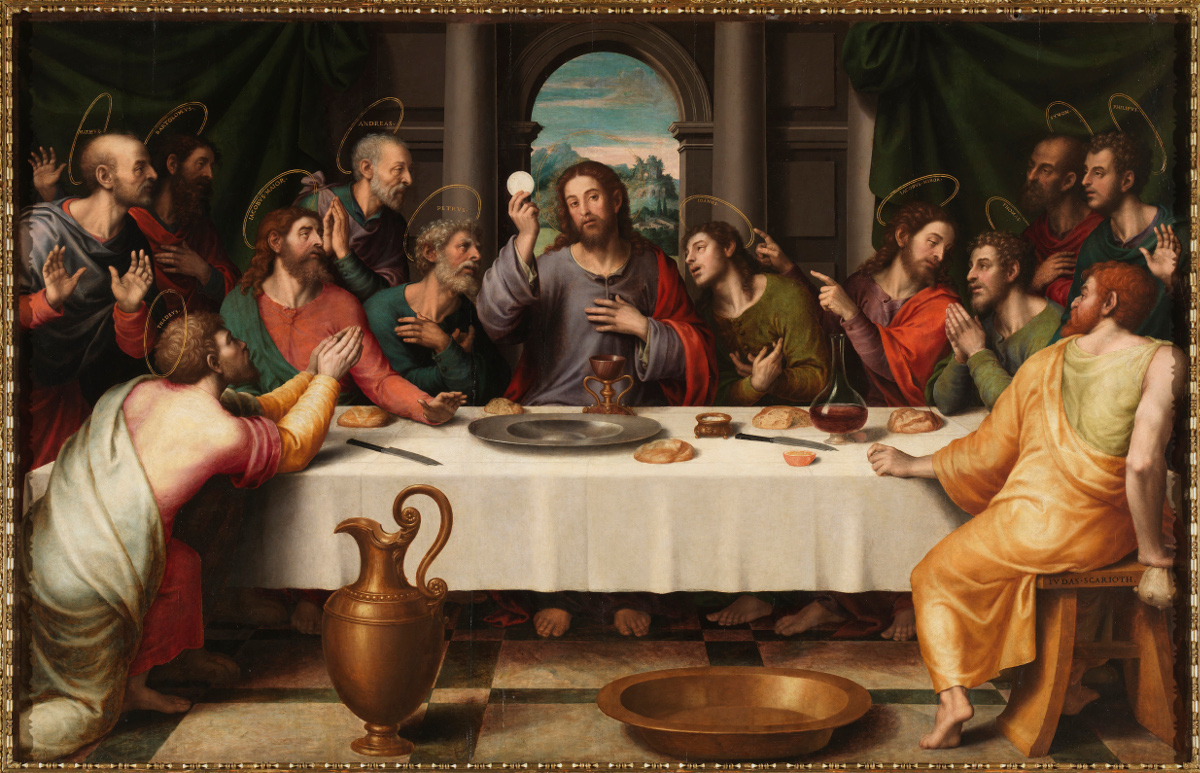 |
| Follow their hands and their eyes. They are looking at Christ, yes. They are looking at the Eucharist. |
Join
yourself, then, more fully to Him and His Church, for those who do
not share in the weaknesses of the Body will separate themselves from
the Body. In rejecting weakness and wickedness as unlovable they move
away from the God “who so loved the world
that He gave His only Son” (Jn 3:16a).
Friday, August 31, 2012
On Reading Scripture: the Beginning
Note before reading:
I wrote this while on my silent retreat. I read the book of Isaiah (most of it--still working) this time. Last year I read Jeremiah during the silence. I don't know why but I find myself ever more drawn to the prophets. Likewise I find myself drawn to Wisdom Literature in the Old Testament. Much like my experience with philosophy where I would revel in the newer, more contemporary philosophers until I became a confused mess, I think the same can be true of the New Testament.
Just as I turned to ancient philosophy to get my bearings--to know from where I'd come--I looked to the prophets who await the fullness of Christ in the same way (but differently) we await the fullness of His presence. So I found myself drawn to them and their admonitions, reading into them the plight, arrogance, trials, and troubles of my own soul.
I wrote this as a way of inspiring you to read but this time also endeavoring to seek instruction from a number of sources, the prophets being primary candidates.
I'm aware that some of this may be nothing more than my 'preaching to the choir' as it were. But even for myself, and I consider myself devout, we can miss out on simple things very easily.
Please leave a comment, I always love reading them!
______________________________
Often when I read discussions, arguments, or biblical-based critiques/attacks of my theology I find that there is both a sad simplification and, at times, an ignorance of Scripture. Many of us, especially Christians, would like to disagree that we are members of this category but the reality is that all the zeal and good (or bad) intention in the world doesn't translate to wisdom (let alone an understanding of Scripture). In order to remedy this situation I would like to offer some ideas on reading Scripture more effectively and some pitfalls to avoid in the process.
Reading Scripture can seem like a daunting task—many aren't sure where to begin or try to muscle their way through right from the beginning. This isn't a bad approach but we can get weighed down in a sea of details. Keep reading and I'll try and put it in a different light.
Many people make comments about a number of subjects while using Scripture such as gay marriage, abortion, sex outside of marriage—and the list goes on. Consequently there are those people who are obviously in the wrong. These are people who curse, hate, ridicule, and belittle. Scripture has already judged these people so we need not concern ourselves with them or that subject. What we do need to focus on are those on either side who establish their argument by claiming that "Jesus says that we should love one another!" or "Judge not lest you be judged!" Far be it from me to call the statement wrong but we are all aware that we can say one thing and mean a number of things.
For example:
1) "I love her" (her = her personality, her body, her presence, her person).
2) "I am saved" (...right now, ...later, ...when I have faith)
"Judgment" and "love" are no different. Everyone uses the words but few consider the meaning. Fewer consider the source where we are drawing that meaning from. I will expand on this in another piece but Scripture conveys many meanings. We can convey just as many about Scripture—only we can be very, very wrong in the process.
Jesus says "Love God with all your heart, soul, and mind. This is the greatest and first commandment. The second is like it: You shall love your neighbor as yourself. The whole law and the prophets depend on these two commandments" (Mt 22:37-40).
In a society and mindset where we want the quick and easy method it seems that we should be content with this passage. Indeed, it seems many people are content with just hearing this passage. They nod their heads and continue on as if nothing has changed and nothing is different.
But listen now and pay close attention: is a building called a building by its foundations alone? Are not all the parts of a house considered together? Indeed, even Paul warns us that "each must be careful how he builds upon it [the foundation]" (1 Cor 3:10). More still that foundation will be revealed for what it is. What we build may be weak and crumble under the weight of practical incompetence, ignorance, pride, laziness, and more. "If the work stands that someone built upon the foundation [Christ] he will receive a wage. But if someone's work is burned up, that one will suffer loss; the person will be saved, but only as through fire." (1 Cor 3:14-15). Sure, you could build poorly—but when you "build" poorly you may also mistake the foundation for Christ when it's not really Him at all. If you can (or should) build, build wisely.
What is this building process, then? For our purposes let's call it our role as evangelizers. When we argue weakly from Scripture we still argue weakly. This is not a case of us "being fools for Christ." We will be called fools for speaking the Truth, but we will also be called fools for speaking wrongly—discerning which is which is the key.
Christ gives us a starting point: Love God and love your neighbor are the foundation of the law and the prophets. But how can we put Christ's hint to good use if we fail to read Scripture, especially the Old Testament—the law and the prophets?
You should make an effort today to read, but when you read Scripture don't be intimidated. I've found that the following holds true in my reading: if Scripture is the wisdom of God speaking to us then we must endeavor to gain wisdom. Indeed, many will hear but not listen and many will see but will not understand (cf., Is 6:9, Mt 13:14-15). Wisdom is the light by which we see truth. But sometimes we need help to see the truth—we need to be taught wisdom.
"Plans fail when there is no counsel, but they succeed when counselors are many" (Proverbs 15:22). Likewise "Listen to counsel and receive instruction that you may eventually become wise" (19:20). Who are our counselors and instructors? First, the prophets. Men who were inspired by the Spirit and who longed for Christ as much as we should long for Him. The letter of James states that "the fervent prayer of the righteous person is very powerful" (James 5:16) and so too is the counsel of those who are prayerful and loving. We have already been taught about love from St. Paul: it is patient, without malice, and kind. Seek these people out and seek their advice when darkness covers your own heart. For "like golden apples in silver settings are words spoken at the proper time" (Prv 25:11). "A word in season, how good it is!" (15:23).
When I am stuck on Scripture it is sometimes a matter of academic ignorance. But in the same way I need instruction from those who are wise. The wise rabbis and scribes compiled these books for us called "Wisdom Literature." They consist of Job, the Psalms, Proverbs, Ecclesiastes, the Song of Songs, Wisdom, and Sirach. If you were to begin anywhere in Scripture (and are unsure where to begin) I would look to Proverbs, Wisdom, and Sirach. These three books contain easy-to-digest phrases and speech but also offer a mature reflection on the whole of Scripture (i.e., the law, the prophets, and the wisdom of many generations).
Though a bit simple, I consider Proverbs part of the oral-wisdom of the Jews. Sayings passed down and collected over the ages. The book of wisdom is like this as well but offers some more mature reflections and invokes king Solomon. The book of Sirach (originally written in Hebrew but only surviving to us in Greek) was written by an Jerusalem Jew, translated by his grandson, an Alexandrian Jew. It is a collection of wisdom and instruction written about 200-175BC. It is the mature musings of a man who grew up loving the law and lived it his whole life. These three books have offered me a great deal of insight and reflection on the entirety of Scripture. Seek out their wisdom and reflect on their words.
The other Wisdom books are excellent sources but much more difficult. St. Bernard of Clairvaux wrote extensively on the Song of Songs, even though the book itself is about 7 pages (he wrote somewhere around 30 long-essays on it and he never finished) and Job itself is a book that should be revisited often. But if you want my advice, start with the easier books.
Wisdom is for all ages. Some are ready for solid food but many more of us must be fed with milk first.
And so I return to my earlier point. Christ tells us that the law and the prophets depend on love. The Apostles and Paul affirmed and upheld this. But when we neglect the prophets we will mourn like those who neglected the prophets in ages past. The prophets warned about false gods, idols, and foreign nations. Do we not also sacrifice to false gods when we love money, power, and things over God and others? Do we not raise idols for ourselves when disdain the chastisements of the wise and instead boast of our own virtue? And are not the foreign nations nothing more than the allure, power, and (in the end) the destructive tendency of sin? When we stop seeing the prophets and the law as merely 'that which has passed' and more as a relevant warning for our souls right now we are all the better. Christ said to stay awake. Peter said 'stay sober and alert.' The devil is indeed like a prowling lion, looking for someone to devour.
"When one turns away his ear from hearing the law, even his prayer is an abomination" (Prv 28:9).
If you want to speak in Jesus' name but do not heed His words as best you can what are you building? Are you building the Kingdom of God or is your work destined for the fire? 'If they will not heed the prophets neither will they heed one who has risen from the dead.' I will address the wisdom of the prophets, primarily Isaiah, Jeremiah, and Ezekiel at a later date. What I will do is set Jerusalem our very souls and not just the city of past ages. I think some very interesting insights arise from making the temple—which is the height and center of Jerusalem—and the city our very own being. For is not our body a "temple of the Holy Spirit"?
And so, when we speak about Scripture and about Christian living are we speaking from the perspective of one who sought counsel or from the perspective of one who simply claims he 'loves God and neighbor'? It is very easy to say we love both, but it is far more difficult to seek others who tell us that we're doing it wrong. These counselors can be Scripture, those who have died, or those still living. This is true because "he who rejects admonition despises his own soul, but he who heeds reproof gains understanding" (Prv 15:32). "Reprove a wise man and he will love you" (9:8b).
Do not blind or deaf to instruction nor be weighed down. My words may seem harsh but only because "evil is cleansed away by bloody lashes, and a scourging to the inmost being" (Prv 20:30). My goal is not to beat you into submission but to warn you sternly about the great task before you. If you are to make God known to the world it would benefit you to make His Word known to yourself—not as one who claims he knows that word. Do not be this person too readily. Rather, seek wisdom. Seek it in Scripture and in the world where God resides. For the Spirit inspires both word and man. God gives us both.
"All wisdom is fear of the Lord; perfect wisdom is fulfillment of the law. The knowledge of wickedness is not wisdom, nor is there prudence in the council of sinners" (Sirach 19:17-18). Do not be quick to declare another a sinner nor be too quick to ignore a man's words. Every man is known by his fruit. "Do people pick grapes from thorn-bushes, or figs from thistles? Just so … a good tree cannot bear bad fruit nor a rotten tree bear good fruit" (Mt 7:16-18). And so if there seems to be merit in the man there may be merit in his words. It is good and wise to trust Scripture and it is good and wise to trust those who live according to Scripture—but how we determine this is also for another time.
If you have questions or want some suggestions please feel free to ask. There is much to say (on my part) and hardly time to record it all. Remember to pray to the Holy Spirit for guidance and if you find yourself drawn to a certain book in Scripture (for this or that reason) read that book! God is inspiring your heart to read something and it benefits you to trust that instinct.
I hope this is a good start! We'll continue with the prophets next time.
I wrote this while on my silent retreat. I read the book of Isaiah (most of it--still working) this time. Last year I read Jeremiah during the silence. I don't know why but I find myself ever more drawn to the prophets. Likewise I find myself drawn to Wisdom Literature in the Old Testament. Much like my experience with philosophy where I would revel in the newer, more contemporary philosophers until I became a confused mess, I think the same can be true of the New Testament.
Just as I turned to ancient philosophy to get my bearings--to know from where I'd come--I looked to the prophets who await the fullness of Christ in the same way (but differently) we await the fullness of His presence. So I found myself drawn to them and their admonitions, reading into them the plight, arrogance, trials, and troubles of my own soul.
I wrote this as a way of inspiring you to read but this time also endeavoring to seek instruction from a number of sources, the prophets being primary candidates.
I'm aware that some of this may be nothing more than my 'preaching to the choir' as it were. But even for myself, and I consider myself devout, we can miss out on simple things very easily.
Please leave a comment, I always love reading them!
______________________________
Often when I read discussions, arguments, or biblical-based critiques/attacks of my theology I find that there is both a sad simplification and, at times, an ignorance of Scripture. Many of us, especially Christians, would like to disagree that we are members of this category but the reality is that all the zeal and good (or bad) intention in the world doesn't translate to wisdom (let alone an understanding of Scripture). In order to remedy this situation I would like to offer some ideas on reading Scripture more effectively and some pitfalls to avoid in the process.
Reading Scripture can seem like a daunting task—many aren't sure where to begin or try to muscle their way through right from the beginning. This isn't a bad approach but we can get weighed down in a sea of details. Keep reading and I'll try and put it in a different light.
Many people make comments about a number of subjects while using Scripture such as gay marriage, abortion, sex outside of marriage—and the list goes on. Consequently there are those people who are obviously in the wrong. These are people who curse, hate, ridicule, and belittle. Scripture has already judged these people so we need not concern ourselves with them or that subject. What we do need to focus on are those on either side who establish their argument by claiming that "Jesus says that we should love one another!" or "Judge not lest you be judged!" Far be it from me to call the statement wrong but we are all aware that we can say one thing and mean a number of things.
For example:
1) "I love her" (her = her personality, her body, her presence, her person).
2) "I am saved" (...right now, ...later, ...when I have faith)
"Judgment" and "love" are no different. Everyone uses the words but few consider the meaning. Fewer consider the source where we are drawing that meaning from. I will expand on this in another piece but Scripture conveys many meanings. We can convey just as many about Scripture—only we can be very, very wrong in the process.
Jesus says "Love God with all your heart, soul, and mind. This is the greatest and first commandment. The second is like it: You shall love your neighbor as yourself. The whole law and the prophets depend on these two commandments" (Mt 22:37-40).
In a society and mindset where we want the quick and easy method it seems that we should be content with this passage. Indeed, it seems many people are content with just hearing this passage. They nod their heads and continue on as if nothing has changed and nothing is different.
But listen now and pay close attention: is a building called a building by its foundations alone? Are not all the parts of a house considered together? Indeed, even Paul warns us that "each must be careful how he builds upon it [the foundation]" (1 Cor 3:10). More still that foundation will be revealed for what it is. What we build may be weak and crumble under the weight of practical incompetence, ignorance, pride, laziness, and more. "If the work stands that someone built upon the foundation [Christ] he will receive a wage. But if someone's work is burned up, that one will suffer loss; the person will be saved, but only as through fire." (1 Cor 3:14-15). Sure, you could build poorly—but when you "build" poorly you may also mistake the foundation for Christ when it's not really Him at all. If you can (or should) build, build wisely.
What is this building process, then? For our purposes let's call it our role as evangelizers. When we argue weakly from Scripture we still argue weakly. This is not a case of us "being fools for Christ." We will be called fools for speaking the Truth, but we will also be called fools for speaking wrongly—discerning which is which is the key.
Christ gives us a starting point: Love God and love your neighbor are the foundation of the law and the prophets. But how can we put Christ's hint to good use if we fail to read Scripture, especially the Old Testament—the law and the prophets?
You should make an effort today to read, but when you read Scripture don't be intimidated. I've found that the following holds true in my reading: if Scripture is the wisdom of God speaking to us then we must endeavor to gain wisdom. Indeed, many will hear but not listen and many will see but will not understand (cf., Is 6:9, Mt 13:14-15). Wisdom is the light by which we see truth. But sometimes we need help to see the truth—we need to be taught wisdom.
"Plans fail when there is no counsel, but they succeed when counselors are many" (Proverbs 15:22). Likewise "Listen to counsel and receive instruction that you may eventually become wise" (19:20). Who are our counselors and instructors? First, the prophets. Men who were inspired by the Spirit and who longed for Christ as much as we should long for Him. The letter of James states that "the fervent prayer of the righteous person is very powerful" (James 5:16) and so too is the counsel of those who are prayerful and loving. We have already been taught about love from St. Paul: it is patient, without malice, and kind. Seek these people out and seek their advice when darkness covers your own heart. For "like golden apples in silver settings are words spoken at the proper time" (Prv 25:11). "A word in season, how good it is!" (15:23).
When I am stuck on Scripture it is sometimes a matter of academic ignorance. But in the same way I need instruction from those who are wise. The wise rabbis and scribes compiled these books for us called "Wisdom Literature." They consist of Job, the Psalms, Proverbs, Ecclesiastes, the Song of Songs, Wisdom, and Sirach. If you were to begin anywhere in Scripture (and are unsure where to begin) I would look to Proverbs, Wisdom, and Sirach. These three books contain easy-to-digest phrases and speech but also offer a mature reflection on the whole of Scripture (i.e., the law, the prophets, and the wisdom of many generations).
Though a bit simple, I consider Proverbs part of the oral-wisdom of the Jews. Sayings passed down and collected over the ages. The book of wisdom is like this as well but offers some more mature reflections and invokes king Solomon. The book of Sirach (originally written in Hebrew but only surviving to us in Greek) was written by an Jerusalem Jew, translated by his grandson, an Alexandrian Jew. It is a collection of wisdom and instruction written about 200-175BC. It is the mature musings of a man who grew up loving the law and lived it his whole life. These three books have offered me a great deal of insight and reflection on the entirety of Scripture. Seek out their wisdom and reflect on their words.
The other Wisdom books are excellent sources but much more difficult. St. Bernard of Clairvaux wrote extensively on the Song of Songs, even though the book itself is about 7 pages (he wrote somewhere around 30 long-essays on it and he never finished) and Job itself is a book that should be revisited often. But if you want my advice, start with the easier books.
Wisdom is for all ages. Some are ready for solid food but many more of us must be fed with milk first.
And so I return to my earlier point. Christ tells us that the law and the prophets depend on love. The Apostles and Paul affirmed and upheld this. But when we neglect the prophets we will mourn like those who neglected the prophets in ages past. The prophets warned about false gods, idols, and foreign nations. Do we not also sacrifice to false gods when we love money, power, and things over God and others? Do we not raise idols for ourselves when disdain the chastisements of the wise and instead boast of our own virtue? And are not the foreign nations nothing more than the allure, power, and (in the end) the destructive tendency of sin? When we stop seeing the prophets and the law as merely 'that which has passed' and more as a relevant warning for our souls right now we are all the better. Christ said to stay awake. Peter said 'stay sober and alert.' The devil is indeed like a prowling lion, looking for someone to devour.
"When one turns away his ear from hearing the law, even his prayer is an abomination" (Prv 28:9).
If you want to speak in Jesus' name but do not heed His words as best you can what are you building? Are you building the Kingdom of God or is your work destined for the fire? 'If they will not heed the prophets neither will they heed one who has risen from the dead.' I will address the wisdom of the prophets, primarily Isaiah, Jeremiah, and Ezekiel at a later date. What I will do is set Jerusalem our very souls and not just the city of past ages. I think some very interesting insights arise from making the temple—which is the height and center of Jerusalem—and the city our very own being. For is not our body a "temple of the Holy Spirit"?
And so, when we speak about Scripture and about Christian living are we speaking from the perspective of one who sought counsel or from the perspective of one who simply claims he 'loves God and neighbor'? It is very easy to say we love both, but it is far more difficult to seek others who tell us that we're doing it wrong. These counselors can be Scripture, those who have died, or those still living. This is true because "he who rejects admonition despises his own soul, but he who heeds reproof gains understanding" (Prv 15:32). "Reprove a wise man and he will love you" (9:8b).
Do not blind or deaf to instruction nor be weighed down. My words may seem harsh but only because "evil is cleansed away by bloody lashes, and a scourging to the inmost being" (Prv 20:30). My goal is not to beat you into submission but to warn you sternly about the great task before you. If you are to make God known to the world it would benefit you to make His Word known to yourself—not as one who claims he knows that word. Do not be this person too readily. Rather, seek wisdom. Seek it in Scripture and in the world where God resides. For the Spirit inspires both word and man. God gives us both.
"All wisdom is fear of the Lord; perfect wisdom is fulfillment of the law. The knowledge of wickedness is not wisdom, nor is there prudence in the council of sinners" (Sirach 19:17-18). Do not be quick to declare another a sinner nor be too quick to ignore a man's words. Every man is known by his fruit. "Do people pick grapes from thorn-bushes, or figs from thistles? Just so … a good tree cannot bear bad fruit nor a rotten tree bear good fruit" (Mt 7:16-18). And so if there seems to be merit in the man there may be merit in his words. It is good and wise to trust Scripture and it is good and wise to trust those who live according to Scripture—but how we determine this is also for another time.
If you have questions or want some suggestions please feel free to ask. There is much to say (on my part) and hardly time to record it all. Remember to pray to the Holy Spirit for guidance and if you find yourself drawn to a certain book in Scripture (for this or that reason) read that book! God is inspiring your heart to read something and it benefits you to trust that instinct.
I hope this is a good start! We'll continue with the prophets next time.
Wednesday, June 20, 2012
Wisdom is a Gift
I've gotten into some pretty rough
conversations over the past week. What often happens is that I'll receive comments from
people who like my articles. They'll say things like "this is nice" or 'well put' and so on. I agree and disagree with my personal friends on a number
of things and we still have many-houred conversations which remain amiable—so don't be afraid
to talk with me or disagree with me. It's actually much more pleasant to speak with
others on topics where we act as friends as opposed to rivals.
Now, I won't complain about these
others who disagree with me. That's the acquired taste of the
philosopher, namely being told you're wrong. In another sense, that's
the acquired joy of a Catholic and all Christians. Scripture seems to
indicate this as well:
"The man of intelligence fixes his
gaze on wisdom, but the eyes of a fool are on the ends of the earth"
(Prv 17:24).
Now to the average ignorant Christian
or the average ignorant non-Christian this may seem like a 'pay
attention to God and those who don't are just fools.'
 |
| Only a foolish fool foolishly fools himself into thinking he understands Scripture by reading it once. (And seeing as I love the Phoenix Wright universe be prepared to see more of these from time to time) |
Well, in one
sense, maybe it is so. Don't be a fool, then, and follow with me here:
perhaps we need to see that wisdom is a gift. In Scriptures it is not
often the powerful or the strong who are wise, rather it is the poor
and the humble. So how could the simple-minded be wise and thus
'intelligent'?
Simply this: that the wise realize that
wisdom is a gift, which is to say that we're given wisdom. Aquinas
likened wisdom to a hill upon which a man can see all that happens
below. I might add that wisdom is thanking God for the gift of hills
that afford us such a sight--if you're still following me.
So what are the ends of the earth that
make us fools sometimes? I find that Chesterton put it well: “There
is nothing which is so weak for working purposes as this enormous
importance attached to immediate victory. There is nothing that fails
like success” (GK Chesterton, Heretics). It may
also be said that “lust indulged starves the soul, but fools hate
to turn from evil” (Prv 13:19) means that when we desire something
very temporary and hollow (such as a victory) we starve our souls and
do not feed it with what is a most beautiful nourishment—reason.
Yet we, like fools, when confronted or attacked feel that crushing
our opponent will result in some sort of nourishment, but it's hardly
the case.
 |
| Technically this meme is still popular but past its peak, so I'm still behind the times. |
Perhaps this is why Augustine said
“hate the sin but not the sinner.” In many ways we must conquer
ignorance, ignorance to sin, and sin for they are 'lackings' as it
were in an otherwise good person.
Now, does this mean that we should shrink from the truth when we've found it? Or even run from difficulty when confronted? No, the former becomes timidity and the latter cowardice. Conviction is not arrogance, but they are cousins. I recall reading in Étienne Gilson saying, though I can't find where exactly, that 'When we are confronted with the truth we are also confronted with a moral problem, that is whether or not I will accept and incorporate this truth.' Naturally, a great number of us don't agree on what 'truth is' and thus we hand the reins to the men who are philosophers--who are seemingly madmen.The problem sometimes is that many people think they're philosophers.
I have to laugh, though, when I'm
confronted by those who say things like “Ah yes.... I would like to
spar with you if I might.” Or “Let us see if Christianity is
true” when their intentions are at times an attempt to strip
credibility from anyone who could possible believe in Catholicism or
Christianity. (We can see this in the recent conversion of Leah
Libresco (http://www.patheos.com/blogs/unequallyyoked/,
see comments).
But I do not fault them for doing this
because this is how I am many times and certainly how I was when I
was younger. I can attest first-hand the great power that
perfectionism held over me and the years upon years it burrowed under
my skin. I didn't have any major breakdowns, but I was prone to
stress because I was also someone who wanted to do 25 different
things—but perfectly. When you lust after perfection in whatever it is you want you're often left the fool. Luckily, and by His grace, people came into
my life and were more patient with me than I ever could have been (we
find that our weaknesses can be grounds for us to be both broken
down, but rebuilt as compassionate to these same weaknesses we find
in others).
Similarly, I do not fault them because
often times these are well-meaning, well-educated individuals worth
talking with and taking seriously. It forces me to stretch my
intellectual muscles and consider propositions that aren't necessarily problems (or hang-ups) for me but are for others. Not only is this attitude necessary for
apologetics, it's necessary for Christians. Or did Christ not feel the
full weight, death, and terror of suffering, sin, and death because
he loved us? So too, we should take on the apprehensions, anxieties,
and difficulties of our fair interlocutors out of love for them.
 |
| Aquinas contemplating the greatest gift and receiving the greatest wisdom, that is the say the Logos. |
That's what I try to do. Sadly I can't
say I always succeed, but young men like myself are moved by passion
when attacked. Passion is in no way bad but it's a tool that must be
used properly.
We all perhaps need to reflect on the
matter that philosophy is properly called a love of wisdom because
wisdom is something worth loving and not always something we really
deserve, but get anyway.
Truly wisdom literature is a gift that
keeps giving. I let this last quote be my prayer and my conclusion:
Wisdom 8:17-21
- Thinking thus within myself, and reflecting in my heart That there is immortality in kinship with Wisdom, and good pleasure in her friendship, and unfailing riches in the works of her hands, And that in frequenting her society there is prudence, and fair renown in sharing her discourses, I went about seeking to take her for my own. Now, I was a well-favored child, and I came by a noble nature; or rather, being noble, I attained an unsullied body. And knowing that I could not otherwise possess her except God gave it-- and this, too, was prudence, to know whose is the gift-- I went to the LORD and besought him ...
Subscribe to:
Posts (Atom)