Showing posts with label Bible. Show all posts

Saturday, May 25, 2013

To Choose and to be a Friend

This is a reflection on the daily readings for 5/24/12 (Sat) which may be found here.

====


The wisdom of Sirach states, “For he who fears God behaves accordingly,” (Sir 6:17) which is to say that someone who fears the Lord will seek to live his life according to right conduct.

The Pharisees, the ones who sought to trick Jesus, were not acting in a manner respectful to the Law, but rather acting according to pride. These are the sort of people we should seek to correct, for any of us who engage in gossip or deceit in order to discredit our foes become a foe to right conduct. If they cannot or will not be corrected we should not share in their friendship, for a friend who speaks ill of others in a mean and spiteful way may become the enemy who does the same to us.

Sirach warns us to be on our guard and that when it comes to friends we should be selective and careful, probing the character of each.

The Psalm today is a hymn to this very process. Those who hold this Psalm in their hearts have the heart that each of us desire in a friend—delighting in God's precepts, desiring to understand His ways, and the humility to be lead in what is right.

Jesus warns, however, that a love of law—the Pharisees loved the law—must always be coupled by a life of love. Only then can both operate in harmony.

Love without the Law allows all others into our hearts as friends. Like bad dispositions, bad friends lead us to vice and sin. The Law without love makes us harsh, deceitful, and protective of a thing over a person. Both are good in themselves, but either can be corrupted into sin. It is only together, loving the Lord and His precepts, and loving each other, that either one takes root and transforms us.

Wednesday, April 10, 2013

The Freedom or Prison of Choice

Another reflection that I delivered today (4/10/2013). This version has some content added and modified.

Please share your thoughts, reactions, or give a critique if you so desire. (You do not need to register in order to post)

The readings may be found here. The readings are: Acts 5:17-26, Ps 34, John 3:16-21


The Sadduces, filled with jealousy, threw the Apostles in prison. We ought to ask ourselves who was really imprisoned.

At times we think it is pitiful to be poor, but the Lord hears the cry of the poor (cf. Psalm 34). The rich live in prisons of money, the prideful live in prisons of ambition, and the relativist lives in the prison of no boundaries.

The powerful grow poor and hungry, but those who seek the Lord lack no good thing” (Ps. 34:11)

Blessed is the man who takes refuge in the Lord,” for that man is given true freedom. Upon reflection we discover that boundaries, rules, restrictions, and commandments were given to us not to restrict our freedom but to ensure it. At times these restrictions pain us, because restrictions cause tensions with our desires.

The one who believes that freedom is fulfilling every desire runs headlong towards a cliff and over, where there is no more freedom. The one who discerns the nature of his desires in light of God's help and His servant's teachings is able to say “yes” to this and “no” to that, preserving his life and developing it too.

Jesus is the “light of the world” (Jn 8:12) and He lights these commandments He's given us. While they do not burn as bright as He does, they are given as guides that keep us close to Him.

John tells us simply and plainly: “light came into the world, but people preferred darkness to light, because their works were evil” (Jn 3:20).

There are those who do not want to be told what to do, and thus they flee the Light and the smaller lights he has placed around us. We can ignore large commandments, but truly we can even ignore instruction in our own life of faith and even those concepts of Him we hold so dear. Shall the lights He's placed around us be where we gather or from where we flee?

The light, in the end, will expose our works, our thoughts, and our heart. Even if we are in error, this is not a cause for fear. Come to the light and you will know Him. Come to Him and you will freely choose Him.

Saturday, December 8, 2012

Mary Most Holy

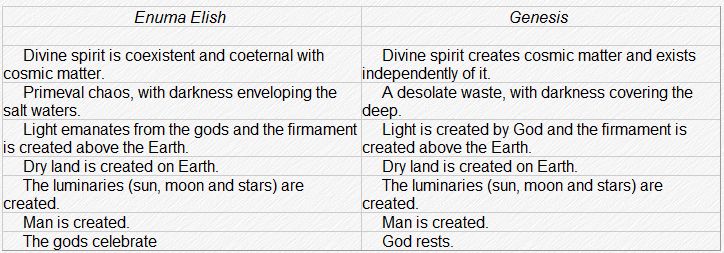
When I have debated with others about the Genesis narratives of creation one comment that emerges is the similarities of those narratives to other creation narratives, most notably the Enuma Elish in Babylonian mythology. This similarity for some is proof enough that the Biblical account is merely one among many accounts or that it simply stole from their captors but made minor changes (The Enuma Elish predates the written Biblical account).

Many Christian scholars now believe that the similarity in construction is intentional and that the Genesis account is structured close to the Babylonian myth in order to act as a theological polemic. When one puts both accounts side by side it seems as if the syntax is nearly identical—for the undiscerning mind. The slight changes of both tone and process reveals a delicate construction on the part of both authors, Babylonian or Hebrew. Contained in simple mythological language are commentaries about creation, the nature of man, the nature of God (or gods), and much more. In reading both I have always found that the Hebrew account was in all ways more fascinating, powerful, and rich. This is not simply my allegiance to Christ but also simply taking both narratives by the power of their own arguments. The Biblical account has the advantage of being the “response” so to speak, but some of the best and most compelling arguments are the ones that sound almost exactly like your opponent but turn the whole issue on its head. The Genesis accounts, both of them (but more the first), share this excellent quality.

This is a perfect example of someone who has taken the time to align the syntax of both stories in such a way so as to situate them as merely a historical occurrence. Indeed, at face value they are nearly identical when seen in this way. What the author of this rather long and not un-scholarly article fails to consider is "why" and "how" the stories are presented.
If the author does not believe in God (or discounts a perspective of belief) those questions are irrelevant anyhow. See the comments at the bottom of this article to see how others treat it. For them it's not a matter of it could be true, or that the construction is intentional, but that it's human, all too human. (Article)

I give you this example as a way of introducing a thought of mine on the great and beautiful account of Mary. It is not the fruit of years of research or devotion—I have not had the grace others who experience an intimate relationship with Mary in their prayer—but I must admit that as I grow older I am drawn more quickly to reflect on her maternal love and anguish, both of them intensified beyond my comprehension by virtue of her son, Jesus Christ. What I want to propose is that the Evangelists, men who knew Scripture and indeed had the Spirit working within them, chose a similar approach of expressing Mary. I do not deny the historicity of the Annunciation but I found it worth my time reflecting on the parallels between Mary's mission, as it were, and the mission and commission of others in Scripture. The similarities tie her into a greater narrative and the differences set her apart. This was a conscious choice by the Evangelists but also, in my mind, their indication of a most unique specialness of Mary in the whole of history.
Her uniqueness often lies in what makes her most unnoticeable.
I will focus on Luke who has a special interest in Mary. Luke also is kind enough to give us the whole paradigm by relating the announcement of the birth of John the Baptist to his father Zechariah. This narrative alone has strong parallels in Abraham's call and promise of a son. When the angel of the Lord told them that their wives would bear them a son Abraham laughed and Zechariah said “How shall I know this? I am an old man and my wife is advanced in years” (Luke 1:18). This is the response of mankind, from ancient times immemorial to the present day. God promises the fantastic and impossible and we shake our heads both stupefied and incredulous.

At first glance, it would seem Mary's response is no different: “How can this be, since I have no relations with a man?” (Lk 1:34). This is a problem for English that masks this profound difference of Mary. In the Greek (I won't bore you with all the details) Zechariah asks “how shall I know this” as if to say 'unless I know how can I believe?' This is why the angel silences him, literally, saying “Now you will be speechless … because you did not believe my words” (Lk 1:20). Mary, on the other hand, responds with the verb “estai” in Greek which perhaps colloquially means “how can this be” but has the force of “it shall be, how shall it come about?” Zechariah asked how will he know (gnosomai) whereas Mary asks with that powerful verb 'to be' “how will it come to pass?” Already, in this small juxtaposition we see in Mary that there is no tension between her and the message of God. This is why she can say afterward “Behold, I am the handmaid of the Lord. May it be done to me according to your word” (Lk 1:38).

We take for granted the circumstances of this passage. After all, an angel of the Lord presents himself to Mary and she trembles as every other man and woman had in all of Scripture. Yet when she is addressed there is no hesitation.

More curious and fascinating still is that in nearly every narrative that deals in a special call is preceded by an admission of the speaker of his weakness. Jeremiah declared he was too young (Jer 1:6), Abraham that he was too old (Gen 17:17), and Moses that he could not speak well (Ex 4:10). Mary, on the other hand, says nothing of her unworthiness in any fashion. Even Isaiah who readily exclaimed “Here I am! Send me” recalled that he was a man of “unclean lips from a people of unclean lips.” Mary, however, not only accepts the word of God but finds herself fully capable from the outset of doing it. The angel says nothing of her unbelief. Rather, Mary asked and the answer was given to her because of her faith. She knew it was not to be done according to her knowledge but His word.
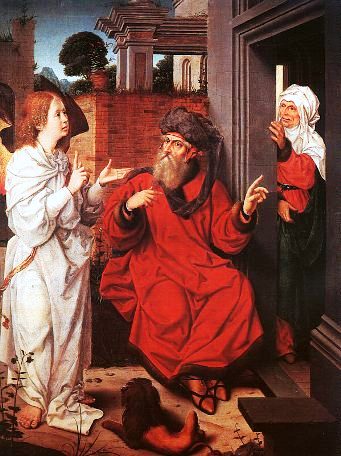
A Flemish painting of the announcement of a son for Abraham. He seems to be saying, "What? With her?" He laughed when God suggested it and thus his son was named "Issac" which roughly means "he laughs."

There are a wealth of examples I could bring up about the stark contrast of Mary to the rest of the holy men and women cataloged in Scripture, such as her name remaining the same despite the gravity of her task (contrary to Peter, Paul, Abraham, Israel, etc. whose names were changed). The question we must ask ourselves when contemplating Mary, her role, her importance, and her significance is “what does it mean?”

Was it arbitrary? For the believer to say such a thing about Scripture is foolishness. Much like Genesis, when we see that the argument is constructed like the others we are lulled into a false security and sense of familiarity. The account of Mary is not a polemic as such, but it is a theology-rich exposition (history). It is constructed like all the others in order to magnify the differences. As to the question “what does it mean,” which is a worthy question for each line of Scripture, she clearly meant a great deal to Luke. The early Church furnishes us with further reflection on Mary and what she meant to them. They were ready to call her the “New Eve” for if sin first entered the world through the disobedience of man and woman then it is only right that through the obedience and humility of a man (Jesus) and woman (Mary) that salvation was made available to all. Augustine expresses this sentiment in his book “On Christian Teaching,” albeit seemingly unfair to women, by saying “The disease [sin] entered through a corrupted female mind; healing emerged from and intact female body” (Book I.13.xxix).
There are too many great images that seem to me to relate Mary's purity in a way that only an image can convey.

For it is not our place to simply say our salvation is “through Christ alone” as if to say “nothing else matters.” Rather, it is better to wonder at “God chose that His only begotten son would be born of a woman and bear our entire human estate.” I do not diminish Christ's supreme and necessary role. What I am saying is that we must examine, marvel, pray, and give thanksgiving for how he chose to effect His grand designs. Where men are often moved by grandeur God chose to enter in all humility. Likewise, where many in Scripture wanted to control the situation they were in (and in the process doubt God) Mary became a perfect conduit of grace by virtue of her obedience and humility.

On this, the Holy Day of the Immaculate Conception I thought it would be worthy to devote some time to reflection on Mary most holy. There is far more to say than my meager words here. I only leave this with you to look at Mary as I see her (or perhaps as I'm beginning to see her). No other human being can claim to have known Christ in his full humanity or divinity than his mother who loved him with all the intensity of motherhood and suffered on account of his suffering more than anyone can comprehend. Woman is the crown of creation and Mary the queen of humanity. May her resplendent example lead us to Jesus Christ her son and to God almighty.

Friday, August 31, 2012

On Reading Scripture: the Beginning

Note before reading:

I wrote this while on my silent retreat. I read the book of Isaiah (most of it--still working) this time. Last year I read Jeremiah during the silence. I don't know why but I find myself ever more drawn to the prophets. Likewise I find myself drawn to Wisdom Literature in the Old Testament. Much like my experience with philosophy where I would revel in the newer, more contemporary philosophers until I became a confused mess, I think the same can be true of the New Testament.

Just as I turned to ancient philosophy to get my bearings--to know from where I'd come--I looked to the prophets who await the fullness of Christ in the same way (but differently) we await the fullness of His presence. So I found myself drawn to them and their admonitions, reading into them the plight, arrogance, trials, and troubles of my own soul.

I wrote this as a way of inspiring you to read but this time also endeavoring to seek instruction from a number of sources, the prophets being primary candidates.

I'm aware that some of this may be nothing more than my 'preaching to the choir' as it were. But even for myself, and I consider myself devout, we can miss out on simple things very easily.

Please leave a comment, I always love reading them!


______________________________


Often when I read discussions, arguments, or biblical-based critiques/attacks of my theology I find that there is both a sad simplification and, at times, an ignorance of Scripture. Many of us, especially Christians, would like to disagree that we are members of this category but the reality is that all the zeal and good (or bad) intention in the world doesn't translate to wisdom (let alone an understanding of Scripture). In order to remedy this situation I would like to offer some ideas on reading Scripture more effectively and some pitfalls to avoid in the process.

Reading Scripture can seem like a daunting task—many aren't sure where to begin or try to muscle their way through right from the beginning. This isn't a bad approach but we can get weighed down in a sea of details. Keep reading and I'll try and put it in a different light.

Many people make comments about a number of subjects while using Scripture such as gay marriage, abortion, sex outside of marriage—and the list goes on. Consequently there are those people who are obviously in the wrong. These are people who curse, hate, ridicule, and belittle. Scripture has already judged these people so we need not concern ourselves with them or that subject. What we do need to focus on are those on either side who establish their argument by claiming that "Jesus says that we should love one another!" or "Judge not lest you be judged!" Far be it from me to call the statement wrong but we are all aware that we can say one thing and mean a number of things.

For example:

1) "I love her" (her = her personality, her body, her presence, her person).

2) "I am saved" (...right now, ...later, ...when I have faith)


"Judgment" and "love" are no different. Everyone uses the words but few consider the meaning. Fewer consider the source where we are drawing that meaning from. I will expand on this in another piece but Scripture conveys many meanings. We can convey just as many about Scripture—only we can be very, very wrong in the process.

Jesus says "Love God with all your heart, soul, and mind. This is the greatest and first commandment. The second is like it: You shall love your neighbor as yourself. The whole law and the prophets depend on these two commandments" (Mt 22:37-40).

In a society and mindset where we want the quick and easy method it seems that we should be content with this passage. Indeed, it seems many people are content with just hearing this passage. They nod their heads and continue on as if nothing has changed and nothing is different.

But listen now and pay close attention: is a building called a building by its foundations alone? Are not all the parts of a house considered together? Indeed, even Paul warns us that "each must be careful how he builds upon it [the foundation]" (1 Cor 3:10). More still that foundation will be revealed for what it is. What we build may be weak and crumble under the weight of practical incompetence, ignorance, pride, laziness, and more. "If the work stands that someone built upon the foundation [Christ] he will receive a wage. But if someone's work is burned up, that one will suffer loss; the person will be saved, but only as through fire." (1 Cor 3:14-15). Sure, you could build poorly—but when you "build" poorly you may also mistake the foundation for Christ when it's not really Him at all. If you can (or should) build, build wisely.

What is this building process, then? For our purposes let's call it our role as evangelizers. When we argue weakly from Scripture we still argue weakly. This is not a case of us "being fools for Christ." We will be called fools for speaking the Truth, but we will also be called fools for speaking wrongly—discerning which is which is the key.

Christ gives us a starting point: Love God and love your neighbor are the foundation of the law and the prophets. But how can we put Christ's hint to good use if we fail to read Scripture, especially the Old Testament—the law and the prophets?

You should make an effort today to read, but when you read Scripture don't be intimidated. I've found that the following holds true in my reading: if Scripture is the wisdom of God speaking to us then we must endeavor to gain wisdom. Indeed, many will hear but not listen and many will see but will not understand (cf., Is 6:9, Mt 13:14-15). Wisdom is the light by which we see truth. But sometimes we need help to see the truth—we need to be taught wisdom.

"Plans fail when there is no counsel, but they succeed when counselors are many" (Proverbs 15:22). Likewise "Listen to counsel and receive instruction that you may eventually become wise" (19:20). Who are our counselors and instructors? First, the prophets. Men who were inspired by the Spirit and who longed for Christ as much as we should long for Him. The letter of James states that "the fervent prayer of the righteous person is very powerful" (James 5:16) and so too is the counsel of those who are prayerful and loving. We have already been taught about love from St. Paul: it is patient, without malice, and kind. Seek these people out and seek their advice when darkness covers your own heart. For "like golden apples in silver settings are words spoken at the proper time" (Prv 25:11). "A word in season, how good it is!" (15:23).

When I am stuck on Scripture it is sometimes a matter of academic ignorance. But in the same way I need instruction from those who are wise. The wise rabbis and scribes compiled these books for us called "Wisdom Literature."  They consist of Job, the Psalms, Proverbs, Ecclesiastes, the Song of Songs, Wisdom, and Sirach.  If you were to begin anywhere in Scripture (and are unsure where to begin) I would look to Proverbs, Wisdom, and Sirach. These three books contain easy-to-digest phrases and speech but also offer a mature reflection on the whole of Scripture (i.e., the law, the prophets, and the wisdom of many generations).

Though a bit simple, I consider Proverbs part of the oral-wisdom of the Jews. Sayings passed down and collected over the ages. The book of wisdom is like this as well but offers some more mature reflections and invokes king Solomon. The book of Sirach (originally written in Hebrew but only surviving to us in Greek) was written by an Jerusalem Jew, translated by his grandson, an Alexandrian Jew. It is a collection of wisdom and instruction written about 200-175BC. It is the mature musings of a man who grew up loving the law and lived it his whole life. These three books have offered me a great deal of insight and reflection on the entirety of Scripture. Seek out their wisdom and reflect on their words.

The other Wisdom books are excellent sources but much more difficult. St. Bernard of Clairvaux wrote extensively on the Song of Songs, even though the book itself is about 7 pages (he wrote somewhere around 30 long-essays on it and he never finished) and Job itself is a book that should be revisited often. But if you want my advice, start with the easier books.

Wisdom is for all ages. Some are ready for solid food but many more of us must be fed with milk first.


And so I return to my earlier point. Christ tells us that the law and the prophets depend on love. The Apostles and Paul affirmed and upheld this. But when we neglect the prophets we will mourn like those who neglected the prophets in ages past. The prophets warned about false gods, idols, and foreign nations. Do we not also sacrifice to false gods when we love money, power, and things over God and others? Do we not raise idols for ourselves when disdain the chastisements of the wise and instead boast of our own virtue? And are not the foreign nations nothing more than the allure, power, and (in the end) the destructive tendency of sin? When we stop seeing the prophets and the law as merely 'that which has passed' and more as a relevant warning for our souls right now we are all the better. Christ said to stay awake. Peter said 'stay sober and alert.' The devil is indeed like a prowling lion, looking for someone to devour.

"When one turns away his ear from hearing the law, even his prayer is an abomination" (Prv 28:9).

If you want to speak in Jesus' name but do not heed His words as best you can what are you building? Are you building the Kingdom of God or is your work destined for the fire? 'If they will not heed the prophets neither will they heed one who has risen from the dead.' I will address the wisdom of the prophets, primarily Isaiah, Jeremiah, and Ezekiel at a later date. What I will do is set Jerusalem our very souls and not just the city of past ages. I think some very interesting insights arise from making the temple—which is the height and center of Jerusalem—and the city our very own being. For is not our body a "temple of the Holy Spirit"?

And so, when we speak about Scripture and about Christian living are we speaking from the perspective of one who sought counsel or from the perspective of one who simply claims he 'loves God and neighbor'? It is very easy to say we love both, but it is far more difficult to seek others who tell us that we're doing it wrong. These counselors can be Scripture, those who have died, or those still living. This is true because "he who rejects admonition despises his own soul, but he who heeds reproof gains understanding" (Prv 15:32).  "Reprove a wise man and he will love you" (9:8b).

Do not blind or deaf to instruction nor be weighed down. My words may seem harsh but only because "evil is cleansed away by bloody lashes, and a scourging to the inmost being" (Prv 20:30). My goal is not to beat you into submission but to warn you sternly about the great task before you. If you are to make God known to the world it would benefit you to make His Word known to yourself—not as one who claims he knows that word. Do not be this person too readily. Rather, seek wisdom. Seek it in Scripture and in the world where God resides. For the Spirit inspires both word and man. God gives us both.

"All wisdom is fear of the Lord; perfect wisdom is fulfillment of the law. The knowledge of wickedness is not wisdom, nor is there prudence in the council of sinners" (Sirach 19:17-18). Do not be quick to declare another a sinner nor be too quick to ignore a man's words. Every man is known by his fruit. "Do people pick grapes from thorn-bushes, or figs from thistles? Just so … a good tree cannot bear bad fruit nor a rotten tree bear good fruit" (Mt 7:16-18). And so if there seems to be merit in the man there may be merit in his words. It is good and wise to trust Scripture and it is good and wise to trust those who live according to Scripture—but how we determine this is also for another time.

If you have questions or want some suggestions please feel free to ask. There is much to say (on my part) and hardly time to record it all. Remember to pray to the Holy Spirit for guidance and if you find yourself drawn to a certain book in Scripture (for this or that reason) read that book! God is inspiring your heart to read something and it benefits you to trust that instinct.

I hope this is a good start! We'll continue with the prophets next time.