Showing posts with label truth. Show all posts

Sunday, October 21, 2012

The Mediation of the Saints: Part 1

(Parts 2 and 3 of this ongoing series are completed, with more on the way! 
Check it out: 

Part 2: God Works Through Us
Part 3: Walking Together)

A: Introduction

In this piece I hope to accomplish, step-by-step, an understanding of the saints. In a small part how we should strive to be saintly and in larger part how we should consider those who are called saints in the fullest sense, i.e., those with almighty God in heaven who pray for us and continue, in His friendship, to aid us in many ways. Though I will begin by mentioning mediation I will pick it up in a later part.

I. Who are They?

Christ indeed is “the one mediator between God and the human race” (1 Tim 2:5) but does this mean that God the Father will only listen to Christ? Does not the Lord “have eyes for the just and ears for their cry”? (Ps 34:16). Further still Christ tells us to “ask and it will be given to you” (Mt 7:7). The letter to James further qualifies this when he says “You do not possess because you do not ask. You ask but do not receive, because you ask wrongly, to spend it on your passions” (James 4:2b-3).

What should we ask for and how do we ask rightly? The letter of James further tells us that in order to do this we must be “doers of the word and not hearers only” (1:22). We learn through many venues but the most powerful teachers of faith and love are the saints.

The saints are, in short, exemplary doers of the word. They stand as a model for us in courage, patience, and wise-counsel among other virtues. We are drawn to a truly holy person because it seems like that ‘have it together.’ They exemplify—it’s almost an aura—a love of God and a love of neighbor. This power and aura are displayed by the Apostles themselves. Look at see the circumstances of these examples:

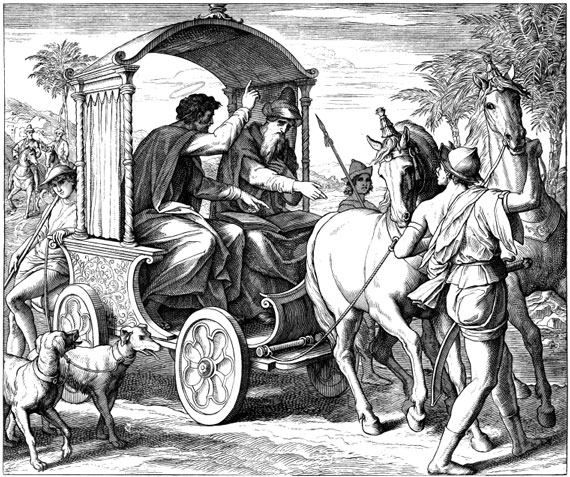
+Phillip runs up to the Ethiopian eunuch reading Isaiah and says ‘Do you understand what you read?’ The man replies, ‘How can I, unless someone instructs me?’ Phillip, filled with the Holy Spirit, instructed him. The eunuch, himself moved by that same Spirit, sought to be baptized immediately. Phillip became a light to a man searching for Christ. (cf. Acts 8:26-40)
Philip instructing the Ethiopian eunuch, pointing to Scripture and pointing to God. His bodily presence and actions making it possible for this man to see both.

+Paul and Barnabas preached at Lystra and healed a crippled man. Their presence and power of spirit and speech drew a large crowd to them. The Greeks there took them to be the gods Zeus and Hermes and began to worship them. But Paul was distraught, saying to them ‘We are flesh and blood just as you are. We have done these works so you might turn from idols and false gods and turn to the living God.’ (cf Acts 14:8-20)
Paul and Barnabas (right) pleading that the Greeks stop worshiping them after healing a crippled man. Men are drawn to great power mixed with great humility, but here too Paul reminds them that they are flesh just as they are.

The Apostles, men moved by the Spirit, proclaimed God to their fellow men. But some men, those confused or unable to see God themselves, found Him through His servants. The living saints do this just as the Apostles did. Some do it through humble service and others through great and powerful works. Saints pray and then go forth having an impact on those around them.

Moving, then, to the blessed Virgin Mary and the saints of past ages, they intercede to Christ for us, asking Him more perfectly than we ever could what we need (this does not deny the Spirit does this for us too). This is because they live with God and have achieved oneness with Him after life here on this earth. For Christ Himself prayed that just as He and the Father were one that “they may also be in us, that the world may believe that you sent me” (Jn 17:21).

When we ask a saint living here on earth or in heaven to pray for us it is not an affront to Christ or the Spirit, rather it is an act of humility. It is an act of humility because we ask the very proper question “Lord, teach us how to pray just as John taught his disciples” (Lk 11:1). John the Baptist, one of the chief saints and prophets, taught his disciples to pray and how to live. A saint, in John’s image, lived these words perfectly: “He must increase, I must decrease” (Jn 3:30).

Thus, asking the saints for intercession is not ignorance of the power or mediation of Christ. The presence of the saints influenced many to virtue and faith. This is why Paul longs to be with the Corinthians in person and to “fill the deficiencies of your faith” (1 Thes 3:10).

In life the Apostles tirelessly labored for the sake of the faithful and even died for it. Their lives and examples alone filled the deficiencies of the faithful. Their faith and the faith of any saint, however, was not a source of pride. Rather they always pointed to Christ.
Peter, saying he would be unworthy to die as Christ did, was crucified upside down. The Cross itself points to heaven.

In the next section, I will discuss in what manner they pointed to Christ and how a saint effects the work of salvation in the world. I shall begin by looking at the Old Testament and then the New to show that this process is nothing new in the long history of faith. Having introduced saintly intercession it is good to see how the holy prophets interceded to God for the people of Israel. Thereafter I will elaborate on the communion of saints in heaven who work tirelessly on our behalf.

Friday, August 31, 2012

On Reading Scripture: the Beginning

Note before reading:

I wrote this while on my silent retreat. I read the book of Isaiah (most of it--still working) this time. Last year I read Jeremiah during the silence. I don't know why but I find myself ever more drawn to the prophets. Likewise I find myself drawn to Wisdom Literature in the Old Testament. Much like my experience with philosophy where I would revel in the newer, more contemporary philosophers until I became a confused mess, I think the same can be true of the New Testament.

Just as I turned to ancient philosophy to get my bearings--to know from where I'd come--I looked to the prophets who await the fullness of Christ in the same way (but differently) we await the fullness of His presence. So I found myself drawn to them and their admonitions, reading into them the plight, arrogance, trials, and troubles of my own soul.

I wrote this as a way of inspiring you to read but this time also endeavoring to seek instruction from a number of sources, the prophets being primary candidates.

I'm aware that some of this may be nothing more than my 'preaching to the choir' as it were. But even for myself, and I consider myself devout, we can miss out on simple things very easily.

Please leave a comment, I always love reading them!


______________________________


Often when I read discussions, arguments, or biblical-based critiques/attacks of my theology I find that there is both a sad simplification and, at times, an ignorance of Scripture. Many of us, especially Christians, would like to disagree that we are members of this category but the reality is that all the zeal and good (or bad) intention in the world doesn't translate to wisdom (let alone an understanding of Scripture). In order to remedy this situation I would like to offer some ideas on reading Scripture more effectively and some pitfalls to avoid in the process.

Reading Scripture can seem like a daunting task—many aren't sure where to begin or try to muscle their way through right from the beginning. This isn't a bad approach but we can get weighed down in a sea of details. Keep reading and I'll try and put it in a different light.

Many people make comments about a number of subjects while using Scripture such as gay marriage, abortion, sex outside of marriage—and the list goes on. Consequently there are those people who are obviously in the wrong. These are people who curse, hate, ridicule, and belittle. Scripture has already judged these people so we need not concern ourselves with them or that subject. What we do need to focus on are those on either side who establish their argument by claiming that "Jesus says that we should love one another!" or "Judge not lest you be judged!" Far be it from me to call the statement wrong but we are all aware that we can say one thing and mean a number of things.

For example:

1) "I love her" (her = her personality, her body, her presence, her person).

2) "I am saved" (...right now, ...later, ...when I have faith)


"Judgment" and "love" are no different. Everyone uses the words but few consider the meaning. Fewer consider the source where we are drawing that meaning from. I will expand on this in another piece but Scripture conveys many meanings. We can convey just as many about Scripture—only we can be very, very wrong in the process.

Jesus says "Love God with all your heart, soul, and mind. This is the greatest and first commandment. The second is like it: You shall love your neighbor as yourself. The whole law and the prophets depend on these two commandments" (Mt 22:37-40).

In a society and mindset where we want the quick and easy method it seems that we should be content with this passage. Indeed, it seems many people are content with just hearing this passage. They nod their heads and continue on as if nothing has changed and nothing is different.

But listen now and pay close attention: is a building called a building by its foundations alone? Are not all the parts of a house considered together? Indeed, even Paul warns us that "each must be careful how he builds upon it [the foundation]" (1 Cor 3:10). More still that foundation will be revealed for what it is. What we build may be weak and crumble under the weight of practical incompetence, ignorance, pride, laziness, and more. "If the work stands that someone built upon the foundation [Christ] he will receive a wage. But if someone's work is burned up, that one will suffer loss; the person will be saved, but only as through fire." (1 Cor 3:14-15). Sure, you could build poorly—but when you "build" poorly you may also mistake the foundation for Christ when it's not really Him at all. If you can (or should) build, build wisely.

What is this building process, then? For our purposes let's call it our role as evangelizers. When we argue weakly from Scripture we still argue weakly. This is not a case of us "being fools for Christ." We will be called fools for speaking the Truth, but we will also be called fools for speaking wrongly—discerning which is which is the key.

Christ gives us a starting point: Love God and love your neighbor are the foundation of the law and the prophets. But how can we put Christ's hint to good use if we fail to read Scripture, especially the Old Testament—the law and the prophets?

You should make an effort today to read, but when you read Scripture don't be intimidated. I've found that the following holds true in my reading: if Scripture is the wisdom of God speaking to us then we must endeavor to gain wisdom. Indeed, many will hear but not listen and many will see but will not understand (cf., Is 6:9, Mt 13:14-15). Wisdom is the light by which we see truth. But sometimes we need help to see the truth—we need to be taught wisdom.

"Plans fail when there is no counsel, but they succeed when counselors are many" (Proverbs 15:22). Likewise "Listen to counsel and receive instruction that you may eventually become wise" (19:20). Who are our counselors and instructors? First, the prophets. Men who were inspired by the Spirit and who longed for Christ as much as we should long for Him. The letter of James states that "the fervent prayer of the righteous person is very powerful" (James 5:16) and so too is the counsel of those who are prayerful and loving. We have already been taught about love from St. Paul: it is patient, without malice, and kind. Seek these people out and seek their advice when darkness covers your own heart. For "like golden apples in silver settings are words spoken at the proper time" (Prv 25:11). "A word in season, how good it is!" (15:23).

When I am stuck on Scripture it is sometimes a matter of academic ignorance. But in the same way I need instruction from those who are wise. The wise rabbis and scribes compiled these books for us called "Wisdom Literature."  They consist of Job, the Psalms, Proverbs, Ecclesiastes, the Song of Songs, Wisdom, and Sirach.  If you were to begin anywhere in Scripture (and are unsure where to begin) I would look to Proverbs, Wisdom, and Sirach. These three books contain easy-to-digest phrases and speech but also offer a mature reflection on the whole of Scripture (i.e., the law, the prophets, and the wisdom of many generations).

Though a bit simple, I consider Proverbs part of the oral-wisdom of the Jews. Sayings passed down and collected over the ages. The book of wisdom is like this as well but offers some more mature reflections and invokes king Solomon. The book of Sirach (originally written in Hebrew but only surviving to us in Greek) was written by an Jerusalem Jew, translated by his grandson, an Alexandrian Jew. It is a collection of wisdom and instruction written about 200-175BC. It is the mature musings of a man who grew up loving the law and lived it his whole life. These three books have offered me a great deal of insight and reflection on the entirety of Scripture. Seek out their wisdom and reflect on their words.

The other Wisdom books are excellent sources but much more difficult. St. Bernard of Clairvaux wrote extensively on the Song of Songs, even though the book itself is about 7 pages (he wrote somewhere around 30 long-essays on it and he never finished) and Job itself is a book that should be revisited often. But if you want my advice, start with the easier books.

Wisdom is for all ages. Some are ready for solid food but many more of us must be fed with milk first.


And so I return to my earlier point. Christ tells us that the law and the prophets depend on love. The Apostles and Paul affirmed and upheld this. But when we neglect the prophets we will mourn like those who neglected the prophets in ages past. The prophets warned about false gods, idols, and foreign nations. Do we not also sacrifice to false gods when we love money, power, and things over God and others? Do we not raise idols for ourselves when disdain the chastisements of the wise and instead boast of our own virtue? And are not the foreign nations nothing more than the allure, power, and (in the end) the destructive tendency of sin? When we stop seeing the prophets and the law as merely 'that which has passed' and more as a relevant warning for our souls right now we are all the better. Christ said to stay awake. Peter said 'stay sober and alert.' The devil is indeed like a prowling lion, looking for someone to devour.

"When one turns away his ear from hearing the law, even his prayer is an abomination" (Prv 28:9).

If you want to speak in Jesus' name but do not heed His words as best you can what are you building? Are you building the Kingdom of God or is your work destined for the fire? 'If they will not heed the prophets neither will they heed one who has risen from the dead.' I will address the wisdom of the prophets, primarily Isaiah, Jeremiah, and Ezekiel at a later date. What I will do is set Jerusalem our very souls and not just the city of past ages. I think some very interesting insights arise from making the temple—which is the height and center of Jerusalem—and the city our very own being. For is not our body a "temple of the Holy Spirit"?

And so, when we speak about Scripture and about Christian living are we speaking from the perspective of one who sought counsel or from the perspective of one who simply claims he 'loves God and neighbor'? It is very easy to say we love both, but it is far more difficult to seek others who tell us that we're doing it wrong. These counselors can be Scripture, those who have died, or those still living. This is true because "he who rejects admonition despises his own soul, but he who heeds reproof gains understanding" (Prv 15:32).  "Reprove a wise man and he will love you" (9:8b).

Do not blind or deaf to instruction nor be weighed down. My words may seem harsh but only because "evil is cleansed away by bloody lashes, and a scourging to the inmost being" (Prv 20:30). My goal is not to beat you into submission but to warn you sternly about the great task before you. If you are to make God known to the world it would benefit you to make His Word known to yourself—not as one who claims he knows that word. Do not be this person too readily. Rather, seek wisdom. Seek it in Scripture and in the world where God resides. For the Spirit inspires both word and man. God gives us both.

"All wisdom is fear of the Lord; perfect wisdom is fulfillment of the law. The knowledge of wickedness is not wisdom, nor is there prudence in the council of sinners" (Sirach 19:17-18). Do not be quick to declare another a sinner nor be too quick to ignore a man's words. Every man is known by his fruit. "Do people pick grapes from thorn-bushes, or figs from thistles? Just so … a good tree cannot bear bad fruit nor a rotten tree bear good fruit" (Mt 7:16-18). And so if there seems to be merit in the man there may be merit in his words. It is good and wise to trust Scripture and it is good and wise to trust those who live according to Scripture—but how we determine this is also for another time.

If you have questions or want some suggestions please feel free to ask. There is much to say (on my part) and hardly time to record it all. Remember to pray to the Holy Spirit for guidance and if you find yourself drawn to a certain book in Scripture (for this or that reason) read that book! God is inspiring your heart to read something and it benefits you to trust that instinct.

I hope this is a good start! We'll continue with the prophets next time.

Tuesday, August 7, 2012

Contraception: How Free are We? (part I)

[Author's Note: Some of the topics and comments below may be offensive to some viewers as this covers the not-so-easy topic of contraception and sex. Though I avoid all graphic descriptions some of the topics may make readers uneasy. Nevertheless, some of the things I quote are what our friends and children are being taught and in many cases what we've grown up with as well. If we are ever going to understand them we need to confront them with faith, prayer, and courage.

Similarly, there are no restrictions on comments, so please feel free to comment below.]


Sometimes the illusion of choice is more attractive than real choices and real consequences. It’s not unlike a beautiful woman or handsome man who, on the outside, is attractive, desirable, and (for many) ideal to go after. Yet when we find out that this or that attractive person is self-absorbed, mean-spirited, or more concerned with remaining attractive than anything else we are often taken aback—we’re almost shocked. The same is true with many other things: when they fail to meet our expectations we may be disappointed. Stronger still, when things are contrary to how they present themselves we are angered, disgusted at, and are repelled from that same person or thing. The object that was once beautiful and attractive becomes an object of scorn and derision.

Indeed, what is this thing—this idea—that promotes freedom of choice, dresses attractively, and draws many in as a solution to your problems? This idea is contraception. Now for many who support contraception this seems crazy or stupid. Indeed,  many people seem to go out of their way to not find fault with contraception or the reasons behind using it, e.g., “people are having sex anyway, they should be safe!” and “it makes my sex life better [because I can have more of it and not worry about pregnancy].” Of course, perhaps everything I will say below is, in fact, stupid and crazy. But if, as contraception websites claim, you are open to different ideas—even ones that disagree with your own—perhaps you will consider something you hadn’t before.
Generic image of an angry woman who may think I'm a woman hater or want to turn women back into stay-at-home-aspire-for-nothings. I assure you I'm not. Please just bear with me!

I will illustrate my points more specifically below. For now, I want to share one quote (a bit long) that I believe illustrates a theme in the contraceptive position. It is framed very practically and seen as both discerning and tolerant. It only wants the best for young men and women, so it seems. It states that:

Young people can be very interested in the moral and cultural frameworks that bind sex and sexuality. They often welcome opportunities to talk about issues where people have strong views, like abortion, sex before marriage, lesbian and gay issues and contraception and birth control. It is important to remember that talking in a balanced way about differences in opinion does not promote one set of views over another, or mean that one agrees with a particular view. Part of exploring and understanding cultural, religious and moral views is finding out that you can agree to disagree.


Attempts to impose narrow moralistic views about sex and sexuality on young people through sex education have failed. Rather than trying to deter or frighten young people away from having sex, effective sex education includes work on attitudes and beliefs, coupled with skills development, that enables young people to choose whether or not to have a sexual relationship taking into account the potential risks of any sexual activity.


Young people get information about sex and sexuality from a wide range of sources including each other, through the media including advertising, television and magazines, as well as leaflets, books and websites (such as www.avert.org) which are intended to be sources of information about sex and sexuality. Some of this will be accurate and some inaccurate. Providing information through sex education is therefore about finding out what young people already know and adding to their existing knowledge and correcting any misinformation they may have. (avert.org) (Italics and underlines added for emphasis by me)

It seems strange for a website, or anyone, to advocate safe, restricted, and “responsible” sex while at the same time being perfectly fine both allowing and taking in all ideas. We should choose carefully which person we have sex with but we should be open and receptive to all ideas about sex? Maybe it’s time we started worrying less about protecting our genitals and invested more time protecting and developing our ideas about sex and relationships. It seems to me like the contraction rate of bad ideas in both men and women is very high when you allow them to consider and tolerate every idea (i.e., “agree to disagree”).

Much like (casual) sex, bad ideas are can be very satisfying and fulfilling while they last. Likewise they can also leave you with feelings of regret, unintended consequences, and being forced into situations you didn’t want to get into. Bad ideas are very contagious and easy to spread. It’s even more dangerous because it can come from family, friends, a loved one, teachers, media, or you can contract it all on your own.
 

But rather than dwell on this I’ll get a bit more specific. Contraception is not only a bad idea, it also sets itself up as a solution to a problem it contributes to. I realize that I’m swimming against the current of our culture saying this but there are some nuances here that should be discussed as well. It is the case that many use contraception of some form; many use it for pleasure (or “safe pleasure”) and others for medical purposes. My concern is not for those who use “contraception” for medicinal reasons (necessarily) such as irregular periods, but my concern is rather (1) with those who use contraception for its namesake—conta-(con)ception, or a means to prevent pregnancy. My other concern (2) is those who use contraception for the sake of more casual sex. I plan to treat both briefly below but I will also return to these points (especially the first) in subsequent pieces as well.


As such, I first ask a question: unwanted pregnancies and STDs can certainly be a problem. But why is it that the cause of these things is sometimes simply attributed to “unprotected sex”? It seems rather the case that the idea behind “sex” is the root of our problems here. We’ll see if it’s true.

Many websites and information outlets try to teach and help identify how one can avoid coercion and undue pressure. This is perfectly good and fine. Sex should be freeing, loving, and mutual. Yet, at the same time, many of these same outlets aggressively push for using condoms. Sex, they claim, should be pressureless but we should pressure men to wear condoms because it’s responsible (cf. Condom Exuses from NHS.uk).

This is simply and clearly another case of allowing one bad idea (casual sex) as inevitable and making up additional bad ideas to cover for it. The cascades of rhetoric cannot hide the logic “If you want to have a fulfilling relationship, good (luck!). If you want to have casual sex, as it’s your choice, good. Oh, and here’s how.”

Is casual sex supposed to be a good idea as long as you’re responsible? ‘If you drink excessively but don’t drive’ it is considered responsible in regards to driving (and health) but it tells us nothing about drinking. ‘Have sex but be safe’ is responsible in regards to contracting disease but it doesn’t relate anything about responsibility for sex, much less relationships (we’ll look at this a bit more in a moment).

In reality, though, it's just about driking related to driving not about drinking itself--perhaps because it's a value we are unable to teach.

For now, however, what contraception does as an idea is a few things: 1) it claims that the opposition, especially religious, wants to turn women into ‘baby factories.’ 2) it claims that the opposition wants to impose “narrow moralistic views” while claiming it is open to all ideas and choices—and they give them to you to choose (They also say "If you can't be bothered to use a condom then I can't be bothered to have sex with you.” Condom Excuses, Dr. Petra Boynton). 3) it claims that it’s the safe, responsible option. I’ll address (1) in greater detail in the next piece.

There are many implicit claims about contraception (and by those who advocate their use), but here’s one more: “you can always choose who you have sex with, but if you choose to have sex with one or many use protection.”

The strange thing is that they never explain why you would want to have multiple sex partners—maybe it’s just “fun.” Yes, oddly they do not want to influence why you have sex but they certainly want to jump in the moment you decide and tell you how.

But again, what becomes the problem or risk with regards to casual sex? Many places say that pregnancy and/or STDs are the risks involved, but are they really the problem? An unwanted pregnancy due to failed contraception is something that puts someone in a trap—and then contraceptive-types give you an out. You could have the child or you could have an abortion. This is especially attractive to teens and men and women in their 20s and 30s who can’t/don’t want to support a child. Rather, I would say it seems like they target them: they warn them of the risks but encourage them to have sex (as long as it’s your choice). In reality, there’s nothing quite like a prison that says “Freedom” on the door. In this case, pregnancy is made to be the prison and abortion the door out. Perhaps it’s the other way around.

Maybe the door that seems to be the way out is really the way in.

But perhaps it’s the case that I’ve been wrong about contraception. It is, after all, the other person’s choice to use the pill or a condom, so maybe we should all just let others choose what they will and let them ‘fight it out’ from there. Contraception is just one valid choice among many.

Okay, that’s fine. Let’s juxtapose two ideas and see if anything turns up:

+ You should marry the person you love after a long period of discernment. Through prayer, time, modesty, and plenty of communication you may then decide to spend the rest of your life with this person if it is your vocation. You’ll meet with a priest who helps discuss the many challenges in marriage and helps both to decide if they’re ready, both individually and together. When married you can have sex with someone whom you know will be faithful to you wholly and like no one else. You give of yourself wholly to the other person even insofar as you are open to new life. If a new life does come into your own you both see it as a blessing despite the challenges.

+You should carefully choose whom you have sex with. You should both be ready, but you should both be responsible. A child/pregnancy could be a great burden so use contraception until you’re absolutely ready to have a child. If you choose to have sex with many people remember to be safe and expect the same from others. Sex should be safe, fun, and above all freeing. It’s your body and you should be happy and healthy in it.


I believe I represented both sides well and ask you to review each and see what emerges. Are both devoid of problems? Of course not. I will address the first, Catholic, option later but for now I will turn my focus to the second.

When it comes to presenting these options to children or teenagers which seems more attractive? Staying with one person (for the rest of your lives) or having choices? Kids probably don’t think about sex or relationships in too much detail; they’re just told that if they want answers there are places they can go to. Or, of course, we could teach children to masturbate. An example from Planned Parenthood for elementary school students:
“Q. Is it okay to touch yourself?
A. Sure, it's okay. It feels good to touch ourselves, but we should only touch ourselves in private.” (Talking to kids about sexuality)
Isn’t this the type of openness we all should want? After all, when we teach children to use their sexuality to feel good in the way they want to, how could it negatively affect them, especially if they do it in private? When you teach children foundational ideas when they’re young they can carry it into their adult lives with ease, as long as they keep up with it. But, in the end, “negative feelings about masturbation can threaten our health and well-being. Only you can decide what is healthy and right for you” (http://www.plannedparenthood.org/health-topics/sex-101/masturbation-23901.htm).

Only you can decide. Not your parents, not your doctor, not any visible code of morality or ethics. Just you. Planned Parenthood is just here to help, folks.
Just this reassuring image I found. Nothing suspicious at all.

Teens, on the other hand, not only know a bit more about sex they also desire it more. Their passions run a bit higher as well. Because things always seem to be changing for them they seek permanence in something—and for many it’s sex. They see it everywhere, some indulge in pornography or masturbation, many occupy their thoughts with it, and are encouraged to have it if they think they’re ready. Well, it probably goes without saying that plenty of teens (and even adults) believe they’re ready.

I suppose somewhere along the way many teens forgot (or we forgot to tell them) that not only is life itself temporary but sexual attraction, acts, and desires are even more temporary. One side tells them to wait and to control themselves through abstinence. The other tells them to explore their bodies, exploit what is pleasurable to them (in their bodies) for their health, wait until they’re ready, and then “control” themselves by using a condom or other contraceptive methods. Perhaps as disease prevention this is a very good method. Why throw teens into the fire with abstinence? Throw them into the fire with fire-retardant gloves.

Sexual urges are powerful things and the more we occupy our minds with sex the more we want it, the more we tend think about it, and the more it influences our future actions. Will this set you free? Or is this putting us in a prison, especially when we teach our children to indulge and explore what is pleasurable to them?—especially with something as intimate and pervasive as our own bodies?

Is it better to understand and control our passions until we are ready to use them, or is it better to explore and indulge our passions so we can learn what benefits us most? But what if it’s too late and we become a slave to our passions? Who do we depend on when we can’t depend on ourselves or our inclinations-made-tyrants?

Regardless, contraception remains a physical tool that is used and promoted by people who see the world physically. Because condoms or pills do not care about family life, relationships, children, or healthy relationships they rather speak about only what they can: preventing disease and pregnancy (in perfect usage). But I must admit that both reasons are dressed very attractively.

Another reason for this is the already self-admitted rule for teaching about contraception: For them there are many different values about relationships, sex, morality, gender, etc. Since they cannot endorse any single one value for anything, they have to simply talk about the biological merits and function of contraception, stating them as objective facts (for biological use only) and giving them as a tool or instrument we place into our own personal value sets. So it’s not that contraception-ideology doesn’t care about your unique situation, it’s that it can’t care about your unique situation. All it can do is tell you that it does this or that biologically and wish you well on that whole happiness thing. But, biologically speaking, sex is a lot of fun and feels really good, so how could more sex (and significantly safer sex) not contribute to happiness? Why wouldn’t you pursue it if you’re ready?
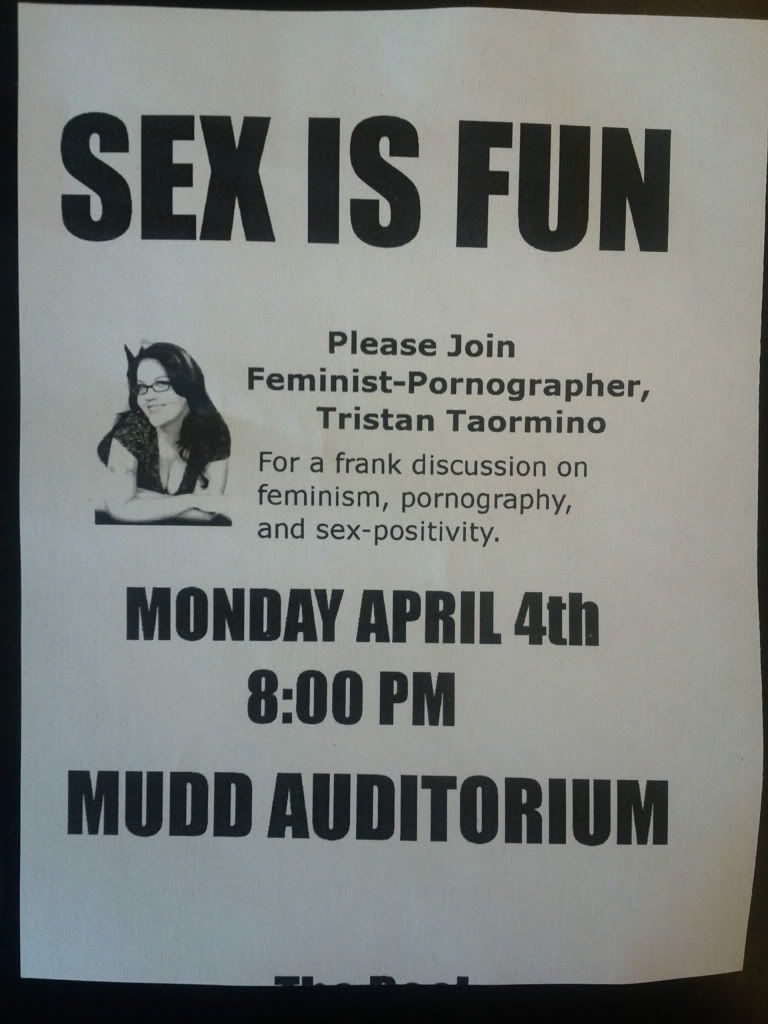
I guess if it's a frank discussion it can't be that bad. She certainly doesn't seem to promote immoderate behavior. Just tell'n it like it is.

But we need another angle. Perhaps we need to ask ourselves some different questions. Questions like ‘is he using a condom because he really loves me?’ ‘Is she taking the pill because she cares about my well-being?’ Perhaps, but does the pill guarantee that? Does it really make relationships better or more loving? Does it even help?

Sometimes it comes down to what people look for in sex. Those who only want sex for pleasure will end up using you or others. But many more look for sex to be completing, intimate, and loving. Many, in some cases, see sex itself as all three. Does contraception facilitate or complete any of these things? When a condom means “I love you” I’ll congratulate you on finding love. When the pill means “my life is complete” I’ll rejoice that you’ve moved past more difficult times—such as time before the pill.

But as far as I’ve seen it contraception remains that mirage that many seek and run towards. Has it really made your life better? Does your man say he’ll love you forever, but it’s a different story if you’re pregnant? And men, if you are responsible for a boy or girl can you call yourself a man by running away? For you see, the challenge of commitment does not lie in how good your sex is and will be but if in the face of the greatest challenges you persevere. A child is a challenge but a blessing because it is by that fire you can forge a true commitment and completely transform your life. What is more conducive to commitment in your life? Is it an unplanned pregnancy or an openness every time to have children if they come?

Do I say this to “scare you from having sex,” as avert.org might say? No. In reality I’m just beginning to “give you the facts.” Sex is a gift and a blessing, but its blessing does not lie tat in it is just pleasurable alone. It is a blessing precisely because it is unitive and procreative. True, holy, and proper sex is an openness to life, a love for life when it comes, and that expression of unified love of a husband and wife powerful enough to conceive life and sustain it happily and lovingly. More still, sex should be the culmination of many things—it should be the expression of love, commitment, trust, and friendship and not a tool by which we think we have all these things. The moment sex becomes a tool is the moment it can be misused. When we think something can be used against us is precisely the moment we feel we need protection from and against it.

Contraception is and has been dressing up as that thing you want and need for a while now. Is there nothing or no one else you can look up to? Next time, I will attempt to provide you with an alternative you can look up to. I will show you how contraception makes you a prisoner—especially women—and how, lades, much of the change we need begins with you. Men and women alike need to change, truly, how they look at relationships and sex. But the victims in many ways are women who leave men consequence-free by taking contraception that can (and does) affect their bodies, all in the name of their own personal pleasure—all the same still exploited by men looking to use women and women looking to use men.

Next time we will begin scratching the surface of the Catholic-Christian response and how through it you can be happier and more fulfilled, with or without sex.
Wednesday, June 13, 2012

I Hope You Have a Good Teacher


I Hope you Have a Good Teacher

Imagine a classroom setting where a teacher requests this of her students, “I want everyone to explain planetary motion to me.”
The students all look blankly at the teacher and respond, “We don't know how.”
The teacher looks at them, perturbed, and asks, “Why don't you?”
“You never taught us,” they responded.
“Everything is right here in the books. All the equations, methods, and considerations are easily accessible ….”

Now, the problem happens to be that these kids are in the 2nd grade and are still learning multiplication and division.

Despite the severity of the metaphor this is what the moral life and human landscape is for us. Life moves forward and expects us to 'do or die' and we often don't know how. The very human thing to do in life is to question “What should I do with my life?” and “why am I here?” Other questions eventually emerge: “How do I tell right from wrong?” and “How do I do what's best for my family, country, and others?” Many feel like they are scattered to uncaring winds. Like the example above, they often feel lost when presented with these unique and individual challenges. Even though the obvious rule of “do good” and “do what makes you happy” is easily seen it's not so easily done. (Another way of putting this, perhaps, is that planets revolved around the sun even before we learned that they did. It was obvious in that it was real, but was it an easy or (necessarily) obvious path getting there?)

In a world where happiness is supposedly laid bare before all—it's a matter of science, acquired knowledge, or “stuff.” Yet it seems the general attitude expressed by many is boredom or contempt.

That universal sign shared by all men alike. It was either pictures like these or people taking pictures of themselves half-naked. How happy we've become!

So many see life as something self-explanatory, but in reality we are all children who need instruction in life. In order to succeed there needs to be both a good teacher and attentive students. There are many more parallels to draw but let me say this: when being taught we need a clear purpose and a clear method. (How many of us act in a clear way with no clear purpose!)

Plato and Aristotle were geniuses at this. See where you're going, see how you're getting there, and evaluate if where you've gone is worth being there. The problem for Aristotle was that he couldn't commit to wonder like Plato could.

Plato realized that if life were composed of measure, balance, and order then a human being who mastered such things was truly blessed both in his life and afterward. The problem was that reason and a love of wisdom only brought him to the precipice of the truth he sought.

I consider Plato a teacher of mine and indeed a brilliant one. There, however, is one who is better: He is Father, Son (the Logos), and Holy Spirit.

And for Christians this is the great grace and reality of revelation. If life is temporary here on earth, then it is bound by measure, proportion—any man, in time, can learn these things. In this way we seem to have a method, but for what purpose? Even if we achieve fleeting happiness death, misfortune, pain, and everything else can come to take it away.

Revelation is the ultimate teaching tool in that it gives reason and purpose behind the mysteries of life. Plato and Aristotle glimpsed these truths as did many other non-Christians throughout history: the world and life are temporary. The one who puts his trust and wonder in material things sees them pass away—either it does or they do. They discovered that happiness did not lie in knowledge or possessions (however convenient they might be). Plato claimed that it is when one surrendered himself to wonder at it all that he began to understand. Our understanding did not begin by forcefully trying to grasp or control knowledge and wisdom, but when we resigned ourselves to the vastness of it all.

But he didn't have Christ. He didn't have the revelation of the Author of both wonder and certainty.

When Jesus came he revealed two key things: he revealed God to man and man to himself. Plato came to the doorway, but Christ is the door.

The Bible is the history of revelation and it additionally reveals in its structure a process, namely that in order to learn about “planetary motions” one has to learn the steps leading up to it, little by little.

The first great revelation and joy for the Jews were the laws of nature given through the commandments. The first few commandments only give a glimpse of God. Rather than reveal God fully it asks and requires that man fix his gaze appropriately on Him in their hearts and by their actions. This was for their benefit. The law of nature, such that humans should act, is an appropriate relationship between God and appropriate relationships between each other. This prepared the human heart. We have to learn to love what is good before we love Goodness.

No one appreciates this fully unless they appreciate all the little things that go into it.

But it wasn't to end there. As we know from the simplest things, that which is right, good, and true is not always chosen. Take, for example, my unhealthy love of red meat over vegetables. Out of preference and taste I will gorge on steak before I eat one pea. Does it mean I'm immoderate? Here, yes, especially because I will gorge myself. I'm sure you have your own vices. But what does that teach us?

Knowledge of the good does not mean that the good will be done. The Ten Commandments are sometimes seen as suggestions (honor your father and mother, especially, it seems), but it was revealed that this is the way to human fulfillment, but not the destination.

God was a wise teacher though. He knew he couldn't expect us to “calculate perfection” without knowing Him. But as humans, we could not do this without the help of nature. Because nature had beauty, order, and proportion we learned perfection by degrees.

But wisdom showed and humans could only feel that guidelines only guided us so far. All of Israel could only arrive at the precipice—all humanity could do was ask, “Now what?”

Vanity of vanities! All things are vanity,” proclaimed Qoheleth. (Ecc 1:2b)

This sage ends saying wisdom is fear (awe) of God and a recognition of his just judgment. Wisdom could only discover that we must dispose our work and heart properly. Humanity sees this. Now what?

Men learned with some help and effort justice, prudence, temperance, and courage.

Yet, where these practical and naturally good things were like multiplication and division the theological virtues (faith, hope, and charity [love]) were advanced calculus.

The Old Testament and nature herself sowed the seeds of this “advanced calculus” of life.

But then Christ came, lived, died, and rose again and it made sense.

Christ came and, much like how math and science do to our physical assumptions, shattered our moral assumptions—our human assumptions.

He told us that all the proportion and order we gained was meant to be given away. What?

This very experience was summed up by Scripture. You can see all of it in action, the experience of the entire Old Testament (and even humanity):

Mk 10:17-20

As he was setting out on a journey, a man ran up, knelt down before him, and asked him, "Good teacher, what must I do to inherit eternal life?" Jesus answered him, "Why do you call me good? No one is good but God alone. You know the commandments: 'You shall not kill; you shall not commit adultery; you shall not steal; you shall not bear false witness; you shall not defraud; honor your father and your mother.' He replied and said to him, "Teacher, all of these I have observed from my youth." "

The young man recognizes the goodness of the teacher and seeks advice. He wants to be taught how he might achieve his own perfection and completion. As John Paul II writes, “The young man senses that there is a connection between moral good and the fulfillment of his own destiny” (Veritatis Splendor [VS] sec. 8)

Jesus gives, in that sense, a rather mundane answer. He gives him an answer as old as time, for the Jew specifically and man generally. For the Jew, Jesus simply states the obvious: align your perspective to God properly and act appropriately towards others.

The young man emphatically responds that he has done this since his youth. He is a faithful Jew and a good man. He discovered that in life there is proportion, measure, and goodness and each man must conform his life as such.

Mk 10: 21

Jesus, looking at him, loved him and said to him, "You are lacking in one thing. Go, sell what you have, and give to (the) poor and you will have treasure in heaven; then come, follow me."

It should first be noted that Jesus loved him. Ever the wise teacher, however, he knew that what he had wasn't enough to complete him even though he was good and love-able.

Jesus telling the young man he lacked something was indicative of the wisdom I spoke above: even when you know what is good it doesn't mean you will always do it. But, on the other hand, even when we obtain proportion and order, how often does life sweep it away? Sirach reminds us, “The knowledge of wickedness is not wisdom” (Sir 19:17).

John Paul II also challenges us: “Do the commandments of God, which are written on the human heart and are part of the Covenant, really have the capacity to clarify the daily decisions of individuals and entire societies?” (VS 4).

Jesus, after giving the obvious and mundane, shatters the young man's expectations. The natural inclination that we all have, the 'moral algebra' as it were, would say that 800 = 800. This is to say “what you have is what you can do.” It may also be said that our natural inclination is 'as long as I'm good to other people and decent myself I am a good person.'

Mk 10:22

At that statement his face fell, and he went away sad, for he had many possessions.

The man fell back, awestruck. All he knew was not the case. It was not that 800 = 800, but rather that 0 = (infinity). Yet, even in Jesus' example his humility and sacrifice made it such that -1 = (infinity).

Mk 10:27-32

Jesus looked at them and said, "For human beings it is impossible, but not for God. All things are possible for God."
Peter began to say to him, "We have given up everything and followed you."
Jesus said, "Amen, I say to you, there is no one who has given up house or brothers or sisters or mother or father or children or lands for my sake and for the sake of the gospel who will not receive a hundred times more now in this present age: houses and brothers and sisters and mothers and children and lands, with persecutions, and eternal life in the age to come. But many that are first will be last, and (the) last will be first."
They were on the way, going up to Jerusalem, and Jesus went ahead of them. They were amazed, and those who followed were afraid. Taking the Twelve aside again, he began to tell them what was going to happen to him.

Indeed the last are first and the first are last. Only he who sacrifices himself for others gains the completion he seeks.

And those who were with him were afraid. They were giving up everything but they were told they still had more to give. But they were instructed by Jesus example, because he told them (for a third time) what was going to happen to him. He would be the perfect teacher by going ahead and putting his lesson plan into practice.


In this short passage Christ instructs us—he gave us the clear method. But it is his Cross that gives us the even clearer lesson. His Resurrection becomes for us the clear goal.

Ever the good teacher he left his Apostles not with a 'good luck!' but a promise of His Holy Spirit.

The Apostles were stewards of the Gospel and the ultimate lesson plan for humanity—a lesson plan all but St. John died for.

Christ as such did not leave us his Spirit alone but a Church to stand in his stead. The Church stands as the bedrock which the Cross is firmly planted as the door to eternity. Its arms are stretched to infinity to gather all who might wander.

Christ is the teacher who taught only God fulfills us. Nature prepares us and teaches us measure and balance so we might withstand the imbalanced weight of the cross.

But we can't carry it without instruction. God gave us two textbooks: Scripture and nature. He have us an instructor in Sacred Tradition that flows from one, holy, catholic, and apostolic Church. He gave us the goal which is Christ for the purpose of becoming like Him just as Christ became man.

No one said life or morals were easy just as learning advanced calculus isn't easy (well, for me). But with such an instructor how could we fail when we apply ourselves to honest learning?

We work at small things in order to reach the infinite where even colossi are dust.


There are many who claim that life is fleeting so the purpose of life is happiness, but the one who begins to understand wisdom sees their idea as dust.

Others claim that we are drifting in an uncaring wind, that all ends in dust. I would say they are described in the latter half of this phrase: “The wise man has eyes in his head, but the fool walks in darkness” (Ecc 2:14).

The one who says there is no purpose walks without direction. The one who seeks pleasure walks to his grave and often with more sorrow than joy (or, perhaps, with more boredom and contempt). Even those who walk happily walk to their grave all the same.

This is why revelation is so crucial. It builds on nature and her wisdom. Yet it instructs us towards what nature is a beautiful reflection of: God Himself.

As it is so, it is the case that grace builds upon nature and faith builds upon reason. As Chesterton says, “The madman is not the one who lost his reason. [He is] the man who lost everything but his reason.” (Orthodoxy)

Prophetically he says, “When materialism leads men to complete fatalism (as it generally does), it is quite idle that it is in any sense a liberating force. It is absurd to say that you are especially advancing freedom when you only use free thought to destroy free will.”

There's much more to say but for now I ask you to look at what turns one into the fool, the unlearned, or the blind. Is it faith, hope, and charity and surrendering (when you must, not always) to the infinite or saying with a stern brow that fleeting happiness, proportion, measure, and reason that is our true end?

Only life teaches this lesson. I hope you have a good teacher.