Showing posts with label Christian. Show all posts

Friday, February 8, 2013

The Bread of the Eucharist: A Bland Reality?

 Some may say, whether they are Catholic or not, "Why is the ‘wafer’ and the ‘host’ so bland?"

Perhaps instead of us thinking of the Church as being cheap, stupid, or boring we should look at the intentionality behind the act. The host being “bland” is symbolic. See that the bread is, for us, a sort of deprivation. It is not special, it does not have an exceptional flavor, and with respect to other foods it is bland. But this is exactly the comment that the Church wants to make about Christ: that he became flesh like us. In comparison to the divine our flesh is cheap, and fallible, and bland. This does not mean that that our flesh is “bad” just as this normal bread is not “bad.” Christ, however, by his graciousness took on our weak and fallen humanity to raise it up. We proclaim through our very bread that humanity is simple and lacking, but not bad—in fact the body may be used for holy work and sacred things.

The bread that we receive is not merely a symbol, but it is a symbol given to us for our benefit—it is meant by means of earthly concerns to direct our mind to heavenly truths. Christ adopted our humanity so that God might adopt us. He “took the form of a slave” (Philippians 2:7) which is to say he was unassuming, common, and everyday. Even the people at the synagogue doubted his power when they asked “Isn’t he the son of Joseph?” (cf. Mt 13:55, Jn 6:42) In his common estate, however, Jesus expressed the power of the Spirit by virtue of his obedience to the Father.

God, incarnate in common humanity, confounded those who would never believe that the body could be redeemed or divinized. To those who believe, however, the bread we have stands as a powerful comfort to us who are still pilgrims.

More powerfully, Christ left us the Eucharist so we might partake of him for our whole lives. The Body of the Sacrifice was resurrected so that we might make continual sacrifice to the Father and that it might be one sacrifice all the same. This is because the Body we offer to the Father is His own, and the Body we offer can never be destroyed or pass away. For “when he became perfect, he became the source of eternal salvation for all who obey him” (Heb 5:9). “Jesus took bread, said the blessing, broke it, and giving it to his disciples said, “Take and eat; this is my body” (Mt 26:26). He did likewise with the cup, saying it was his blood.

The early Church herself attests to this reality. When Irenaeus wrote Against Heresies (circa 182 AD) the Eucharist was an important mark of the true Church:
The Church offers with single-mindedness, her gift is justly reckoned a pure sacrifice with God. ...[and we truly offer the first fruits of creation, that which is most loved] ... how can they [the heretics] say that [our] flesh, which is nourished with the body of the Lord and with His blood, goes to corruption, and does not partake of life? ... Our opinion is in accordance with the Eucharist, and the Eucharist in turn establishes our opinion. For we offer Him His own, announcing consistently the fellowship and union of the flesh and Spirit. For as the bread, which is produced from the earth, when it receives the invocation of God, is no longer common bread, but the Eucharist, consisting of two realities, earthly and heavenly. (Book IV.18.iv-v)
Irenaeus of Lyon didn't treat it as if it were simple bread.
Indeed, the Gospel of Luke relates to us the power of this most precious treasure. As the men from Emmaus leave Jerusalem Jesus meets them. Jerusalem is the image of the heavenly city, it is the place where Christ proclaims himself the Temple and where he sacrificed himself. The cross stands there, and thus heaven through the cross. The men meet him and Jesus walks with them. Even Scripture is explained to them and their hearts are on fire, but they do not turn back. It is only when Jesus “was with them at table, [took bread], said the blessing, broke it, and gave it to them. With that their eyes were opened and they recognized him, but he vanished from their sight” (Lk 24:30-31). Does it not seem strange that Christ should vanish? But in the end he did not vanish: “this is my body, this is my blood.” They set out at once back to Jerusalem to proclaim that “he was made known to them in the breaking of the bread” (24:35). Yes, not even Scripture revealed this to them, but the bread.

Recognize our savior in the breaking of the bread in new ways. Reflect not only on the spiritual truths, but what the physical experience of it all relates to us.

Sunday, January 13, 2013

Then Who Made God?

When I was around three years old I sat on my grandfather's lap. He would talk to me about many things, but one subject that persists in my memory is when he would talk about God. He would tell me how God created the universe and everything in it. He began by asking me “Do you see the trees outside? Do you know where they came from?” I would ask where they came from and he would say any number of things that a three-year-old could understand and then say “Do you know where all of that came from?” I would then ask where it came from. Finally he said that “God made everything.” I then asked, “But, grandpa, who made God?” He would respond that no one made God and that God was never made or created. I would persist, “But where did he come from?” He would respond “He was always there before everything else.”

Certainly I was confused—I had just gotten my head around contingency (for you adults here): that something comes from something else. Now I was told that there was something that always was. Despite my confusion and repeatedly asking the questions “But where? How?” my grandfather reinforced the answer. Whether I was tired of the answer or, more likely, I accepted the answer, I moved on.
Unless you become like a little child you will not enter the Kingdom of Heaven.

Some may take this moment to be the favorable or regrettable turning point where God was firmly placed in my mind. He was no longer just a name or some chimera, but something so great he defied common logic and experience—sometimes children understand this better than we adults.

Even if I did not believe in God, or if I had forsaken the faith my ancestors strove to protect, the answer I accepted puts me above the great number of adults who pose the question “Then who made God?”(as if it were triumph of secular reason). From the commonly educated to Oxford Professors of Physics, adults pose this question, and others like it, with confidence and a sort of smug satisfaction that could only make my three-year-old self ask “Why don't you just listen?” If one is to engage in a debate or discussion with anyone who has a reasonable (or for others, “considerate”) belief in God, they owe it to them to accept their definition at least as their [the “theist's”] starting point.

Many find this answer “God is uncaused” as a cop-out or a microcosm of faith—or rather the idiocy, apathy, irrationality, or indoctrination of that faith. These wise spectators are quick to taut physics and various explanations of the universe as the superior way. They treat those who believe as dreamers; they consider themselves pioneers and careful investigators. One can discover this disposition in many of them in some form, for once you press the issue that someone truly believes in God you may get a response such as “They can believe in what they want, but I'll stick to science and reason.”
They eat this stuff up. Then again, Mr. Russell believed that all "ideologies" were like a religion which served to make one dependent and fearful. Neither reason nor science have ever been used that way, reports claim.

Yet despite anthropic principles, multiverse theories, etc. which claim to answer the questions of “why are we here” and “why is the universe/earth/etc. so supportive of complex life,” these responses simply produce something else that demands explanation. Now that we've conceived of a multiverse where various constants (for each universe) are different we presently have a multiverse that is unexplained—on what grounds do the constants rise that allow for a multiverse that produces a universe like ours? However fascinating the discoveries are and however deeply we probe the mechanisms of the universe our answer has only answered “how” and not “why” in the fullest sense.

With science silent on the answer that some adherents claim it satisfies, many of these intellectuals give their intellectualism over to a sort of religious tagline (derogatory in their sense): “We'll figure it out eventually.”
I almost figured out this game. Didn't mean I understood it.

In ancient times those in the cult of Dionysus might become drunk on wine to achieve/feel greater unity with the god. Today, many in the cult of Science become drunk on progress in hopes that they will understand everything, perhaps some wish to control it too. They give it praise and protect it zealously should anyone slander its good and holy name.
The face of one who has made the breakthrough discovery that religion is stupid.

Many of these sober men of science become drunk on the prospect of what we can and may understand. No doubt that there is pleasure in understanding and there is something noble about the human spirit trying to understand the world he lives in. But then these men forget themselves and more often forget what others had said about God in all sobriety. Men of science treat the answer “God” as a “god of the gaps” with chilling efficiency and simply shake their heads at the notion, “Those who do not wish to understand respond with 'God', those who know better answer something else.” They rarely pause—they're in such a frenzy—to consider that the one who answers 'God' believes that He is the foundation for all other inquiry and not merely the answer for what we can not understand. The scientists of the 12th-17th centuries sat perfectly content with a crucifix on the wall and an experiment on their tables. Such convictions continue even today.
Big Bang theory, anyone? (Georges Lemaitre)

Many of those who put forth a scientific or secular idea of the whole, however, are often convinced in the notion that they are supported by evidence and facts—in some ways they hold that they rely on facts and evidence alone. While it is true that the make use of facts and data, some of them must be aware that facts, proofs, and likelihoods as they stand offer no reason for us to reflect on them, i.e., how they affect us as users of those facts. Many forget that “facts,” however one wishes to define them, has two aspects: 1) what they convey and state and 2) how they are used. Those who rely on facts alone have no ground in those same facts on how to make use of them. At the least, those who believe in God have ground to consider what he does with the discoveries of nature in our world.

Certainly those who do not believe have grounds upon which they decide how to use what they find, it's just not upon the fact that they discovered. It is usually some other “fact” or ideology that organizes what they find. Eventually we find that it isn't grounded in facts, as such, but rather some disposition that they hold as a matter-of-fact. At this point we may dispute who has better grounds to argue this or that, but it won't be found purely in science or empirical observation.

God is not the answer to how or why for me in a mundane sense, he is the reason and authority upon whom we may ask and answer how and why. One has only to read the end of Job and see the wisdom of the Jews: “Where were you when I founded the earth? … Who determined its size; do you know? … Have you ever in your lifetime commanded the morning and shown the dawn its place for taking hold of the ends of the earth” (Job 38:4, 5, 12). We are not in charge of the universe, we dwell in it—fragile, weak, dependent. Anyone who ridicules belief in God by bringing up scientific or naturalist explanations should reflect on the book of Job and what it says about a belief in God.

Those who believe that we stop with God have stopped themselves from thinking, or they have rather stopped themselves from listening. Creation comes from the creator. We cannot understand the creator fully, but Scripture relates to us what we may extract from creation about Him: creation was made out of love, creation was made as good, and creation was made to be both lived in and known.

God founded the earth so that we may live in it and appreciate it. We appreciate the earth through nourishment, beauty, and understanding. Though it is not the purpose of this piece to discuss evil, we may even learn about the creator in our reflection of evil, imperfection, and tragedy. We must confront ourselves about tragedy and loss, asking why it exists and asking ourselves if it is really unnecessary. Regardless of anyone's answer it is grounds for reflection “is suffering natural or unnatural?” The crucifix stands as an answer for you to interpret, but also stands as an answer that goes beyond a simple yes or no.
"He is before all things, and in him all things hold together ... In him all fullness was pleased to dwell, and through him to reconcile all things for him, making peace by the blood of his cross, whether those on earth or those in heaven" (Colossians 1:17, 19-20)

When arguing about God it helps to listen rather than react. Here we can learn virtue from children who trust even when they do not understand. They are trusting but they are not forced to remain ignorant. Those who teach children not to believe also rely on them trusting you and what you believe is true. The trust of a child should never be taken for granted. But when we become adults we are confronted with adult understandings. As adults we should listen as well as a child (odd as it sounds) and learn to accept what the other is saying, rather than reduce one's belief in God to their own disbelief in God—that's being childish, ironically a common vice among adults.

Is belief in God a “god of the gaps” or a surrender of reason? For countless generations and myself it isn't. For me it is the beginning of wonder: someone who is outside the commonly observable, the foundation of all being, and ultimate simplicity. Must I account for where He came from? At that point we're no longer speaking about the same God.

Wednesday, October 31, 2012

In Praise of Weakness

 Author's Note:

I realized after writing this that it may be cryptic for some. For those struggling with one of the themes, please consider this: to neglect, hate, or ridicule someone or something for weakness or simplicity is an error on your part. These are all strong words, to be sure, but I've heard far too many arguments along the lines of "he's a sinner how could you love him?" Even of the blessed St. Peter "he was a fool and serves as an example for us." Others may say "I hate myself because I keep messing up [in sin, etc.]." Others still have said that "the Church is just human authority filled with human weakness, I follow God alone."

Part of this is about patience and perseverance coupled with understanding and a willingness to change.

I ask, humbly, you reflect on those sentiments with this. This is hardly adequate for full but in the interest of your own attention and retention I cut this down significantly.
What are you talking about??  (Comment below if you feel that way)

I. Introduction

Those who do not share in the weaknesses of the body have no share in the body itself. For what body in this life is free from corruption and limitedness? Even the great Body of Christ is subject to weakness precisely because he subjected Himself to our weakness since “he took the form of a slave” (Phil 2:7) and “was of human estate.” Even after the Resurrection His resplendent and transformed body still bore the wounds of his glorious crucifixion (cf. Jn 20:20). It should be noted even more that Jesus identifies Himself with the weak and broken for “what you have done for the least of these you have done for me” (Mt:25:40). Likewise Jesus identified Himself with those who were persecuted, ridiculed, and killed in His name. This is why He said “Saul, Saul, why are you persecuting me?” (cf. Acts 9:4, 5).

Paul said that “Christ is the head of the body the church.” (Col 1:18). We have seen, albeit briefly, that Christ shared in our humanity fully and willfully. We saw, through His resurrection, that He transformed our weaknesses while still keeping the physical marks of that weakness. They were not cast aside or hidden but present in plain sight. Jesus told Thomas “put your finger in my hands and in my side” (cf. Jn 20:27ff). The history of Christianity is a constant call to “place our fingers on the wounds of His body.” Thomas doubted the Resurrection, perhaps, because after witnessing the horror and shame of the cross (and living in his own shame) he asked ‘how might anything good come from this?’ Christ showed him precisely the good that came from it, namely His own person.
Caravaggio's famous painting not only represents the doubt of Thomas but that same doubt that we feel about our Church and her divine characteristics. Are we willing to address our doubts? Are we still willing to trust in the Church?

II. Sharing in Weakness

This is what I call each of you to do today: If you are to truly share in the Body of Christ do you share in its weaknesses? The weaknesses I refer to are failures in charity, excessive opulence, elements of the Inquisition and Crusades, sex abuses, and every weakness that we see in our own person. Blaming the past, however horrible—and indeed some things are horrible—is to separate fallen and weak humanity from the life of faith. Faith is not perfection but, in a manner of speaking, seeking perfection. Weakness is either self-generated or encountered, shall we shy away from either?

I rarely see this type of image, of Jesus as a fragile child being cared for. Jesus Christ, our savior and Lord, became as a little child out of love for us.
Christ met our broken humanity. He calls us through faith and baptism to share in His mission of transforming all of humanity. If we deny the humanity of the Body we separate ourselves from that Body. The Church is the Body of Christ beset by human weakness but all the same transformed by Christ and upheld by the Spirit.

When we recognize weaknesses and failures there is a twofold response: the first is active insofar as we seek to rid ourselves of that weakness (whatever it may be). The second, equally important, is to realize that we are not separate from our weaknesses. The weaknesses that we carry inform our actions for the future, even in healing. If we do not address our weakness actively we won’t change effectively. If we try to disassociate ourselves from our weaknesses we become insensitive to the weaknesses of others and we forget who we are.

III. Examples of Weakness Transformed

St. Peter is our first example and our guide. He was filled with faith and he was blessed personally by Christ (cf. Mt 16:16-20). But he had his faults too. He was rash and at times overzealous. This zeal, coupled with his predispositions about what the Messiah was supposed to be, led him to deny Christ three times while He was being humiliated. He abandoned his friend and the one whom he loved. “He wept bitterly” (cf. Mt 27:75). After the resurrection Christ called out to him and Peter responded. Christ confronted Peter’s sin, fear, and weakness not by shaming him but by asking him, “Peter, do you love me?” Jesus asked him this three times for every time Peter denied him. Peter recanted three times saying “You know that I love you” (Jn 21:17). Peter is a man whose strengths and weaknesses are on full display. Just as God had chosen Moses, Abraham, and David before He chose this time to call a simple fisherman to greatness. These patriarchs and this king themselves sinned, doubted, and failed. Through it all they carried out what God had asked of them. Only Peter, however, was given “the keys of the kingdom of heaven” (Mt 16:19).
Despite his brashness and weakness Christ still pulled him from the water. Despite his denial Jesus came to him and Peter grew in understanding, wisdom, and love because of Christ's example.
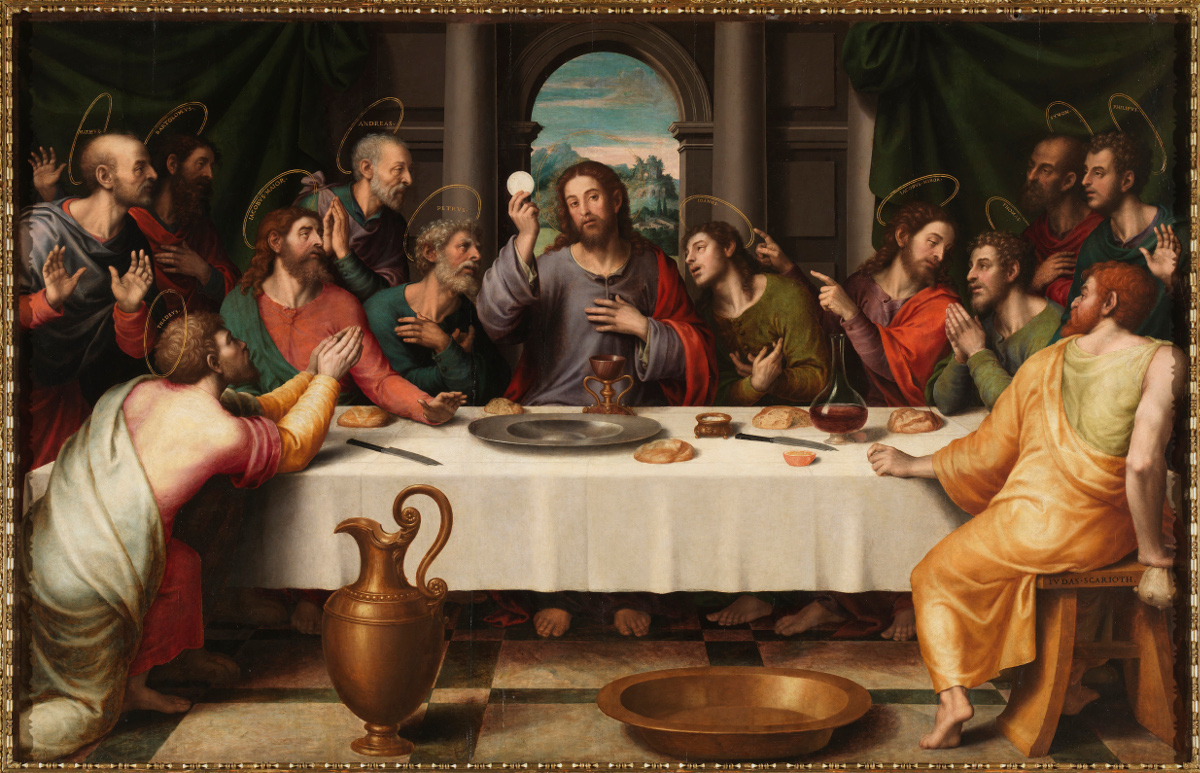
Our chief example, and one that has given me pause for years, is the Eucharist. I believe in Christ and I believe in Christ risen. I also believe that at the Last Supper he gave us a model to follow: he took the bread, broke it and said, 'take this all of you and eat this. This is my body which has been given up for you.' He also said of the wine 'this is my blood.' This I believe with my whole heart. This sentiment is in accord with all that has been said above. Truly, to our senses it appears as mere bread and mere wine. Then I recall with wonder that “he emptied himself … coming in human likeness and found in human appearance” (Phil 2:7). Likewise that “he had to become like his brothers in every way” (Heb 2:17).

Indeed, the Eucharist is regarded as the Son of Man, present sacramentally in ordinary bread and wine which has been transformed by the prayer that Christ entrusted to His Apostles and their successors. The Eucharist is both a glorification of the Cross and a sacrifice that dips into the eternal moment of Christ's one sacrifice and shares fully in it. It is something that stands outside of time. Something so grand, God Himself! in ordinary, daily food. Christians have praised the extraordinary in the ordinary as well as paradox from the beginning insofar as “Jews look for signs and Greeks look for wisdom but we proclaim Christ crucified” (1 Cor 1:22-23).
This is what we exalt. Do you?

Furthermore Jesus Christ Himself is “the living bread that came down from heaven that one may eat it and not die. I AM the living bread that came down from heaven; whoever eats this bread will live forever; and the bread that I will give is my flesh for the life of the world” (Jn 6:50-51). I could occupy an encyclopedia set with the richness of these verses. The word “eat” (phagein) has no spiritual connotation. It literally means to chew and physically eat. By eating this living bread we shall not die. Then Christ follows by saying “ego eimi” which means “I am.” But this is no mere “I am” but rather a direct reference to God speaking about Himself in the Old Testament. It is a proclamation of authority and power—this is something we should listen to. He said “I AM the living bread come down from heaven.” He then says “Whoever eats/chews this bread will live forever.” He further says “the bread which I give is my flesh,” Literally my earthly flesh. The simple bread which He gives is his flesh. For the time being let this entirely inadequate account suffice. No “ego eimi” statement in Scripture is a metaphor or an opinion. It is Jesus speaking in the authority of the Father on an intrinsic reality.

IV. Share in Weakness, Share in Glory

What is my purpose in saying all of this? Proceeding from the Eucharist and the example of the Apostles (chief among them Peter) Christ gave us two simple and lowly things and transformed them. He transformed bread and wine into His flesh and blood. He transformed simple fishermen into philosophers, teachers, and bearers of His message. Though they were of human estate they were transformed and “filled with the Holy Spirit” (Acts 2:4).

The Church is the Body of Christ—it is subject to weakness. The Eucharist is bread and wine made the Body and Blood of Christ—it is common and ordinary yet mysterious and sublime. The Apostles were chosen by Christ Himself to bear unique witness to His teaching and mission—they were “also human beings” (Acts 10:26). Jesus Christ identifies with the poor, persecuted, and the oppressed in an intimate way—they are lowly and 'worthless' in the eyes of the world. Finally, Jesus Christ Himself, was born of a virgin in poverty. He was a helpless child and a man subjected to ridicule and cruel torture. A man who took on our every weakness.

By eating His flesh and blood, and through baptism, we join ourselves more fully to Him so that we may share in His suffering. In our own flesh we “fill up what is lacking in the afflictions of Christ on behalf of His body, which is the Church” (Col 1:24). When the Church, or even her members, do evil the whole suffers. By our personal and communal work, love, and suffering we correct the wounds of that Body and also “share in our master's joy” (cf. Mt 25:14-23).
Follow their hands and their eyes. They are looking at Christ, yes. They are looking at the Eucharist.
Join yourself, then, more fully to Him and His Church, for those who do not share in the weaknesses of the Body will separate themselves from the Body. In rejecting weakness and wickedness as unlovable they move away from the God “who so loved the world that He gave His only Son” (Jn 3:16a).

Friday, October 26, 2012

Faith and Works Part II: Love

II. To Speak of these Things We Must Speak about Love

Last time we briefly examined faith, works, and the aim of my work. We saw that faith was both a response to a call and a 'hope for things not yet realized.' My claim, for the sake of clarification, is that faith is something that looks outwards. Without faith we cannot know what to look for or what to trust, and without works that faith is dead. By works we mean actions that seek to bring about that hope. So in a certain sense faith does inspire us to works and works do flow from faith. On the other hand faith allows us to see what we should work towards. Stronger still, faith helps us to see what we must work for. (see part 1 here:Part 1)

But if faith is perceiving what we desire then desire alone will not allow us to receive what we desire. Works are necessary to reach the goal that we desire. This is why James says “I will demonstrate my faith to you from my works” (James 2:18) and that “faith was completed [literally: perfected] by the works [of Abraham]” (2:22). This theme will be expanded on later by viewing in detail the parable of the Sower and the seed in hopes to make this point clearer. For now we shall turn to the argument at hand.

Rather than analyzing faith and works right away we should look at love [caritas]. In order to speak of these two words and ideas we must speak of a third, namely love.

There is hardly a better place to begin either, for “God is love” (1 Jn 4:8) and that of all the virtues and gifts of the Holy Spirit “faith, hope, and charity [caritas] remain … but the greatest of these is charity [i.e., love]” (1 Cor 13:13). Faith itself is initiated by love and sustained by love. Faith is a sort of relationship to God and knowledge of God. The blessed Apostle John says, however, that “Whoever is without love does not know God … [for] no one has ever seen God. Yet if we love one another, God remains in us, and his love is brought to perfection in us” (1 Jn 4:8, 12). Love then seems superior to faith in many instances in Scripture. It is not superior such that faith is useless. Rather, Augustine speaks well in his masterpiece On Christian Teaching when he says “faith will be replaced by the sight of visible reality, and hope by the real happiness we shall attain, whereas love will actually increase when [the world] passes away” ( Book I. 90). Faith is meant to get us somewhere and Love is where we must go. Augustine also says rightly that if our faith lapses then our love will also lapse, since we would not know what to love. As it stands, however, “if I have faith so as to move mountains, but do not have love, I am nothing” (1 Cor 13:2).

Love is also greater than works because love is both a work and the foundation of all works. Every man acts for some purpose and that purpose is love. A man may love wrongly—preferring evil things to good things. But a proper love produces proper works. A problem emerges: someone may give to the poor which is itself a good work, but that person may not love the poor. The foundation of all law and service, however, is not to give goods to others but to love them. Love is not a work like other works but it is the supreme work that must be the source of all others if any of our works are to have life. An analogy, imperfect as it is, may help here: our bodies sometimes twitch. Nerves are excited and our arm or leg jerks because of something that affected us. But when we have a sound disposition we order our arms and bodies to do many different tasks with precision.

Works when they are without love, even though they are good, are like barely-lifeless twitches. Works inspired and guided by love is like the skill of a fine craftsman—intentional, knowledgeable, and purposeful.

Love, it seems, is truly the foundation of all. For our purposes it seems to be the foundation for both faith and works. There is no greater work of love, apart from Christ crucified, than that of creation. Love, therefore, creates. It may be said that faith and works alike proceed from love and are completed by love. All the same, faith and works are the expressions of love as well as the road by which we love.

God's love is perfect but our own love lacks perfection. This is why we have faith and works.

Faith directs our hearts and peers into the shadows of great mysteries. For revelation is God's gift which allows us to know of the world, ourselves, and God Himself. We see all of these things by faith: that creation is good, ordered, and loved. It shows us that God is Three-in-One, transcendent, and yet immanent.

Works temper our bodily passions and sharpen our vision. For without doing good works ourselves how may we see the work of the Holy Spirit in us and others? When our bodies are distracted by idle passions we will fail to see truth clearly and, by our weakened disposition, fail to love readily.


At this point, however, love is still a vague idea. As I have mentioned above we all love something or someone. In like manner we desire certain things, jobs, pleasures, and honors for ourselves. In order to understand love more precisely I would like to focus our attention to the Trinity. In order to understand how faith and works proceed from love it is important, I think, to first look at Love Himself. Though I can only speak weakly I want to speak on the Trinity so we may reflect on perfect Love which produced everything—a love so powerful that it brought forth everything from nothing! From that reflection we shall see a bit more clearly, I think, what that means for us and what it reveals to us about humanity made in His image.


For next time: The Trinity, Love, and Human Beings

Sunday, October 21, 2012

The Mediation of the Saints: Part 1

(Parts 2 and 3 of this ongoing series are completed, with more on the way! 
Check it out: 

Part 2: God Works Through Us, 
Part 3: Walking Together)

A: Introduction

In this piece I hope to accomplish, step-by-step, an understanding of the saints. In a small part how we should strive to be saintly and in larger part how we should consider those who are called saints in the fullest sense, i.e., those with almighty God in heaven who pray for us and continue, in His friendship, to aid us in many ways. Though I will begin by mentioning mediation I will pick it up in a later part.

I. Who are They?

Christ indeed is “the one mediator between God and the human race” (1 Tim 2:5) but does this mean that God the Father will only listen to Christ? Does not the Lord “have eyes for the just and ears for their cry”? (Ps 34:16). Further still Christ tells us to “ask and it will be given to you” (Mt 7:7). The letter to James further qualifies this when he says “You do not possess because you do not ask. You ask but do not receive, because you ask wrongly, to spend it on your passions” (James 4:2b-3).

What should we ask for and how do we ask rightly? The letter of James further tells us that in order to do this we must be “doers of the word and not hearers only” (1:22). We learn through many venues but the most powerful teachers of faith and love are the saints.

The saints are, in short, exemplary doers of the word. They stand as a model for us in courage, patience, and wise-counsel among other virtues. We are drawn to a truly holy person because it seems like that ‘have it together.’ They exemplify—it’s almost an aura—a love of God and a love of neighbor. This power and aura are displayed by the Apostles themselves. Look at see the circumstances of these examples:

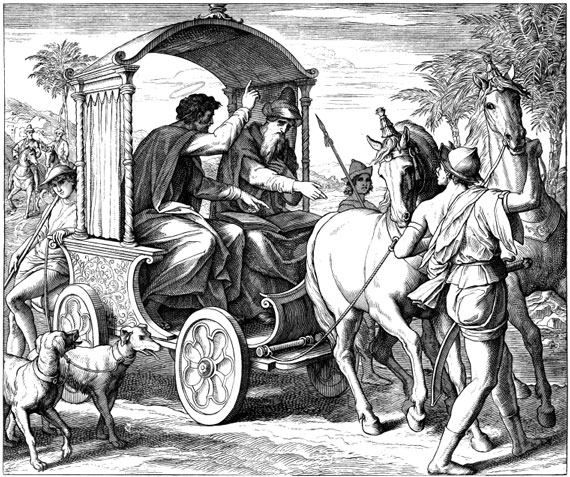
+Phillip runs up to the Ethiopian eunuch reading Isaiah and says ‘Do you understand what you read?’ The man replies, ‘How can I, unless someone instructs me?’ Phillip, filled with the Holy Spirit, instructed him. The eunuch, himself moved by that same Spirit, sought to be baptized immediately. Phillip became a light to a man searching for Christ. (cf. Acts 8:26-40)
Philip instructing the Ethiopian eunuch, pointing to Scripture and pointing to God. His bodily presence and actions making it possible for this man to see both.

+Paul and Barnabas preached at Lystra and healed a crippled man. Their presence and power of spirit and speech drew a large crowd to them. The Greeks there took them to be the gods Zeus and Hermes and began to worship them. But Paul was distraught, saying to them ‘We are flesh and blood just as you are. We have done these works so you might turn from idols and false gods and turn to the living God.’ (cf Acts 14:8-20)
Paul and Barnabas (right) pleading that the Greeks stop worshiping them after healing a crippled man. Men are drawn to great power mixed with great humility, but here too Paul reminds them that they are flesh just as they are.

The Apostles, men moved by the Spirit, proclaimed God to their fellow men. But some men, those confused or unable to see God themselves, found Him through His servants. The living saints do this just as the Apostles did. Some do it through humble service and others through great and powerful works. Saints pray and then go forth having an impact on those around them.

Moving, then, to the blessed Virgin Mary and the saints of past ages, they intercede to Christ for us, asking Him more perfectly than we ever could what we need (this does not deny the Spirit does this for us too). This is because they live with God and have achieved oneness with Him after life here on this earth. For Christ Himself prayed that just as He and the Father were one that “they may also be in us, that the world may believe that you sent me” (Jn 17:21).

When we ask a saint living here on earth or in heaven to pray for us it is not an affront to Christ or the Spirit, rather it is an act of humility. It is an act of humility because we ask the very proper question “Lord, teach us how to pray just as John taught his disciples” (Lk 11:1). John the Baptist, one of the chief saints and prophets, taught his disciples to pray and how to live. A saint, in John’s image, lived these words perfectly: “He must increase, I must decrease” (Jn 3:30).

Thus, asking the saints for intercession is not ignorance of the power or mediation of Christ. The presence of the saints influenced many to virtue and faith. This is why Paul longs to be with the Corinthians in person and to “fill the deficiencies of your faith” (1 Thes 3:10).

In life the Apostles tirelessly labored for the sake of the faithful and even died for it. Their lives and examples alone filled the deficiencies of the faithful. Their faith and the faith of any saint, however, was not a source of pride. Rather they always pointed to Christ.
Peter, saying he would be unworthy to die as Christ did, was crucified upside down. The Cross itself points to heaven.

In the next section, I will discuss in what manner they pointed to Christ and how a saint effects the work of salvation in the world. I shall begin by looking at the Old Testament and then the New to show that this process is nothing new in the long history of faith. Having introduced saintly intercession it is good to see how the holy prophets interceded to God for the people of Israel. Thereafter I will elaborate on the communion of saints in heaven who work tirelessly on our behalf.

Thursday, October 4, 2012

The Body of Christ: Concerning Protestants, Christians, and Ideology

Author's Note:
I had worked a great deal on this but am humbled in the simple fact that this barely scratches the surface on a number of issues. By the time I had realized my efforts (up until now) this essay had gone past 3000 words.

Not willing to subject you the torture of reading me for too long I decided to end the piece somewhat abruptly. It would have taken me years to write this as I truly intentioned. For now I hoped to write this as partly historical, partly theological, and in part analysis, exhortation, correction, and more. Have I succeeded? I'm not sure. I'll see the discussion that comes from it--so I do hope you comment.

It is a bit long, but I hope to continue on this topic in a more concise manner. I have some comments on this already in my pieces "On the Priesthood," "On Hierarchy," "On Confession," and "On Forgiveness." If you are so inclined, please read (or reread) them.
[I have employed parenthetical citations. In them I list the primary text and cite by letter the book I used. This can be viewed at the end of the piece. -M]

 The Body of Christ

The weaknesses and failings on the Catholic Church are well focused on. Far be it from me to deny or cover up the faults of my Body. Rather I recognize them and yet, through it all, love it. Though I would like to reflect on this I would rather like my reader to consider two things: 1) that same Body which we call the Church, specifically what that means, and 2) the general view(s) of my Protestant brothers and sisters regarding this issue. If we, believers in Christ, are also called the Body of Christ, do you know what that Body looks like? Below I shall examine those communities known as Protestant and Christian as well as those people who call themselves followers of Christ. I ask my readers, Catholic and Protestant alike, to examine their own communities and ask themselves if it represents Christ and if it represents the 'body' and ‘people of God’ images that we are supposed to be.

The opposition that had begun in the form of schism and reform by the Protestant Reformation is one that should be read with sympathy by Catholics and a critical eye by Protestants. The former are often all too ready to deny their words of “faith alone” and “sola scriptura” without considering why the reformers felt they needed to say it. The latter are ready to applaud the evaluation that the Catholic Church as the “whore of Babylon” and the pope as “anti-Christ” and then fail to evaluate the reasons some reformers derived these notions. Let us all not rest in ignorance but truth. Though I wish I could focus on all things the topic is larger than my competence. Below I leave for your evaluation my analysis and interpretation of some Protestant ideologies and their implications in practice.
This man was not a fan of sola scriptura.
Lutherans and other groups say that Scripture is authoritative and binding. Yet the fragmentation of these movements, sects, and communities showed many of them that the Bible alone—however true it is—was not sufficient for the unity of the community. For example, the Missouri Synod of Lutherans is a group that is very reverent towards God. They are also quite faithful to the teachings of Luther. They, however, agree to abide by certain rules through a signed confession, such as rules found in ‘The Book of Concord’ (1580 AD). They also agree to a certain form of governance (e.g., ministers and councils) and, of course, rely on Scripture.

Martin Luther and Phillip Melanchthon. These two were the primary authors of The Book of Concord. Both, especially Phillip, wanted to rid the Christian faith of the Catholic Church. Luther moderately and Melanchton aggressively. As intellecectuals they aren't to be taken lightly--they were geniuses. But perhaps they both got swept up in a movement that was bigger than Luther anticipated.
This rule is not binding, though. It is merely a confession and agreement. They, the Episcopalians, and Baptists have learned that their unions cannot be held together by doctrine but by Scripture and faith. For Protestants in general the Holy Spirit speaks to each man. As a result, when conflict arises among them two problems emerge: 1) you are mistaken and the Spirit isn’t in you. 2) You’ve misread Scripture. This argument could go back and forth. Whereas these two statements can be used as a critique, the same two statements can be used as a support: ‘I read it correctly’ and ‘I know the Holy Spirit inspired me.’

Indeed, for Protestant Reformers the interpretation of Scripture comes through the Holy Spirit alone and “the Holy Spirit can only be possessed by pure hearts” (Luther, To the Christian Nobility of the German Nation, 1520; J.100). Yet who possesses this pure heart? Ulrich Zwingli, a Swiss reformer, said “I know for certain God teaches me, for I know this by experience” (On Clarity and Certainty, 1522; J.188) where before he defined faith as 'having nothing to do with reason.' Neither ideology can challenge itself here. One cannot say to Zwingli “you did not experience this” on the grounds that only Zwlingli could have experienced God in the manner he describes. For Luther, no one could say to him “you are not pure of heart” because purity is a gift of the Spirit and a total trust of that Spirit makes one pure. But let us leave this here for now. Let us consider only that the proposal of these two well-intentioned men was to emphasize Scripture as the Word of God and that faith, a gift, is the guarantee of salvation. We shall examine this again in a moment.
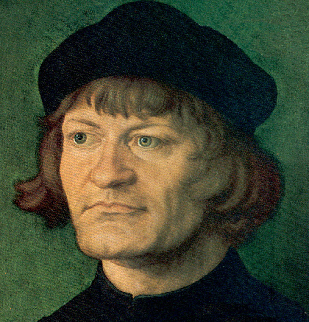
Ulrich Zwingli, a Swiss reformer, was very charismatic but just as temperamental. Before his split from Rome he had been a priest. As a priest he had been a suspected womanizer.
Luther and Zwingli (and later Calvin, to name a few) each formed their own communities based on their ideology—similar at their core and divergent in their expressions. These proposals, however, were the cause of much division. Whether it is through a true love and care for the truth or an apathy for the interpretations and witness of others, leaders who were at one time united formed their own separate congregations because of their conviction that God promised them, in faith, that they were correct. Today, the Missouri Lutherans, Episcopalians, and others came to rely on, ironically, promises and edicts outside of Scripture to maintain unity. These edicts were and are in no ways binding, but they are agreements by a people that proclaim how Scripture should be read and what is required of the faithful.

In their efforts to cast off the yoke of “institution” they were eventually confronted by the practicality and necessity of institutionalizing their faith so as to maintain unity. For example, a Missouri Synod Lutheran can only be called as such if he adheres to the agreement of this synod. A faith that is founded upon a personal faith and Scripture alone is now defined more clearly according to this code. The purpose of this is not wrong, I should say. But those who believe in a personal faith that saves (and that’s it), is it coherent?

These established Protestant groups advocated, and not unjustly, a personal faith. The problem then becomes what “orthodoxy” is for one who considers himself a ‘follower of Christ.’ One says there must be priests while others say that there is only one high priest. One says that Christ is present in the Lord’s Supper while another will say that it is only a symbol for our edification. Some meet for prayer regularly while others meet rarely.

Scripture itself became a battleground, perhaps as it always had been. But now Scripture was the only authority for the Christian and only those inspired could preach it (properly). Now, we say that it is true that those without faith will struggle with Scripture. They may not be able to pierce its depths at all for “the mystery of the kingdom of God has been granted to you [Jesus' disciples]. But to those outside everything comes in parables so that they may look and see but not perceive” (Mk 4:11-12a). Jesus also says that we should “beware false prophets … [since] by their fruits you will know them” (Mt 7:15) and yet the method by which we evaluate these fruits is difficult. Those from outside cannot effectively speak—some think not at all (which is false)—and even those within could lead people away.

A Christian who rejected the Catholic Church could no longer refer to any precedent in history or practice for support or clarification. This is true because the rejection of precedence and tradition gave way, eventually, to preference—both in determining one's spiritual fruits as well as orthodoxy. In reality it was the only option remaining. 

In the past, an ecclesial council (such as Nicea in 325 AD) was called because of some dispute in practice or some affront to dogma (and/or doctrine). A council met, typically, so as to resolve those topics which lacked clarity and not impose practices or beliefs that were arbitrarily new. These disputes arose either because of variant practices, clashing theologies, or a development of long-held doctrine in light of a new crisis. The most famous example was the divinity (Godhood) of Christ challenged by Arius. Councils of the past appealed to Scripture but also Tradition, for they looked to and “held fast to the traditions they were taught” (cf. 2 Thes 2:14). They used both of these to test the truth of new practices and beliefs would inevitably arise over the course of time, just as they had for the Apostles when the name of Christ Jesus gathered Gentile and Jew (see: Acts 15). From this council the Apostles dispersed once again to reaffirm the good practices and correct the errors of each community.
The Council of Trent (1545-1563) stands as perhaps one of the Church's greatest councils. It was a response to the Protestant Reformation but also a council by which the leaders of the whole Church met to enact reform, clarify doctrine, as well as extend a pastoral hand to those disenfranchised with the faith.

For the Christian reformers of the 15th and 16th centuries, however, the opinions of past ages were true if and only if they were in accord with the present age, in a manner of speaking. The councils did not speak authoritatively in that the declared this or that was proper or improper in regard to Scripture. Rather the purpose of ecclesial councils was so that “many may derive benefit from it.” Yet here in the Smalcald Articles, which were written in 1537 by Luther, he immediately follows by saying “[We ourselves do not] need such a council, for by God's grace our churches have now been so enlightened and supplied with the pure Word … that we do not ask for a council … [for we believe that] it would not improve our condition” (T.290). Those who are well do not need a doctor and those who are enlightened do not need council (or a council).

If you look at this situation as I do perhaps you see how much of a mess it could become. Even among Luther's friends there were stark divisions towards the end of his life. The Christian who had faith must follow the Holy Spirit more than the counsel of men and he must also prefer Scripture as higher than all other words. The organized reformers, in recognizing the weakness of human nature, also sought to establish communities, churches, and rules by which they would not be led astray. The goal of the reformers was to rely on God alone but many ended up with a local, often times a state institution—for “no one can [form a truly free council] so well as temporal authorities … [since] whenever it is profitable or necessary, they ought to exercise the office and work which they have received from God over everyone” (Letter to the German Nation, J.101). The intention was that the state [not the best term for this time-period] would facilitate a free council for religion. A problem arose, however, in that the Catholic Church at this time had in many senses true autonomy from the state. Of course there were clashes and corruption, but as a whole the Catholic Church under the guidance of the pope and bishops was concretely separate from the state in many respects. This relationship could only survive, in part, by an agreement from Church and State. The Protestant model, however, relied on the uniformity of State and church almost to the point where the authority wielded was the State's alone. Temporal authority was charged with protecting the freedom of the faith in that land. But in many cases the reformers became a member of the state themselves and concerned very much with temporal power (the same power they accused the Catholics of hoarding). In other cases, reformers and the faithful became indebted or even reliant on the state to support their faith. (It should be noted that Pope Boniface VIII, when he published “Unum Sanctam” in 1302, made the opposite error for Catholics by proclaiming the Church alone had all power, temporal and spiritual—but a proper examination of this is for another time).

However, there were those who recognized this weakness and absurdity—for if the pope and bishops were merely a human institution how did the state guarantee better governance? As such, they reduced the whole of faith into a personal venture. But as time progressed these ones entered into an even greater absurdity for they call those who have faith Christian but they appear to be far from a “people of God.” Many of them identify under the maxim “I believe in Jesus but not religion.” These people see faith as nothing more than a personal relationship with Christ. At the same time there is nothing in their lives that might explicitly direct them or warn them of deficiencies in their faith.
Spiritual and not Religious = not spiritual.

Certainly we can recognize deficiencies in our bodies and in our behavior, such as alcoholism or extreme arrogance. Their faith, however, is personal and no man could point a deficiency in it. For some, perhaps, they believe that their own faith is weak and that's how it's supposed to be. All the same they believe that just as a relationship grows so too does theirs with Christ develop.

As a thought on its own it isn't bad. In fact we are all called to grow closer to the God who loves us. Let us return, however, to the image of the Body of Christ. Those who claim to be non-denominational must make an account for themselves as to how they see this Body. For a body is not a patchwork of personal relationships of bones to the head, sinews to the head, blood to the head, and so forth. Rather every sinew, muscle, vein, and follicle is interconnected in some manner. Is the Church simply the number of those who believe or is it something greater? The blood is not the head yet does it not provide life to our limbs? The bones are not the head yet do they not support the whole? Likewise the hands are not the head but do they not labor and provide for the body?

Those who would isolate themselves from others insofar as they reject a visible and concrete community of believers would do well to heed Scripture: Peter and John “went back to their own people … [and] as they prayed, the place where they gathered shook[.] The community of believers was of one heart and mind” (Acts 4:23,31a,32a). More still, Scripture herself speaks not only of our weakness that is brought about by the struggle between flesh and spirit, but in the spirit itself. Paul says that “we pray beyond measure to see you in person and remedy the deficiencies of your faith” (1 Thes 3:10). Here we have men, acting in the Holy Spirit, gathering physically together and desiring a physical union so as to teach, preach, instruct, and safeguard against deficiencies in personal faiths. Stronger still, Paul relates to Timothy both the things he taught and what was given to him by the community of the faithful. He tells Timothy to “Command and teach these things … Attend to [your own faith] and to your teaching; persevere in both tasks, for by doing so you will save both yourself and those who listen to you” (1 Tim 4:11,16). 
Spiritual and Religious. They gathered in the upper room and received the Holy Spirit and immediately began preaching Jesus to the World.

I think I have spoken enough on this matter. Faith neither starts nor ends as a private or isolated venture. Rather faith in Christ Jesus joins us to His Body, the Church. That Church is likewise more than the number of believers but a community of believers that is visible. More still that visible community is one made up of laborers, teachers, parents, and priests where those “who are spiritual should correct [one who errs] in a gentle spirit” (Gal 6:1). All of us are in a community called to holiness, and that call to holiness is a perfection of charity for all people. Like a Body, however, some are charged with greater authority. “We ask you, brothers, to respect those who are laboring among you and who are over you in the Lord and who admonish you, and to show esteem for them with special love on account of their work” (1 Thes 5:12-13).

I rise, now, towards my Protestant brothers and sisters who have acknowledged much of what I said above by gathering together in prayer, accepting admonishment from others in regard to faith, and in a greater sense of Christian unity. You must wrestle with what you place upon Scripture as well as the manifestation/expression of your image of 'Church.'

If indeed you hold that “All Scripture is inspired by God and ise useful for teaching, for refutation, for correction, and for training in righteousness” (2 Tim 3:16) what was it that compelled Luther, a general among the milites contra catholicam, to say “St. James' epistle is really an epistle of straw, compared to these other [books of Scripture] for it has nothing of the nature of the gospel about it” (Preface to the New Testament, 1522, 1546; J.117)? Many deny, as a matter of belief, that we are justified by works and have ignored this holy author when he says “Was not Abraham our father justified by works when he offered his son upon the altar? You see that faith was active along with his works, and faith was completed by the works. … See how a person is justified by works and not by faith alone” (James 2:21-22,24). What determines Scripture and its interpretation if this phrase could be ignored in favor of St. Paul? By what standard do you judge these matters?
I only put this here because I love this image.

I pose another question to you, friends: who spoke truly in this regard?

Two men read that Christ said “this is my body” at His Last Supper.

One claimed that Christ's Body and Blood were truly present in that sacrament. He claimed that Christ's “is” was true and real. That at the repeating on these words Christ Himself is present “in, around, under, and through” the bread and wine. He believes this is true because Christ Himself said so.

The other countered that just as Jesus had called Himself the “Way” and the “Vine,” and that both were not literal, that His words here also constituted a symbol by which we are edified in faith.

The issue was not resolved among them—how do you resolve it?

There is much more that I would like to speak on, but I will refrain from some of it here in favor of explaining a different aspect in a future piece concerning the holy ones, the saints. In it I hope to address human weakness, how we participate with God (and examples in Scripture), and other aspects. In this piece I regretfully omitted the wisdom of Augustine who can offer us a great deal of wisdom. I hope to introduce him when I am more comfortable and versed in the vast body of his work on this issue. Until then I heartily recommend “On Christian Teaching” as a good starting point. Lutherans owe much to Augustine's theology of which Luther was well versed.

I conclude by urging a greater reflection on that powerful image the “Body of Christ” and all its implications. It is easy for us, if we have faith, to simply see ourselves as members. It is far more difficult for any of us to see ourselves as pained, maligned, festering, bleeding, crippled, maimed, or cancerous. The unity of any Body rests in both uniformity (for a body has many parts working towards the same purpose) as well as diversity (i.e., the aforementioned parts). Does that Body which you call 'Church' facilitate this? Is it accomplishing the call for one Church here on earth as it is in heaven? Is Scripture the only authority, and if so which is greater, faith or Scripture? Consequently, how is this question answered? There is much more to say but for now I will pause my argument and allow it to grow from here. My other pieces refer to Catholic perspectives on some of these matters, but as of now I hardly have the talent or the time to expound on these subjects as I would like.

Cited as [J]
Denis R, Janz. A Reformation Reader (2008).

Cited as [T]
Theodore G Tappert, editor. The Book of Concord (1580, trans.1959).

Tuesday, August 7, 2012

Contraception: How Free are We? (part I)

[Author's Note: Some of the topics and comments below may be offensive to some viewers as this covers the not-so-easy topic of contraception and sex. Though I avoid all graphic descriptions some of the topics may make readers uneasy. Nevertheless, some of the things I quote are what our friends and children are being taught and in many cases what we've grown up with as well. If we are ever going to understand them we need to confront them with faith, prayer, and courage.

Similarly, there are no restrictions on comments, so please feel free to comment below.]


Sometimes the illusion of choice is more attractive than real choices and real consequences. It’s not unlike a beautiful woman or handsome man who, on the outside, is attractive, desirable, and (for many) ideal to go after. Yet when we find out that this or that attractive person is self-absorbed, mean-spirited, or more concerned with remaining attractive than anything else we are often taken aback—we’re almost shocked. The same is true with many other things: when they fail to meet our expectations we may be disappointed. Stronger still, when things are contrary to how they present themselves we are angered, disgusted at, and are repelled from that same person or thing. The object that was once beautiful and attractive becomes an object of scorn and derision.

Indeed, what is this thing—this idea—that promotes freedom of choice, dresses attractively, and draws many in as a solution to your problems? This idea is contraception. Now for many who support contraception this seems crazy or stupid. Indeed,  many people seem to go out of their way to not find fault with contraception or the reasons behind using it, e.g., “people are having sex anyway, they should be safe!” and “it makes my sex life better [because I can have more of it and not worry about pregnancy].” Of course, perhaps everything I will say below is, in fact, stupid and crazy. But if, as contraception websites claim, you are open to different ideas—even ones that disagree with your own—perhaps you will consider something you hadn’t before.
Generic image of an angry woman who may think I'm a woman hater or want to turn women back into stay-at-home-aspire-for-nothings. I assure you I'm not. Please just bear with me!

I will illustrate my points more specifically below. For now, I want to share one quote (a bit long) that I believe illustrates a theme in the contraceptive position. It is framed very practically and seen as both discerning and tolerant. It only wants the best for young men and women, so it seems. It states that:

Young people can be very interested in the moral and cultural frameworks that bind sex and sexuality. They often welcome opportunities to talk about issues where people have strong views, like abortion, sex before marriage, lesbian and gay issues and contraception and birth control. It is important to remember that talking in a balanced way about differences in opinion does not promote one set of views over another, or mean that one agrees with a particular view. Part of exploring and understanding cultural, religious and moral views is finding out that you can agree to disagree.

…

Attempts to impose narrow moralistic views about sex and sexuality on young people through sex education have failed. Rather than trying to deter or frighten young people away from having sex, effective sex education includes work on attitudes and beliefs, coupled with skills development, that enables young people to choose whether or not to have a sexual relationship taking into account the potential risks of any sexual activity.

…

Young people get information about sex and sexuality from a wide range of sources including each other, through the media including advertising, television and magazines, as well as leaflets, books and websites (such as www.avert.org) which are intended to be sources of information about sex and sexuality. Some of this will be accurate and some inaccurate. Providing information through sex education is therefore about finding out what young people already know and adding to their existing knowledge and correcting any misinformation they may have. (avert.org) (Italics and underlines added for emphasis by me)

It seems strange for a website, or anyone, to advocate safe, restricted, and “responsible” sex while at the same time being perfectly fine both allowing and taking in all ideas. We should choose carefully which person we have sex with but we should be open and receptive to all ideas about sex? Maybe it’s time we started worrying less about protecting our genitals and invested more time protecting and developing our ideas about sex and relationships. It seems to me like the contraction rate of bad ideas in both men and women is very high when you allow them to consider and tolerate every idea (i.e., “agree to disagree”).

Much like (casual) sex, bad ideas are can be very satisfying and fulfilling while they last. Likewise they can also leave you with feelings of regret, unintended consequences, and being forced into situations you didn’t want to get into. Bad ideas are very contagious and easy to spread. It’s even more dangerous because it can come from family, friends, a loved one, teachers, media, or you can contract it all on your own.
 

But rather than dwell on this I’ll get a bit more specific. Contraception is not only a bad idea, it also sets itself up as a solution to a problem it contributes to. I realize that I’m swimming against the current of our culture saying this but there are some nuances here that should be discussed as well. It is the case that many use contraception of some form; many use it for pleasure (or “safe pleasure”) and others for medical purposes. My concern is not for those who use “contraception” for medicinal reasons (necessarily) such as irregular periods, but my concern is rather (1) with those who use contraception for its namesake—conta-(con)ception, or a means to prevent pregnancy. My other concern (2) is those who use contraception for the sake of more casual sex. I plan to treat both briefly below but I will also return to these points (especially the first) in subsequent pieces as well.


As such, I first ask a question: unwanted pregnancies and STDs can certainly be a problem. But why is it that the cause of these things is sometimes simply attributed to “unprotected sex”? It seems rather the case that the idea behind “sex” is the root of our problems here. We’ll see if it’s true.

Many websites and information outlets try to teach and help identify how one can avoid coercion and undue pressure. This is perfectly good and fine. Sex should be freeing, loving, and mutual. Yet, at the same time, many of these same outlets aggressively push for using condoms. Sex, they claim, should be pressureless but we should pressure men to wear condoms because it’s responsible (cf. Condom Exuses from NHS.uk).

This is simply and clearly another case of allowing one bad idea (casual sex) as inevitable and making up additional bad ideas to cover for it. The cascades of rhetoric cannot hide the logic “If you want to have a fulfilling relationship, good (luck!). If you want to have casual sex, as it’s your choice, good. Oh, and here’s how.”

Is casual sex supposed to be a good idea as long as you’re responsible? ‘If you drink excessively but don’t drive’ it is considered responsible in regards to driving (and health) but it tells us nothing about drinking. ‘Have sex but be safe’ is responsible in regards to contracting disease but it doesn’t relate anything about responsibility for sex, much less relationships (we’ll look at this a bit more in a moment).

In reality, though, it's just about driking related to driving not about drinking itself--perhaps because it's a value we are unable to teach.

For now, however, what contraception does as an idea is a few things: 1) it claims that the opposition, especially religious, wants to turn women into ‘baby factories.’ 2) it claims that the opposition wants to impose “narrow moralistic views” while claiming it is open to all ideas and choices—and they give them to you to choose (They also say "If you can't be bothered to use a condom then I can't be bothered to have sex with you.” Condom Excuses, Dr. Petra Boynton). 3) it claims that it’s the safe, responsible option. I’ll address (1) in greater detail in the next piece.

There are many implicit claims about contraception (and by those who advocate their use), but here’s one more: “you can always choose who you have sex with, but if you choose to have sex with one or many use protection.”

The strange thing is that they never explain why you would want to have multiple sex partners—maybe it’s just “fun.” Yes, oddly they do not want to influence why you have sex but they certainly want to jump in the moment you decide and tell you how.

But again, what becomes the problem or risk with regards to casual sex? Many places say that pregnancy and/or STDs are the risks involved, but are they really the problem? An unwanted pregnancy due to failed contraception is something that puts someone in a trap—and then contraceptive-types give you an out. You could have the child or you could have an abortion. This is especially attractive to teens and men and women in their 20s and 30s who can’t/don’t want to support a child. Rather, I would say it seems like they target them: they warn them of the risks but encourage them to have sex (as long as it’s your choice). In reality, there’s nothing quite like a prison that says “Freedom” on the door. In this case, pregnancy is made to be the prison and abortion the door out. Perhaps it’s the other way around.

Maybe the door that seems to be the way out is really the way in.

But perhaps it’s the case that I’ve been wrong about contraception. It is, after all, the other person’s choice to use the pill or a condom, so maybe we should all just let others choose what they will and let them ‘fight it out’ from there. Contraception is just one valid choice among many.

Okay, that’s fine. Let’s juxtapose two ideas and see if anything turns up:

+ You should marry the person you love after a long period of discernment. Through prayer, time, modesty, and plenty of communication you may then decide to spend the rest of your life with this person if it is your vocation. You’ll meet with a priest who helps discuss the many challenges in marriage and helps both to decide if they’re ready, both individually and together. When married you can have sex with someone whom you know will be faithful to you wholly and like no one else. You give of yourself wholly to the other person even insofar as you are open to new life. If a new life does come into your own you both see it as a blessing despite the challenges.

+You should carefully choose whom you have sex with. You should both be ready, but you should both be responsible. A child/pregnancy could be a great burden so use contraception until you’re absolutely ready to have a child. If you choose to have sex with many people remember to be safe and expect the same from others. Sex should be safe, fun, and above all freeing. It’s your body and you should be happy and healthy in it.


I believe I represented both sides well and ask you to review each and see what emerges. Are both devoid of problems? Of course not. I will address the first, Catholic, option later but for now I will turn my focus to the second.

When it comes to presenting these options to children or teenagers which seems more attractive? Staying with one person (for the rest of your lives) or having choices? Kids probably don’t think about sex or relationships in too much detail; they’re just told that if they want answers there are places they can go to. Or, of course, we could teach children to masturbate. An example from Planned Parenthood for elementary school students:
“Q. Is it okay to touch yourself?
A. Sure, it's okay. It feels good to touch ourselves, but we should only touch ourselves in private.” (Talking to kids about sexuality)
Isn’t this the type of openness we all should want? After all, when we teach children to use their sexuality to feel good in the way they want to, how could it negatively affect them, especially if they do it in private? When you teach children foundational ideas when they’re young they can carry it into their adult lives with ease, as long as they keep up with it. But, in the end, “negative feelings about masturbation can threaten our health and well-being. Only you can decide what is healthy and right for you” (http://www.plannedparenthood.org/health-topics/sex-101/masturbation-23901.htm).

Only you can decide. Not your parents, not your doctor, not any visible code of morality or ethics. Just you. Planned Parenthood is just here to help, folks.
Just this reassuring image I found. Nothing suspicious at all.

Teens, on the other hand, not only know a bit more about sex they also desire it more. Their passions run a bit higher as well. Because things always seem to be changing for them they seek permanence in something—and for many it’s sex. They see it everywhere, some indulge in pornography or masturbation, many occupy their thoughts with it, and are encouraged to have it if they think they’re ready. Well, it probably goes without saying that plenty of teens (and even adults) believe they’re ready.

I suppose somewhere along the way many teens forgot (or we forgot to tell them) that not only is life itself temporary but sexual attraction, acts, and desires are even more temporary. One side tells them to wait and to control themselves through abstinence. The other tells them to explore their bodies, exploit what is pleasurable to them (in their bodies) for their health, wait until they’re ready, and then “control” themselves by using a condom or other contraceptive methods. Perhaps as disease prevention this is a very good method. Why throw teens into the fire with abstinence? Throw them into the fire with fire-retardant gloves.

Sexual urges are powerful things and the more we occupy our minds with sex the more we want it, the more we tend think about it, and the more it influences our future actions. Will this set you free? Or is this putting us in a prison, especially when we teach our children to indulge and explore what is pleasurable to them?—especially with something as intimate and pervasive as our own bodies?

Is it better to understand and control our passions until we are ready to use them, or is it better to explore and indulge our passions so we can learn what benefits us most? But what if it’s too late and we become a slave to our passions? Who do we depend on when we can’t depend on ourselves or our inclinations-made-tyrants?

Regardless, contraception remains a physical tool that is used and promoted by people who see the world physically. Because condoms or pills do not care about family life, relationships, children, or healthy relationships they rather speak about only what they can: preventing disease and pregnancy (in perfect usage). But I must admit that both reasons are dressed very attractively.

Another reason for this is the already self-admitted rule for teaching about contraception: For them there are many different values about relationships, sex, morality, gender, etc. Since they cannot endorse any single one value for anything, they have to simply talk about the biological merits and function of contraception, stating them as objective facts (for biological use only) and giving them as a tool or instrument we place into our own personal value sets. So it’s not that contraception-ideology doesn’t care about your unique situation, it’s that it can’t care about your unique situation. All it can do is tell you that it does this or that biologically and wish you well on that whole happiness thing. But, biologically speaking, sex is a lot of fun and feels really good, so how could more sex (and significantly safer sex) not contribute to happiness? Why wouldn’t you pursue it if you’re ready?
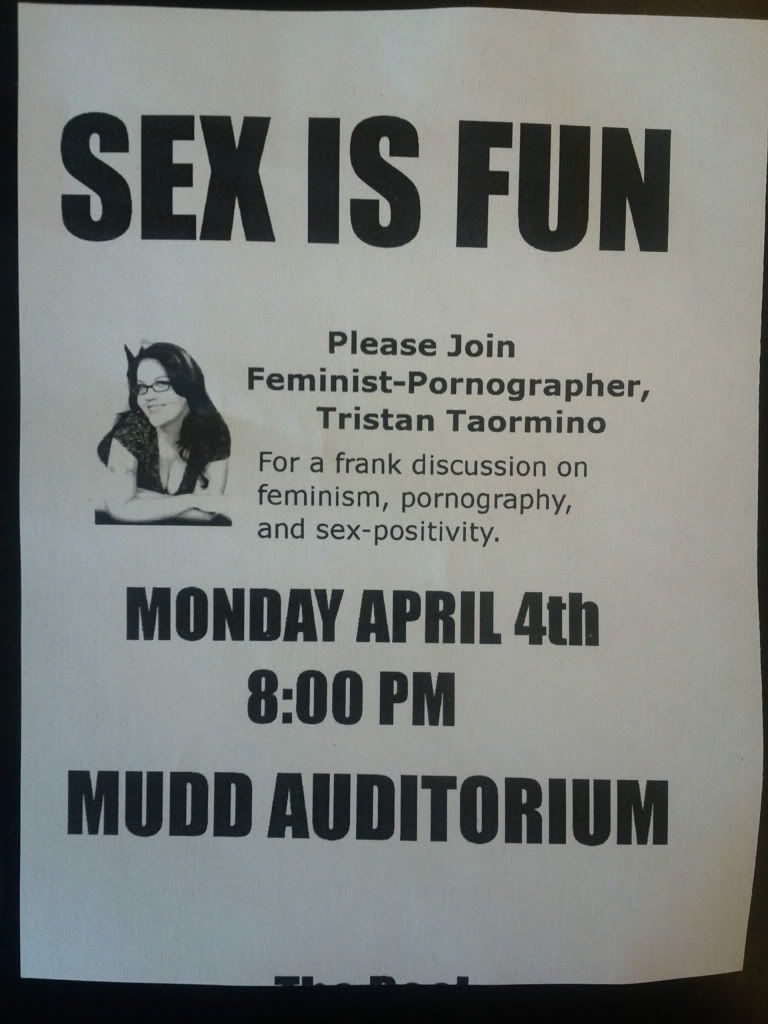
I guess if it's a frank discussion it can't be that bad. She certainly doesn't seem to promote immoderate behavior. Just tell'n it like it is.

But we need another angle. Perhaps we need to ask ourselves some different questions. Questions like ‘is he using a condom because he really loves me?’ ‘Is she taking the pill because she cares about my well-being?’ Perhaps, but does the pill guarantee that? Does it really make relationships better or more loving? Does it even help?

Sometimes it comes down to what people look for in sex. Those who only want sex for pleasure will end up using you or others. But many more look for sex to be completing, intimate, and loving. Many, in some cases, see sex itself as all three. Does contraception facilitate or complete any of these things? When a condom means “I love you” I’ll congratulate you on finding love. When the pill means “my life is complete” I’ll rejoice that you’ve moved past more difficult times—such as time before the pill.

But as far as I’ve seen it contraception remains that mirage that many seek and run towards. Has it really made your life better? Does your man say he’ll love you forever, but it’s a different story if you’re pregnant? And men, if you are responsible for a boy or girl can you call yourself a man by running away? For you see, the challenge of commitment does not lie in how good your sex is and will be but if in the face of the greatest challenges you persevere. A child is a challenge but a blessing because it is by that fire you can forge a true commitment and completely transform your life. What is more conducive to commitment in your life? Is it an unplanned pregnancy or an openness every time to have children if they come?

Do I say this to “scare you from having sex,” as avert.org might say? No. In reality I’m just beginning to “give you the facts.” Sex is a gift and a blessing, but its blessing does not lie tat in it is just pleasurable alone. It is a blessing precisely because it is unitive and procreative. True, holy, and proper sex is an openness to life, a love for life when it comes, and that expression of unified love of a husband and wife powerful enough to conceive life and sustain it happily and lovingly. More still, sex should be the culmination of many things—it should be the expression of love, commitment, trust, and friendship and not a tool by which we think we have all these things. The moment sex becomes a tool is the moment it can be misused. When we think something can be used against us is precisely the moment we feel we need protection from and against it.

Contraception is and has been dressing up as that thing you want and need for a while now. Is there nothing or no one else you can look up to? Next time, I will attempt to provide you with an alternative you can look up to. I will show you how contraception makes you a prisoner—especially women—and how, lades, much of the change we need begins with you. Men and women alike need to change, truly, how they look at relationships and sex. But the victims in many ways are women who leave men consequence-free by taking contraception that can (and does) affect their bodies, all in the name of their own personal pleasure—all the same still exploited by men looking to use women and women looking to use men.

Next time we will begin scratching the surface of the Catholic-Christian response and how through it you can be happier and more fulfilled, with or without sex.