[A homily given on the fourth of July. Some of the more "philosophical" elements, as opposed to the pastoral/moral ones, were added after the fact. This is not a verbatim homily, but rather an approximation]
Brothers and sisters,
On this feast day for our nation we are confronted with many troubling things. The Supreme Court's ruling on marriage, the issues of abortion, contraception, and health care (who provides it and how), are among the many things that affect our hearts and minds. Yet we must be careful, because it is all too easy to focus on ideologies and people.
Archbishop Cupich said it well, I think, calling all of us to respect our brothers and sisters and love them, whoever they are. This love and respect must be "real, not rhetorical." He also says that we must proclaim and preach the Gospel, "hold fast to an authentic understanding of marriage which has been
written in the human heart, consolidated in history, and confirmed by
the Word of God."
Gay marriage and abortion are contrary to Catholic faith and teaching, but proclaiming the Gospel with respect to life and marriage should not allow us to lose sight of the people to whom we preach.
For we know that there are many homosexuals who are abandoned, mistreated, bullied, and shunned for who they are or what they struggle with. Moreover, many homosexuals who are Christian, who seek to live chastely and grow in holiness are rejected both by Christians and this or that gay community.
Similarly, women who seek abortions are often times scared, coerced, abused, or abandoned.
People such as these need the Gospel as much as we do, and we are called to be Christ to them in a real fashion, not rhetorically.
On this Fourth of July, we celebrate the birth of our nation. It is our home, where our father and mothers of ages past came to seek shelter from persecution, to seek a better life, or to raise their families in peace. We know that just as our homes are not perfect, our home is not perfect. In Scripture today, we see that even the descendents of Abraham were far from perfect. Jacob tricked his father Issac into receiving his blessing, depriving his brother Esau from his birthright (cf., Gen 27:1-29). Esau hunted and exiled Jacob, but later, when Jacob (now Israel) returned, his brother reconciled himself to him. Through our many difficulties we too much seek peace and unity.
Thus, though we disagree with what our country calls justice and equality, we must love our country for our sake as well as theirs. Only love brings forth reconciliation, peace, and truth. Truth cannot be purchased in any other way. Nevertheless, we also recognize that there is no justice, faith, or love without God. We have already learned, again and again, that the justice of our nation is not Justice.
Our laws, Constitution, and courts interpret each other. The notion of equality is not dependent upon them but upon their interpretation, which comes and goes with the tide. We Christians must, all the same, strive for love, faith, and justice that is not temporary, but firmly rooted in God. We must do this is a real, and not rhetorical way.
This is done by concerning ourselves with those who are weakest among us, the sick, the elderly, the imprisoned, and the abandoned. The only equality and freedom that lasts is freedom in the love of Christ.
May God bless us all this day, and may we, His children, strive for unity and peace which can only result from a genuine and real love of Him who loved us first.
Showing posts with label faith. Show all posts
Showing posts with label faith. Show all posts
Saturday, July 4, 2015

Friday, November 14, 2014
Private Values and a Public Faith (Part I)
Do Religious Values have any Place
in the Public Square?
The general consensus among those of
faith and without seem to be “no.” Religion is a personal
preference and conviction. Personal convictions, while good for me
based on various experiences and reasons, are not grounds for me to
impose these convictions and others. I believe in God because (a) I
was brought up to believe, (b) it gives me comfort, and (c) it makes
me a better person. But someone else may have experienced religion in
negative circumstances. Likewise a non-believer may not share
feelings and values of religious pronouncements on reproduction,
family, and (deeper still) premises that inform public action and
(politically-speaking) policy.
A non-Christian, non-religious,
non-believer also builds convictions derived from his experiences and
holds onto them for various reasons. They too may have been brought
up to hold certain values that give them comfort and in turn,
according to those values, make them “better.” I use quotes for
“better” insofar as anyone, when he lives according to values,
wants to live up to those values he considers as good. No one, or
more accurately, very few of us ever embody fully the values
we hold dear—but the more we live our lives according to these
values we consider ourselves “better off,” perhaps because we can
decide on things more confidently or can discern and solve problems
more efficiently.
None of us can escape our upbringing
and no one is ever truly free to choose his own experiences. While we
are active agents in our lives we are also passive—things happen to
us whether we like it or not. We are just as informed by what we do
out of choice and by what we experience with no say in the matter. We
as humans, however, have a unique ability to reflect on our
experiences. More uniquely, since other animals also have memory and
learn from experience, human beings have the capacity to reflect on
their values and culture. This is not only consistent with ancient
wisdom but also modern science.
Man, by applying his reason to himself,
may reject what he has been given in a nearly-complete way. Moreover
some may even claim that we are unique among the animals insofar as
we know how we came to be and that we are also aware of how
we are wired (this imagery is by no means exhaustive). Because we
“know” we may also reject our wiring in some ways—the example
Dawkins uses is that we “rebel against our genes” when we
contracept, i.e., that we actively deny the 'desire' of our genes to
be replicated through propagation.
Thus both ancient sources, e.g.,
philosophy or theology, and modern sciences have agreed throughout
the ages that man is unique. He is not unique according to his flesh,
since his flesh and composition is not too different from other
mammals. Perhaps one might say that his brain as an organ is the most
impressive according to its construction and capacity. Man is unique
according to his reason—formulated in antiquity as possessing a
“rational soul”—because by his reason he can even master
himself.
While our knowledge,
scientifically-speaking, is still expanding on the subject of human
cognition we can see that we form connections, both socially (e.g.,
mother and child) and intellectually (i.e., neural connections), in a
way not dissimilar from other creatures. All but a few can recognize,
however, that we are capable of understanding how we work and,
by our own efforts, direct ourselves beyond mere instinct. While
evolution has brought the structure of our bodies and brains to a
certain point we also know that in the realm of human and
child-development the manner in which we teach each other affects the
way that our brain makes connections. In a manner of speaking we can
intentionally affect how our brains are organized. This organization,
in turn, affects how we act and interact. One may even argue that how
we act makes us more fit. Fitness in the narrow sense is simply
propagation. I believe that in a broader sense it involves more than
just reproduction—fitness also includes well-being, productivity,
and living in concord with fellow human beings. Thus how we regard
one another, work with one another, and help each other to be our
best is a benefit for both ourselves and for those around us.
These activities are achieved through
“values” which is shorthand for those conceptions which influence
dispositions, habits, and actions. Man, since he has been able to
communicate with his fellow man, has discussed values—what is good
and what is best—and likewise handed down those values. Values
themselves are tested by time and experience. They are tested by
hardships and challenges.
Reason and discussion, it may be said,
are what make up the furnace of values. Likewise values are applied
by different people and in different circumstances, thus their
weaknesses are exposed and strengths refined. How those values are
expressed are also important—do our actions actually mirror
our values? It is foolishness to think that we automatically embody
our values—living in accord with any value takes time, effort, and
humility. We must always recognize our weakness. On the other hand
when we do not attempt to live out certain values we do not actually
express them.
In a manner of speaking values are
physical and organic, both in their history and within an individual.
Consider the image of a tree: when a tree is planted it needs the
right circumstances and ingredients to grow. It may very well grow in
weak or sandy soil, grow in competition with other trees, grow to be
proud and strong, or simply die. Some trees by virtue of its light
source will grow in a different direction. Others may be twisted,
broken, and bent because of natural disaster. Nevertheless many of
them survive in various conditions and amid various trials. Thus,
while the tree may appear different in its external presentation each
tree is from the same heritage, source, or family (e.g., an oak or a
maple are still themselves despite their outward image).
Values themselves may die or they may
die in the individual. They may also take root and flourish. Every
generation is both the soil and the planter. We are the ones who,
having grown up, decide where to plant and how. Values are, in some
ways, of supreme importance for how we interact with one another as
well as important insofar as they actually affect our physical makeup
on the macro and even micro level.
With these in mind, we will proceed to
the next part and talk more directly about values and the people who
hold them.
Monday, May 26, 2014
Inheritance
Note: This was a homily I gave on the weekend of May 25th, 2014. If you would like to readings for the day that I used you can find them here. While not necessary they are a good aid for what follows.
“Be prepared to give an account of
the hope in in you … with gentleness and reverence” (1 Pet 3:15-16a).
I've recently been able to visit the school where I grew up and the
school from my internship. In going to these classrooms the kids
eventually open up to me with various questions. Things from as
simple as “Why do you wear all black?” and “Why do you wear a
collar?” to questions as deep and penetrating as “Why did Jesus
have to die for us?” and “Why did Jesus have to come when he
did?” It reminds me all the more, especially as I grow older: “Be
prepared to give an account of the hope in you.” Our hope is in
Jesus Christ, through whom all things were created. How do we come to
know the source and reason for our hope? By keeping his commandments,
Jesus says, and in keeping them close to our hearts we will also grow
in love of Him.
Still others may ask us, “Why do you
believe in Jesus? Why do you waste your time on Sunday? Why don't you
choose for yourself what's right and what's wrong?” While not
necessarily the case, these questions will come from those who
neither believe in Jesus not know Him. Nevertheless these are all
questions that we need to answer for ourselves.
Jesus, however, has not left us as
orphans. He has given us an Advocate, the Holy Spirit. This is the
same Spirit who spoke through the prophets and the holy Apostles, the
Spirit who is “the giver of life.” Jesus promises us the same
Spirit. How then does He send this Spirit? It is no mistake that in
our first reading from the Acts of the Apostles (cf. Acts 8:5-17)
those who came to believe in Christ received the Holy Spirit from
Peter and John. Phillip brought the word of Christ to Samaria—a
land to the north—and those who heard came to believe. Yet they
sent for Peter and John who were in Jerusalem, in the south, to visit
them. They prayed for the Holy Spirit to visit them and they
accomplished this task by the laying on of hands.
 |
| While not necessarily the route Peter and John took, it's important to recall the animosity between Samaria and Jerusalem dating back many centuries (at that time) and that the notion of both those of Jewish and Samaritan descent would be united was quite unusual. |
What does this teach us? It teaches us
that we receive the Spirit through the Church, and not just the
church we all are in today, though indeed we receive it here. We
receive the Spirit, rather, though the Church of our fathers, the
community of believers from ancient times to the present day in union
with one another. Phillip, though he was an Apostle himself, sought
Peter and John to confirm the faith of the Samarians so that the
believers in both the south and the north would be one through the
same prayer and the same Spirit.
But perhaps some will ask, “Doesn't
our faith alone make us one? Why do we need the Church?” I answer
to them that just as we could not exist without our mother our faith
could not exist without our mother, the Church. Just as we have
received life as a gift we must also give our lives as a gift. In the
same way we have received our faith as a gift, given to us through
those who believe. Parents might understand this analogy best, but
all of us are sons and daughters so I believe we can all relate to
this fact: we receive our traits from our parents and as we grow
older we resemble the features of our parents. Moreover we also find
that, deep down, our children inherit our mannerisms, our attitudes,
and our dispositions. If this is true then it is indeed also true
that our faith is the same. In living Jesus' commandments we
transform ourselves and we inherit His traits, His dispositions, and
imitate Him more closely. And when we as adults do this we give this
to our children so they might also resemble Christ a little bit more
each day. Our hope, then, is that by inheriting these things they may
also inherit His very image as sons and daughters of God.
Through all this we discover this
truth: faith is not a private possession but a gift that is handed
down from generation to generation. The Church aids us in handing
down this faith through her sacraments, her prayers, and by her
members (us included) who safeguard this precious gift and offer it
to everyone.
We will all return to our own lives,
our own problems, and our own homes in a very short while. But we are
one in Christ's Body, the Church. The Spirit will come to us when we
pray as one, united to the whole Body of Christ. Jesus, truly, will
not leave us as orphans. He has given us a home this very day.
Tuesday, March 11, 2014
My Desire for Marriage
(Note: I've made some major revisions to this piece, mostly attempting to add clarity to my message and fixing up some diction. ~M, 3/15/2014)
As I approach ordination to the Diaconate after 12 years in the seminary it's easy to think about the many “what ifs” in my life. Things such as career, money, jobs, a wife, children, and even a permanent home are things I've given up in pursuit of this call. A call, however, is both something desirable and undesirable. When it comes to vocations I call to mind that “when you were young, you fastened your own belt and walked where you would; but when you are old, you will stretch out your hands, and another will fasten your belt for you and carry you where you do not wish to go” (Jn 21:18). Any walk of life requires sacrifice and any vocation, in my view, goes against the grain of our desires.
As I approach ordination to the Diaconate after 12 years in the seminary it's easy to think about the many “what ifs” in my life. Things such as career, money, jobs, a wife, children, and even a permanent home are things I've given up in pursuit of this call. A call, however, is both something desirable and undesirable. When it comes to vocations I call to mind that “when you were young, you fastened your own belt and walked where you would; but when you are old, you will stretch out your hands, and another will fasten your belt for you and carry you where you do not wish to go” (Jn 21:18). Any walk of life requires sacrifice and any vocation, in my view, goes against the grain of our desires.
While the Apostle Matthew was called, “rose and followed him”
(Mt 9:9), this is not true of all followers. Calls demand a response,
not necessarily a wholehearted desire for the content of that call.
Peter himself said, “Depart from me, for I am a sinful man, O Lord”
(Lk 5:8). Isaiah lamented, “Woe is me! For I am lost; for I am a
man of unclean lip in the midst of a people of unclean lips” (Is
6:5a). Jeremiah complained, “Ah, Lord God! Behold, I do not know
how to speak, for I am only a youth!” (Jer 1:6). All types of
people are represented in Scripture. The overwhelming majority are
those who aren't too keen to do what God has asked of them—it's not
bad to see ourselves in them.
 |
| As Matthew's expression illustrates, "How could you choose me?" |

Having given up everything to follow Him I approach a new chapter
in my life: sacrificing personal desire for the sake of those sheep
whom Christ said to feed and shepherd. I will soon experience this
call and experience it with the people of God, and there are
many trials and many blessings herein.
As I prayed about these things in my heart I called to mind the
couples that I will marry. I called to mind that they too are called
and respond as all men do to God's call. I thought of my friends with
children and the unique opportunity that having children offers in
your life, but I also considered the many trials they will
experience. In a life that is, by necessity, “focused on the things
of this world” (cf. 1 Cor 7:33-34). What hope is there for a
married couple and, I thought, what could I say to them to take the
concrete experiences of their life and see God?
This, then, is my desire for marriage: that couples reflect on the
fact that their relationship truly reflects the Divine Life and to
keep this close to their heart throughout their own trials.
Your spouse, the one whom you love, was a co-creator and cooperator in your own love. You share life and you share hardships, even if each one bears it unevenly. Your love changes you and it is completed by being received and then returned. This too is the life of grace. This is a life of faith in as concrete a manner as one can experience it. This is the God of the Old Testament and New in as intimate, reasonable, and accessible way as one can approach it.
Any child becomes a sign of God's covenant with His people. Know
that your feelings for your child are merely a fraction of what God
feels for you. Yet despite your child's suffering that result from
his wickedness, from misfortune, or persecution your love for him
remains undaunted. If a mother or father's love can endure evil and
even death, how much more does God's love endure through our sins and
the sins of of the world!
Jesus promises that “his burden is easy” and his yoke light
(Mt 11:30). Life has shown us that it is not easy. “Much labor was
created for every man, and a heavy yoke is upon the sons of Adam”
(Sir 40:1). Christ said this, however, because not only is this life
of imitating God possible, it is peace for the soul. For “when a
woman is in labor, she has pain because her hour has come; but when
she is delivered of the child, she no longer remembers the anguish,
for joy that a child is born into the world” (Jn 16:21). This is
love God shows to those who return to Him, love and peace we all have
access to.
Life for both of us, ordained or married, is a unique call from the others. It is indeed a life of responsibility unlike any other. This is a gift given to us, even if it doesn't always seem good or desirable. All life is a gift, no matter the type, since we are all pilgrims on one path—may our feet not stray! We have all been called.
Life for both of us, ordained or married, is a unique call from the others. It is indeed a life of responsibility unlike any other. This is a gift given to us, even if it doesn't always seem good or desirable. All life is a gift, no matter the type, since we are all pilgrims on one path—may our feet not stray! We have all been called.

His response is simple: Be not afraid,
follow me.
Let it happen to me according to your
word.
Friday, February 21, 2014
A Moral about Seeing
 |
| The city of Bethlehem. |
As we walked through the streets of
Bethlehem we talked about getting a cup of coffee. We had just bought
some icons and were looking at the face of this city, both ancient
and modern. The street was a mixture of vendors, cars, taxis, and
travelers. We walked up a hill and as we walked a saw a small child,
no more than 8 or 9, pushing a shopping cart up this stone street. He
would get over a few stones only to be halted by gravity and his own
lack of strength.
We reached the top of the hill and I
stopped. They said, “What's up?” I responded, “Did you see that
kid?” They said, “No.” I handed my bag to a friend and walked
up to the kid. He didn't speak English but I pointed to his cart and
asked if he wanted help. He said yes, perhaps thinking I asked “Is
this yours?”
I pulled the cart of the hill—it was
empty and a light task for a grown man. I motioned to him to follow
me. I stopped at the top and I gave him a smile. He stared at me,
saying nothing, and I couldn't decipher it as a sign of thanks,
disappointment, or anger. It was a strange face. Two of the other
guys, my friends who were looking on, gave their hand for a high-five
(or fives of some kind) and the kid reciprocated—so he must have
been a little happy.
We went on our way to get a cup of
coffee. One said, “That was a particularly Christian thing to do.”
This was in the shadow of the birth place of our Lord. Another noted,
“I didn't even see him.”
The moral is not a tale of my virtue.
What I did was minor and most likely of little consequence. What is
important is how, even in holy places and in the company of friends,
how easy it is to simply not see others. Others who suffer from
hunger, injustice, or from simply going on unseen.
It is not merely sin, that is an active
form of rebellion that progresses evil in the world. A lack of seeing
and, when we see, inaction that stunts the growth of love. My friends
did not act because they did not see. I saw, so how could I not act
if my conscience has been formed by God—by “observing his
decrees” (Dt 4:40) and “walking in his ways” (Ps 128:1)?
Being attentive to the world advances
love when we respond as we are able. “You shall eat the fruit of
the labor of your hands” (128:2) so “practice justice, love
compassion, and be prepared to walk with the Lord your God” (Mic
6:8).
Sunday, September 15, 2013
Faith and not Religion? A Response
This was a response that someone, a non-Catholic Christian, wrote to me regarding my piece One Voice: Concrete Catholicism. I thought it would be worth sharing. I hope it is. The person who wrote to me is indicated by italics. My responses follow below.
A Response
That being said, I've noticed a trend that began years ago—I'm not sure exactly when it was; I personally became aware of it roughly 6-7 years ago. It's the whole "I have a relationship, not a religion" idea. Now, it's not so much the idea itself that I'm calling into question (that's another topic), but more so the motivation behind its appearance.
In effect, it's a trend that has its origins nearly 400-700 years ago. It can be linked to a trust in personal faith, a sort of "faith alone" and "Scripture alone" mentality. Religiously speaking these are primary suspects. Why? Whose faith is "faith alone" regarded as? The faith of the individual. If I only need faith, why do I need religion? Why do I need brothers and sisters in faith? Why do I really need a community, rules, disciplines, etc. if God forgives me anyway? Scripture alone likewise ties into personal interpretation. [Another person who commented on this piece], whom you've seen responding to you here, wrote a comment (that I need to get to) wherein one cannot err "if he has the Holy Spirit with him."
This is a fine sentiment, except it seems 20 people have the Holy Spirit with them with 25 different views. When one approaches Scripture as a rogue, a ronin, or an anti-religious he will almost always fail in interpreting Scripture. He may, and probably will, receive some personal, spiritual edification but Scripture is not a personal book, it's a book of the people of God--written for each while simultaneously written for all.
When we make faith a matter of "me" and the Bible "my Bible" we don't need religion, just ourselves.
Religion has come to have a negative connotation, especially in recent decades. At my university, on much of the television, in numerous academic writings, and in many other places, we learn about how dangerous religion can be. We're told how it started the bloodiest of wars and the darkest of ages.
Despite a rather elementary understanding of human history, where bloodier and more costly wars were waged in the name of the god called "the State" and "the King," the middle ages (so called) and the crusades were labeled as epochs and acts of cruelty in the name of God. In all ages there are cruelties justified by a number of things. Did religion motivate people to violence? Of course. But was all that violence by necessity unjust? Did religion only motivate violence while the indomitable human spirit and human goodwill motivate all works of charity and justice? I think we find these simple categories to be false.
Religion can be dangerous, perhaps, but individuals who are moral agents and who are ruled by either sin or vice are more dangerous. Religion is not harmful unless its precepts are harmful--the problem is that so many people today would rather just redefine what's harmful so that religion and harm to self/others/mankind are the same.
Religion, properly called, preaches discipline, measured thinking within boundaries, morality, and a balance between tolerance and conservation. If others laugh at that statement, I'm willing to bet they're less tolerant than any religion they make fun of.
This sentiment also comes from a hatred for humanity, which can also be seen in the sciences, though we hardly take notice of it. Science soon developed in such a way that our personal experience and perspectives ruined any chance at "objectivity." Science is conducted and perceived in such a manner that human beings more often "get in the way" of 'progress' than anything else. Those who abandon religion for a number of reasons see it as "man getting in the way of God" even though the origins of belief, faith, and the like are rooted in community, the same way that knowledge is linked, in part, to our communal experience of the world. Faith and science alike have communal aspects and individual ones.
A short time after all of this starts up, I see Christians distancing themselves from this by saying that what they have isn't a religion but a relationship with Jesus.
Some of them are afraid of being identified with what is labeled as "bigotry" or "antihumanism" preferring rather the safety of saying "I believe by myself, not any of that stuff." It's party timidness and partly cowardice, but it's likely inherited and cultured cowardice. Christians who distance themselves from a community of believers are not so much Christians as they are individuals who believe some things Christ taught. Christ formed a community, not a confederation of believers.
Perhaps "cowardice" is a bit uncharitable of me. It could also be faultless ignorance or simply a rejection of a communal faith. Any relationship with Jesus is always with His Church too, since the Church is His body. No relationship to the Church, no meaningful relationship with Jesus.
Saturday, April 13, 2013
Our Works, His Grace
[For your benefit I've included the Gospel since it was my sole focus for this reflection. Please leave a comment or your reaction below!]
When it was evening, the disciples of Jesus went down to the sea, embarked in a boat, and went across the sea to Capernaum. It had already grown dark, and Jesus had not yet come to them. The sea was stirred up because a strong wind was blowing. When they had rowed about three or four miles, they saw Jesus walking on the sea and coming near the boat, and they began to be afraid. But he said to them, “It is I. Do not be afraid.” They wanted to take him into the boat, but the boat immediately arrived at the shore to which they were heading. (Jn 6:16-21)
The Gospel writers were
fond of relating 'on/by the water' scenes to their readers. Many
significant events happen by the seashore: some of the Apostles are
called, Jesus teaches great crowds, and he encounters the Apostles
after the Resurrection.
In this instance—Jesus
walking on water—it would appear as if nothing significant happens,
at least nothing as instructive as Jesus' instruction and dialogue
with Peter.
Our indication comes from
what follows this scene, namely the 'bread of
life' discourse in the sixth
chapter of John. The account of Jesus appearing to the disciples
walking on water is the prelude to one of His most important
teachings.
 |
| Place your own spirit in this setting. |
The theme of light, again,
helps us understand how we should take these events to heart.
In the evening, the time
light recedes from the sky, the Apostles set out to sea. The boat
here is an instrument of man's labor and when rowing on the sea a man
is entirely dependent upon his efforts to keep himself safe and guide
his journey.
Darkness came and Jesus
was not yet with them. They anticipated Jesus would be with them, but
instead they were confronted with darkness. They could no longer rely
on their senses and their sense of direction was reduced or even
negated. These men, by their own efforts, sought God in the darkness
but could not find Him straightaway. They, however, were not
disheartened.
Then a storm stirred the
waters, which indicates that their efforts would not only meet
resistance but that at this moment they had no control over their own
situation. Nevertheless they remained steadfast and labored in the
storm. Life itself will have moments of darkness where we do not know
where we are going and storms that leave us at the mercy of all
around us.
After a time they saw
Jesus walking on water: Jesus navigates the darkness easily and He is
not at the mercy of what surrounds Him. Rather, He is in complete
control. He approached their boat and at that moment they
became afraid. They had encountered difficulties but never this
strange and marvelous sight. Jesus tells them, “Do not be afraid”
and they listened.
Rather than accept upon
impulse something marvelous and strange they waited for the Lord's
voice to assure them. After His reassurance, meaning they discerned
clearly that He was the Lord, they desired that He enter their
boat, that is to say their own efforts.
The moment they desired
this the boat they were in landed at their destination. Here
it does not say they “rowed to their destination” but rather they
“immediately arrived.” It was still dark and the storm persisted
but Jesus brought them safely to their destination.
 |
| Seek Him in all you do--it sounds easy, but it requires strength and perseverance. It also requires that we humble ourselves and submit to instruction and correction. |
My brothers and sisters,
our good works and labors will not bring us to our final destination,
only Jesus can. Like the disciples in this boat, however, they
persevered through darkness and storm anticipating Jesus. Jesus came
to them, not the other way around. When they desired that He might
with them their journey had ended.
There is no journey apart
from seeking Christ. Though we are stuck at times in storm and
darkness He approaches us in all serenity. Accept Him into your daily
labors. Then all of your works, if not successful, will be complete.
============================
A reflection I gave today (4/13/2013). The readings I reflected on may be found here, but I provided the Gospel, my sole focus, in the work.
I decided to go the 'allegorical' route this time around while mixing in some moral/spiritual instruction. While I don't feel myself particularly qualified or worthy to offer such lofty advice, this is rather me sitting with this reading and allowing it to rest with me for a while. Hopefully you find something to reflect on yourself.
I decided to go the 'allegorical' route this time around while mixing in some moral/spiritual instruction. While I don't feel myself particularly qualified or worthy to offer such lofty advice, this is rather me sitting with this reading and allowing it to rest with me for a while. Hopefully you find something to reflect on yourself.
Sunday, January 13, 2013
Then Who Made God?
When I was around three years old I sat
on my grandfather's lap. He would talk to me about many things, but
one subject that persists in my memory is when he would talk about
God. He would tell me how God created the universe and everything in
it. He began by asking me “Do you see the trees outside? Do you
know where they came from?” I would ask where they came from and he
would say any number of things that a three-year-old could understand
and then say “Do you know where all of that came from?” I would
then ask where it came from. Finally he said that “God made
everything.” I then asked, “But, grandpa, who made God?” He
would respond that no one made God and that God was never made or
created. I would persist, “But where did he come from?” He would
respond “He was always there before everything else.”
Certainly I was confused—I had just
gotten my head around contingency (for you adults here): that
something comes from something else. Now I was told that there was
something that always was. Despite my confusion and repeatedly asking
the questions “But where? How?” my grandfather reinforced the
answer. Whether I was tired of the answer or, more likely, I accepted
the answer, I moved on.
 |
| Unless you become like a little child you will not enter the Kingdom of Heaven. |
Some may take this moment to be the
favorable or regrettable turning point where God was firmly placed in
my mind. He was no longer just a name or some chimera, but something
so great he defied common logic and experience—sometimes children
understand this better than we adults.
Even if I did not believe in God, or if
I had forsaken the faith my ancestors strove to protect, the answer I
accepted puts me above the great number of adults who pose the
question “Then who made God?”(as if it were triumph of secular
reason). From the commonly educated to Oxford Professors of Physics,
adults pose this question, and others like it, with confidence and a
sort of smug satisfaction that could only make my three-year-old self
ask “Why don't you just listen?” If one is to engage in a debate
or discussion with anyone who has a reasonable (or for others,
“considerate”) belief in God, they owe it to them to accept their
definition at least as their [the “theist's”] starting
point.
Many find this answer “God is
uncaused” as a cop-out or a microcosm of faith—or rather the
idiocy, apathy, irrationality, or indoctrination of that faith. These
wise spectators are quick to taut physics and various explanations of
the universe as the superior way. They treat those who believe as
dreamers; they consider themselves pioneers and careful
investigators. One can discover this disposition in many of them in
some form, for once you press the issue that someone truly believes
in God you may get a response such as “They can believe in what
they want, but I'll stick to science and reason.”
 |
| They eat this stuff up. Then again, Mr. Russell believed that all "ideologies" were like a religion which served to make one dependent and fearful. Neither reason nor science have ever been used that way, reports claim. |
Yet despite anthropic principles,
multiverse theories, etc. which claim to answer the questions of “why
are we here” and “why is the universe/earth/etc. so supportive of
complex life,” these responses simply produce something else that
demands explanation. Now that we've conceived of a multiverse where
various constants (for each universe) are different we presently have
a multiverse that is unexplained—on what grounds do the constants
rise that allow for a multiverse that produces a universe like ours?
However fascinating the discoveries are and however deeply we probe
the mechanisms of the universe our answer has only answered “how”
and not “why” in the fullest sense.
With science silent on the answer that
some adherents claim it satisfies, many of these intellectuals give
their intellectualism over to a sort of religious tagline
(derogatory in their sense): “We'll figure it out eventually.”
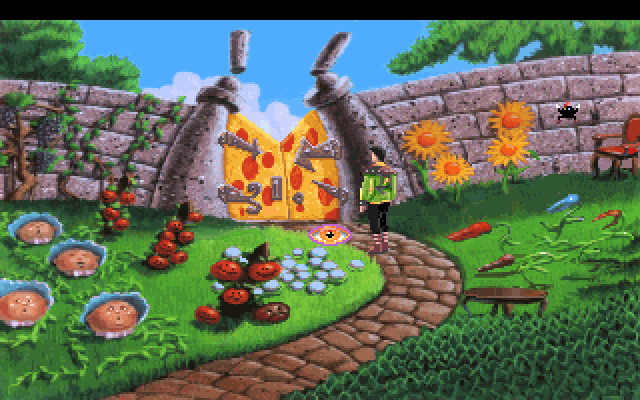 |
| I almost figured out this game. Didn't mean I understood it. |
In ancient times those in the cult of
Dionysus might become drunk on wine to achieve/feel greater unity
with the god. Today, many in the cult of Science become drunk on
progress in hopes that they will understand everything, perhaps some
wish to control it too. They give it praise and protect it zealously
should anyone slander its good and holy name.
 |
| The face of one who has made the breakthrough discovery that religion is stupid. |
Many of these sober men of science
become drunk on the prospect of what we can and may understand. No
doubt that there is pleasure in understanding and there is something
noble about the human spirit trying to understand the world he lives
in. But then these men forget themselves and more often forget what
others had said about God in all sobriety. Men of science treat the
answer “God” as a “god of the gaps” with chilling efficiency
and simply shake their heads at the notion, “Those who do not
wish to understand respond with 'God', those who know better answer
something else.” They rarely pause—they're in such a
frenzy—to consider that the one who answers 'God' believes that He
is the foundation for all other inquiry and not merely the answer for
what we can not understand. The scientists of the 12th-17th
centuries sat perfectly content with a crucifix on the wall and an
experiment on their tables. Such convictions continue even today.
 |
| Big Bang theory, anyone? (Georges Lemaitre) |
Many of those who put forth a
scientific or secular idea of the whole, however, are often convinced
in the notion that they are supported by evidence and facts—in some
ways they hold that they rely on facts and evidence alone. While it
is true that the make use of facts and data, some of them must
be aware that facts, proofs, and likelihoods as they stand offer no
reason for us to reflect on them, i.e., how they affect us as users
of those facts. Many forget that “facts,” however one wishes to
define them, has two aspects: 1) what they convey and state and 2)
how they are used. Those who rely on facts alone have no ground in
those same facts on how to make use of them. At the least, those who
believe in God have ground to consider what he does with the
discoveries of nature in our world.
Certainly those who do not believe have
grounds upon which they decide how to use what they find, it's
just not upon the fact that they discovered. It is usually some other
“fact” or ideology that organizes what they find. Eventually we
find that it isn't grounded in facts, as such, but rather some
disposition that they hold as a matter-of-fact. At this point we may
dispute who has better grounds to argue this or that, but it won't be
found purely in science or empirical observation.
God is not the answer to how or why for
me in a mundane sense, he is the reason and authority upon whom we
may ask and answer how and why. One has only to read the end of Job
and see the wisdom of the Jews: “Where were you when I founded the
earth? … Who determined its size; do you know? … Have you ever in
your lifetime commanded the morning and shown the dawn its place for
taking hold of the ends of the earth” (Job 38:4, 5, 12). We are not
in charge of the universe, we dwell in it—fragile, weak, dependent.
Anyone who ridicules belief in God by bringing up scientific or
naturalist explanations should reflect on the book of Job and what it
says about a belief in God.
Those who believe that we stop with God
have stopped themselves from thinking, or they have rather stopped
themselves from listening. Creation comes from the creator. We cannot
understand the creator fully, but Scripture relates to us what we may
extract from creation about Him: creation was made out of love,
creation was made as good, and creation was made to be both lived in
and known.
God founded the earth so that we may
live in it and appreciate it. We appreciate the earth through
nourishment, beauty, and understanding. Though it is not the purpose
of this piece to discuss evil, we may even learn about the creator in
our reflection of evil, imperfection, and tragedy. We must confront
ourselves about tragedy and loss, asking why it exists and asking
ourselves if it is really unnecessary. Regardless of anyone's answer
it is grounds for reflection “is suffering natural or unnatural?”
The crucifix stands as an answer for you to interpret, but also
stands as an answer that goes beyond a simple yes or no.
 |
| "He is before all things, and in him all things hold together ... In him all fullness was pleased to dwell, and through him to reconcile all things for him, making peace by the blood of his cross, whether those on earth or those in heaven" (Colossians 1:17, 19-20) |
When arguing about God it helps to
listen rather than react. Here we can learn virtue from children who
trust even when they do not understand. They are trusting but they
are not forced to remain ignorant. Those who teach children not to
believe also rely on them trusting you and what you believe is true.
The trust of a child should never be taken for granted. But when we
become adults we are confronted with adult understandings. As adults
we should listen as well as a child (odd as it sounds) and learn to
accept what the other is saying, rather than reduce one's belief in
God to their own disbelief in God—that's being childish,
ironically a common vice among adults.
Is belief in God a “god of the gaps”
or a surrender of reason? For countless generations and myself it
isn't. For me it is the beginning of wonder: someone who is outside
the commonly observable, the foundation of all being, and ultimate
simplicity. Must I account for where He came from? At that point
we're no longer speaking about the same God.
Monday, December 3, 2012
The Mediation of the Saints 3: Walking Together
III. Walking Together, the Chosen
Few
Last time we examined briefly how God
uses and works with our desires. He works with our friends and
enemies alike to effect His great wisdom. Now this can be hard to
understand and it can make it seem like we play no part. Some feel
that this makes God controlling or domineering while others feel they
have no control or say. Below I will look at how the prophets worked
with God, voluntarily, to bring about His will. That through
their own acceptance of His will (though it was God's initiative and
grace, always) they shared in it.
God sent his prophets to the people of
Israel. God preferred them over others to spread His message by
asking “Whom shall I send?” (Is 6:8). To Jeremiah He said “I
place my words in your mouth” (Jer 1:9). To Ezekiel he said “Son
of man, I am sending you … eat this scroll … and speak my words
to them” (Ez 2:3, 3:1,4). It did not matter what rank or station.
God formed a special relationship with a priest, one already a
prophet, and a herdsman. “The Lord took me from following the
flock, and said to me, 'Go and prophecy to my people Israel'” (Amos
7:15).
It should be noted that every prophet
counted himself unworthy for the task God put before him. God,
however, strengthened them by His Spirit. The inspiration he gave
them was not a matter of replacing them with His own Body. It was not
replacement but literally inspiration, a “breathing into.” The
prophets did not lose their soul, mind, speech, or person. They were
men who were deeply entrenched in the world they lived in and all of
its evils. They were not transported to an ethereal realm but God met
them where they were.
More powerfully still it is written:
“Do two walk together unless they have agreed?
… Indeed, the Lord God does nothing without revealing his
plan to his servants the prophets” (Amos 3:3, 7). It pleased God to
not merely use the prophets as a tool, nor does he use those faithful
to him as a tool. Rather God asks us to walk with Him. He asks that
we seek his voice, hear it, and respond. Each of the prophets
believed, heard His voice, and were deeply moved by the presence of
God. Then God asked them if they would go to his people and speak to
them. God speaks through his prophets, but the prophets do not merely
speak for God. They speak through God, rather God and the
prophet speak together. The prophets stand in His presence (e.g.,
“Thus the Lord answered me [personally]: if you repent, that I
restore you, in my presence you shall stand … you shall be my
mouthpiece. Then it shall be they [Israel] that turns to you” (Jer
16:19)).
A prophet listens to the plight of God
who looks upon the children that he loves. He sees them turning their
backs to Him and instead preferring to sacrifice children to wood and
stone. The prophet feels what God feels and cannot help but speak
out. The prophet is so attuned to God's will that he acts clearly and
directly. But not all men, even the holiest among them, experienced
this. Only a select few were called. Some considered weak, faithless,
and sinful. Some struggled and failed even after they were called.
But God does not necessarily call the strong, the proud, or the sure.
God called the Hebrews saying “It was not because you are the
largest of all nations that the Lord set his heart on you and chose
you, for you are really the smallest of all nations” (Deut 7:7).
The same was true with the Apostles and prophets.
All of these men and others—holy men
and women alike—were chosen by God to proclaim his word. They were
men “of unclean lips in a people of unclean lips” (Is 6:5) and
yet God selected them to deliver his message of repentance and
reconciliation. He used our humble humanity and at times the
wickedness of humanity to do His will. He effected his will through
the agency of man. Some are willing while others are unknowing. God's
hand directs them both. His kindness rests on those who turn to him.
Next time we will turn to the
Resurrection of Jesus and his instruction to his Apostles. We see
that the course of history changed at the coming of the Word but we
see also that Christ continued the course God set from the beginning.
That is to say that men and women from every generation would guide
people to God in extraordinary ways. This was true in life and in
eternal life, now afforded by the blood of Christ. Because Christ
rose death now carried no sway over the souls of the faithful
departed. The saints ran the race and so celebrated their victory
over death. We will treat the Apostles and their successors and how
they too are more than just a model but fully living and forever
servants of God leading us to Him.
Saturday, November 17, 2012
The Mediation of the Saints (2): God Works through Us
Note: You can see part 1 here (Mediation of the Saints Part 1)
Part 3 posted now as well! (Part 3: Walking Together)
Part 3 posted now as well! (Part 3: Walking Together)
This was actually twice as long and I split this up into two parts. The
good news is that the next part is done. The bad news is that this may
be disjointed. I'm going to come back to this tomorrow and see if I need
to edit anything (such as make additions).
Please leave your comments and questions below. It's not finished, so I realize that some of you may not want to render judgment just yet, but a heads-up to potential problems makes for a better process. Thanks again!
Please leave your comments and questions below. It's not finished, so I realize that some of you may not want to render judgment just yet, but a heads-up to potential problems makes for a better process. Thanks again!
II. God Works through His People
Last time we said that the saints, in
accord with the letter of James, were exemplary “doers of the word”
(James 1:22). They not only stand before us as a model but a living
voice in every age calling each of us to conversion. In the previous
section we saw that the Apostles, filled with the Spirit, attracted a
great number to them. Some take delight in having others flock to
them and hang on their every word. A saint, however, does as John the
Baptist did: he pointed to Christ.
A saint, in his perfect humility, does
all his work for the sake of Jesus Christ and His mission which is
the salvation of the whole world. I also claimed last time that
seeking their intercession was not an act of disobedience to Christ
but an act of personal humility for Christ. We, weak as we
often are, ask for the prayers of men and women who know how to ask
more perfectly. Indeed, James tells us that “you ask but do not
receive, because you ask wrongly, to spend it on your
passions” (James 4:3).
Below
we shall examine this truth: God
uses us and the whole world in order to call us to Himself.
Some have argued that asking for the
aid of the saints is to put a sort of “middle man” in between God
and the person. This argument, which takes many forms, seems to me to
be ignorant of Scripture as well as the process of salvation.
God employs harvesters and fishers of
men to do his work. He gives those who are faithful in small matters
even greater responsibility (cf. Mt 25:14-30).
But God's will and action are not
limited to his own word or his hands. It pleased God to use
intermediaries to effect his designs such as the prophets, the
Apostles, the angels, and his saints. God also used the wicked and
the deformed to effect his will. He did not use them as a puppeteer
but rather allowed their wickedness to bring about an inevitable
good. God used the Assyrians and Babylonians to convert Israel back
to Him:
Who was it that gave Jacob to be plundered, Israel to the despoilers [the Assyrians]? Was it not the Lord, against whom we have sinned? In his ways they refused to walk, his law they disobeyed. So he poured out wrath upon them, his anger, and the fury of battle; It blazed round about them, yet they did not realize, it burned them, but they took it not to heart. (Is 42:24-25, italics added for emphasis).
Their houses will fall to strangers [the Babylonians], their fields and their wives as well; For I will stretch forth my hand against those who dwell in this land, says the Lord” (Jer 6:12) (cf., Jer 27:2-6).
 |
| The prophet Jeremiah. Hated among his peers and countrymen. Laughed at, scorned, and threatened his whole life he proclaimed God's word. Other prophets and believers tried to silence him and offer a different message. He is a reminder to us that those whom we dislike, hate, or consider as 'less faithful' (or whatever suits us) may in fact be a clearer display of God's message than we care to say. The man who speaks out against evil despite the consequences is a man of God. Jeremiah was a true man of God, despite his pitiable appearance and difficult life. |
We see that God uses and allows our
desires to aid us or harm us. The prophet Hosea proclaims that God
“will hedge in her way with thorns and erect a wall against her, so
that she cannot find her paths. If she runs after her lovers, she
shall not overtake them; if she looks for them she shall not find
them. Then she shall say, "I will go back to my first husband,
for it was better with me then than now." So I will allure her;
I will lead her into the desert and speak to her heart” (Hos 2:8-9,
16).
Look closely at this passage and
reflect deeply on these words. The thorns He erects are for paths
that lead to false gods and immorality. These paths are none other
than our malformed choices and desires. The destination we all seek,
however, is happiness. She runs “after her lovers” which is
happiness gained through immorality and false worship. She “searches
but shall not find” means that those who look for happiness outside
of God (i.e., in these errant ways) will not find it. This is not to
say that we do not have things that make us happy. But we invariably
fool ourselves when we think finite and temporary things will give us
lasting pleasure. Pleasure gives way to pain. Moreover attachment to
anything, good or bad, will be counted as a loss to us. It will
return to dust regardless of our actions. True happiness is found in
the true God. The path that leads to Him will have what we need to
get to Him—it does not exclude loved ones, pleasure, or happiness
but it is ordered to God and God alone. When God leads her “into
the desert” this means that our hearts, when they recognize that
nothing else will last except God we will realize He is the sum of
all our desires and we will seek Him in all we do and do His will. So
many want to have “God and...” and end up with nothing.
Wisdom dictates that when we have “God alone...”
we gain everything, even what we thought was lost. When we believe we
are building paths to God through our desires we are often
constructing cages and walls that keep us from Him. The prophets are
all of one voice saying “What must we lose to gain?”
 |
| The prophet Hosea was told to take a wife for himself. She was a known prostitute who committed many infidelities. God told Hosea that this was how Israel had treated Him. All the same, God commanded that he love her and take her back because the love of God and deeper and more powerful than any infidelity. God could not show us this striking image, however, unless Hosea loved and trusted God enough to do as he was asked. |
This passage from Hosea is only one
example that explains how God works with us and through us whether we
are conscious of it or not. Some, however, believe that this
interaction of God in our lives (i.e., “grace”) is irresistible
and unavoidable. The believe that God will use anyone and we just
happen to be lucky if we're on the right side of the battle. I
propose to show how that isn't true.
Next time we will look at how God
interacted with the prophets and how the prophets worked with
God. We shall see how the prophets were men of all walks of life who
were given a special mission and a unique grace to feel what
God feels and speak with Him openly.
Wednesday, October 31, 2012
In Praise of Weakness
Author's Note:
I realized after writing this that it may be cryptic for some. For
those struggling with one of the themes, please consider this: to neglect,
hate, or ridicule someone or something for weakness or simplicity is an error on your part. These are all strong words, to be sure, but I've
heard far too many arguments along the lines of "he's a sinner how could
you love him?" Even of the blessed St. Peter "he was a fool and serves
as an example for us." Others may say "I hate myself because I keep messing up [in sin, etc.]." Others still have said that "the Church is just
human authority filled with human weakness, I follow God alone."
Part of this is about patience and perseverance coupled with understanding and a willingness to change.
I ask, humbly, you reflect on those sentiments with this. This is hardly adequate for full but in the interest of your own attention and retention I cut this down significantly.
I ask, humbly, you reflect on those sentiments with this. This is hardly adequate for full but in the interest of your own attention and retention I cut this down significantly.
 | |
| What are you talking about?? (Comment below if you feel that way) |
I. Introduction
Those who do not share in the
weaknesses of the body have no share in the body itself. For what
body in this life is free from corruption and limitedness? Even the
great Body of Christ is subject to weakness precisely because he
subjected Himself to our weakness since “he took the form of a
slave” (Phil 2:7) and “was of human estate.” Even after the
Resurrection His resplendent and transformed body still bore the
wounds of his glorious crucifixion (cf. Jn 20:20). It should be noted
even more that Jesus identifies Himself with the weak and broken for
“what you have done for the least of these you have done for me”
(Mt:25:40). Likewise Jesus identified Himself with those who were
persecuted, ridiculed, and killed in His name. This is why He said
“Saul, Saul, why are you persecuting me?” (cf. Acts 9:4,
5).
Paul said that “Christ is the head of
the body the church.” (Col 1:18). We have seen, albeit briefly,
that Christ shared in our humanity fully and willfully. We saw,
through His resurrection, that He transformed our weaknesses while
still keeping the physical marks of that weakness. They were not cast
aside or hidden but present in plain sight. Jesus told Thomas “put
your finger in my hands and in my side” (cf. Jn 20:27ff). The
history of Christianity is a constant call to “place our fingers on
the wounds of His body.” Thomas doubted the Resurrection, perhaps,
because after witnessing the horror and shame of the cross (and
living in his own shame) he asked ‘how might anything good come
from this?’ Christ showed him precisely the good that came from it,
namely His own person.
 |
| Caravaggio's famous painting not only represents the doubt of Thomas but that same doubt that we feel about our Church and her divine characteristics. Are we willing to address our doubts? Are we still willing to trust in the Church? |
II. Sharing in Weakness
This is what I call each of you to do
today: If you are to truly share in the Body of Christ do you share
in its weaknesses? The weaknesses I refer to are failures in charity,
excessive opulence, elements of the Inquisition and Crusades, sex
abuses, and every weakness that we see in our own person. Blaming the
past, however horrible—and indeed some things are horrible—is to
separate fallen and weak humanity from the life of faith. Faith is
not perfection but, in a manner of speaking, seeking perfection.
Weakness is either self-generated or encountered, shall we shy away
from either?
 |
| I rarely see this type of image, of Jesus as a fragile child being cared for. Jesus Christ, our savior and Lord, became as a little child out of love for us. |
Christ met our broken humanity. He
calls us through faith and baptism to share in His mission of
transforming all of humanity. If we deny the humanity of the
Body we separate ourselves from that Body. The Church is the Body of
Christ beset by human weakness but all the same transformed by Christ
and upheld by the Spirit.
When we recognize weaknesses and
failures there is a twofold response: the first is active insofar as
we seek to rid ourselves of that weakness (whatever it may be). The
second, equally important, is to realize that we are not separate
from our weaknesses. The weaknesses that we carry inform our actions
for the future, even in healing. If we do not address our weakness
actively we won’t change effectively. If we try to disassociate
ourselves from our weaknesses we become insensitive to the weaknesses
of others and we forget who we are.
III. Examples of Weakness
Transformed
St. Peter is our first
example and our guide. He was filled with faith and he was blessed
personally by Christ (cf. Mt 16:16-20). But he had his faults too. He
was rash and at times overzealous. This zeal, coupled with his
predispositions about what the Messiah was supposed to be, led him to
deny Christ three times while He was being humiliated. He abandoned
his friend and the one whom he loved. “He wept bitterly” (cf. Mt
27:75). After the resurrection Christ called out to him and Peter
responded. Christ confronted Peter’s sin, fear, and weakness not by
shaming him but by asking him, “Peter, do you love me?” Jesus
asked him this three times for every time Peter denied him. Peter
recanted three times saying “You know that I love you” (Jn
21:17). Peter is a man whose strengths and weaknesses are on full
display. Just as God had chosen Moses, Abraham, and David before He
chose this time to call a simple fisherman to greatness. These
patriarchs and this king themselves sinned, doubted, and failed.
Through it all they carried out what God had asked of them. Only
Peter, however, was given “the keys of the kingdom of heaven” (Mt
16:19).
 |
| Despite his brashness and weakness Christ still pulled him from the water. Despite his denial Jesus came to him and Peter grew in understanding, wisdom, and love because of Christ's example. |
Our chief example, and one that
has given me pause for years, is the Eucharist. I believe in Christ
and I believe in Christ risen. I also believe that at the Last Supper
he gave us a model to follow: he took the bread, broke it and said,
'take this all of you and eat this. This is my body which has been
given up for you.' He also said of the wine 'this is my blood.' This
I believe with my whole heart. This sentiment is in accord with all
that has been said above. Truly, to our senses it appears as mere
bread and mere wine. Then I recall with wonder that “he emptied
himself … coming in human likeness and found in human appearance”
(Phil 2:7). Likewise that “he had to become like his brothers in
every way” (Heb 2:17).
Indeed, the Eucharist is regarded as
the Son of Man, present sacramentally in ordinary bread and wine
which has been transformed by the prayer that Christ entrusted to His
Apostles and their successors. The Eucharist is both a glorification
of the Cross and a sacrifice that dips into the eternal moment of
Christ's one sacrifice and shares fully in it. It is something that
stands outside of time. Something so grand, God Himself! in ordinary,
daily food. Christians have praised the extraordinary in the ordinary
as well as paradox from the beginning insofar as “Jews look for
signs and Greeks look for wisdom but we proclaim Christ crucified”
(1 Cor 1:22-23).
 |
| This is what we exalt. Do you? |
Furthermore Jesus Christ Himself is
“the living bread that came down from heaven that one may eat it
and not die. I AM the living bread that came down from heaven;
whoever eats this bread will live forever; and the bread that I will
give is my flesh for the life of the world” (Jn 6:50-51). I could
occupy an encyclopedia set with the richness of these verses. The
word “eat” (phagein) has no spiritual connotation. It
literally means to chew and physically eat. By eating this living
bread we shall not die. Then Christ follows by saying “ego eimi”
which means “I am.” But this is no mere “I am” but rather a
direct reference to God speaking about Himself in the Old Testament.
It is a proclamation of authority and power—this is something we
should listen to. He said “I AM the living bread come down from
heaven.” He then says “Whoever eats/chews this bread will
live forever.” He further says
“the bread which I give is my flesh,” Literally my earthly flesh.
The simple bread which He gives is
his flesh. For the time being let this entirely inadequate account
suffice. No “ego eimi”
statement in Scripture is a metaphor or an opinion. It is Jesus
speaking in the authority of the Father on an intrinsic reality.
IV. Share in
Weakness, Share in Glory
What is my purpose
in saying all of this? Proceeding from the Eucharist and the example
of the Apostles (chief among them Peter) Christ gave us two simple
and lowly things and transformed them. He transformed bread and wine
into His flesh and blood. He transformed simple fishermen into
philosophers, teachers, and bearers of His message. Though they were
of human estate they were transformed and “filled with the Holy
Spirit” (Acts 2:4).
The Church is the
Body of Christ—it is subject to weakness. The Eucharist is bread
and wine made the Body and Blood of Christ—it is common and
ordinary yet mysterious and sublime. The Apostles were chosen by
Christ Himself to bear unique witness to His teaching and
mission—they were “also human beings” (Acts 10:26). Jesus
Christ identifies with the poor, persecuted, and the oppressed in an
intimate way—they are lowly and 'worthless' in the eyes of the
world. Finally, Jesus Christ Himself, was born of a virgin in
poverty. He was a helpless child and a man subjected to ridicule and
cruel torture. A man who took on our every weakness.
By eating His flesh
and blood, and through baptism, we join ourselves more fully to Him
so that we may share in His suffering. In our own flesh we “fill up
what is lacking in the afflictions of Christ on behalf of His body,
which is the Church” (Col 1:24). When the Church, or even her
members, do evil the whole suffers. By our personal and communal
work, love, and suffering we correct the wounds of that Body and also
“share in our master's joy” (cf. Mt 25:14-23).
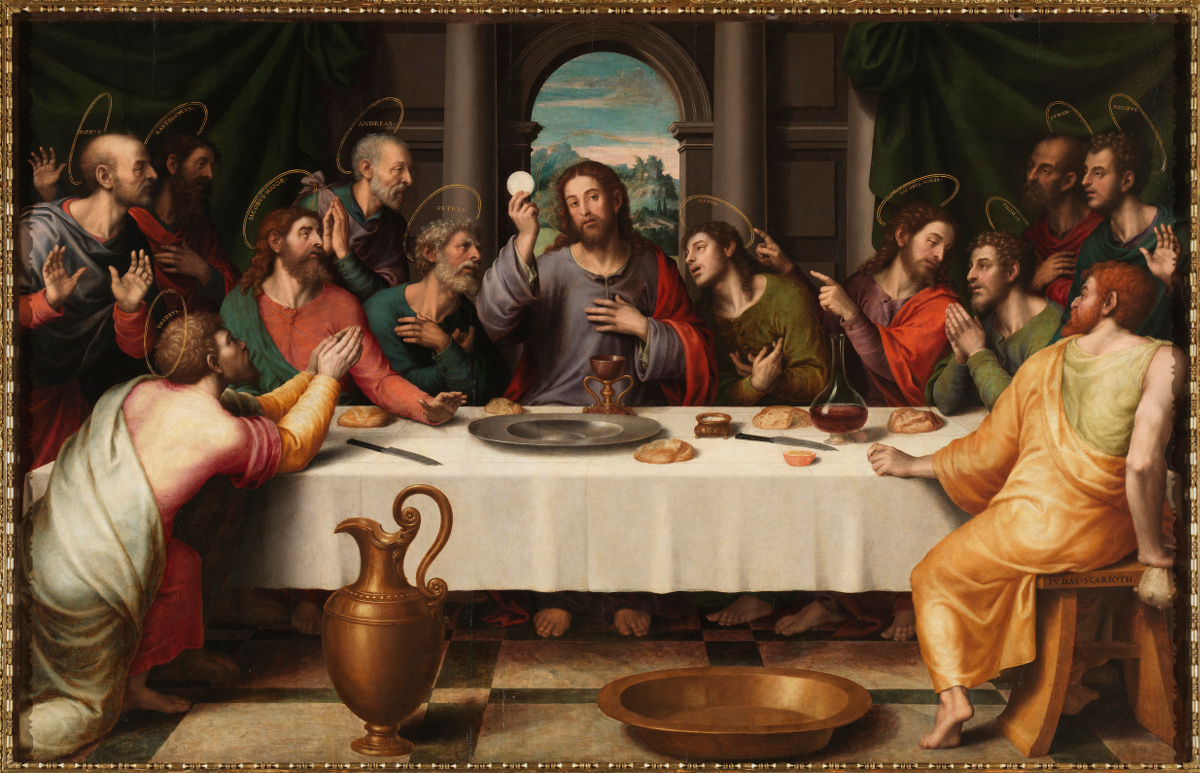 |
| Follow their hands and their eyes. They are looking at Christ, yes. They are looking at the Eucharist. |
Join
yourself, then, more fully to Him and His Church, for those who do
not share in the weaknesses of the Body will separate themselves from
the Body. In rejecting weakness and wickedness as unlovable they move
away from the God “who so loved the world
that He gave His only Son” (Jn 3:16a).
Friday, October 26, 2012
Faith and Works Part II: Love
II. To Speak of these Things We Must
Speak about Love
Last time we briefly examined faith,
works, and the aim of my work. We saw that faith was both a response
to a call and a 'hope for things not yet realized.' My claim, for the
sake of clarification, is that faith is something that looks
outwards. Without faith we cannot know what to look for or what to
trust, and without works that faith is dead. By works we mean actions
that seek to bring about that hope. So in a certain sense faith does
inspire us to works and works do flow from faith. On the other hand
faith allows us to see what we should work towards. Stronger still,
faith helps us to see what we must work for. (see part 1 here:Part 1)
But if faith is perceiving what we
desire then desire alone will not allow us to receive what we desire.
Works are necessary to reach the goal that we desire. This is why
James says “I will demonstrate my faith to you from my works”
(James 2:18) and that “faith was completed [literally: perfected]
by the works [of Abraham]” (2:22). This theme will be expanded on
later by viewing in detail the parable of the Sower and the seed in
hopes to make this point clearer. For now we shall turn to the
argument at hand.
Rather than analyzing faith and works
right away we should look at love [caritas]. In order to speak
of these two words and ideas we must speak of a third, namely love.
There is hardly a better place to begin
either, for “God is love” (1 Jn 4:8) and that of all the virtues
and gifts of the Holy Spirit “faith, hope, and charity [caritas]
remain … but the greatest of these is charity [i.e., love]” (1
Cor 13:13). Faith itself is initiated by love and sustained by love.
Faith is a sort of relationship to God and knowledge of God. The
blessed Apostle John says, however, that “Whoever is without love
does not know God … [for] no one has ever seen God. Yet if we love
one another, God remains in us, and his love is brought to perfection
in us” (1 Jn 4:8, 12). Love then seems superior to faith in many
instances in Scripture. It is not superior such that faith is
useless. Rather, Augustine speaks well in his masterpiece On
Christian Teaching when he says “faith will be replaced by the
sight of visible reality, and hope by the real happiness we shall
attain, whereas love will actually increase when [the world] passes
away” ( Book I. 90). Faith is meant to get us somewhere and Love is
where we must go. Augustine also says rightly that if our faith
lapses then our love will also lapse, since we would not know what to
love. As it stands, however, “if I have faith so as to move
mountains, but do not have love, I am nothing” (1 Cor 13:2).
Love is also greater than works because
love is both a work and the foundation of all works. Every man acts
for some purpose and that purpose is love. A man may love
wrongly—preferring evil things to good things. But a proper love
produces proper works. A problem emerges: someone may give to the
poor which is itself a good work, but that person may not love the
poor. The foundation of all law and service, however, is not
to give goods to others but to love them. Love is not a work like
other works but it is the supreme work that must be the source of all
others if any of our works are to have life. An analogy, imperfect as
it is, may help here: our bodies sometimes twitch. Nerves are excited
and our arm or leg jerks because of something that affected us. But
when we have a sound disposition we order our arms and bodies to do
many different tasks with precision.
Works when they are without love, even
though they are good, are like barely-lifeless twitches. Works
inspired and guided by love is like the skill of a fine
craftsman—intentional, knowledgeable, and purposeful.
Love, it seems, is truly the foundation
of all. For our purposes it seems to be the foundation for both faith
and works. There is no greater work of love, apart from Christ
crucified, than that of creation. Love, therefore, creates. It may be
said that faith and works alike proceed from love and are
completed by love. All the same, faith and works are the expressions
of love as well as the road by which we love.
God's love is perfect but our own love
lacks perfection. This is why we have faith and works.
Faith directs our hearts and peers into
the shadows of great mysteries. For revelation is God's gift which
allows us to know of the world, ourselves, and God Himself. We see
all of these things by faith: that creation is good, ordered, and
loved. It shows us that God is Three-in-One, transcendent, and yet
immanent.
Works temper our bodily passions and
sharpen our vision. For without doing good works ourselves how may we
see the work of the Holy Spirit in us and others? When our bodies are
distracted by idle passions we will fail to see truth clearly and, by
our weakened disposition, fail to love readily.
At this point, however, love is still a
vague idea. As I have mentioned above we all love something or
someone. In like manner we desire certain things, jobs, pleasures,
and honors for ourselves. In order to understand love more precisely
I would like to focus our attention to the Trinity. In order to
understand how faith and works proceed from love it is important, I
think, to first look at Love Himself. Though I can only speak weakly
I want to speak on the Trinity so we may reflect on perfect Love
which produced everything—a love so powerful that it brought forth
everything from nothing! From that reflection we shall see a bit more
clearly, I think, what that means for us and what it reveals to us
about humanity made in His image.
For next time: The Trinity, Love, and
Human Beings
Subscribe to:
Posts (Atom)