Showing posts with label prophet. Show all posts

Saturday, November 17, 2012

The Mediation of the Saints (2): God Works through Us

Note: You can see part 1 here (Mediation of the Saints Part 1)
Part 3 posted now as well!  (Part 3: Walking Together)

This was actually twice as long and I split this up into two parts. The good news is that the next part is done. The bad news is that this may be disjointed. I'm going to come back to this tomorrow and see if I need to edit anything (such as make additions).

Please leave your comments and questions below. It's not finished, so I realize that some of you may not want to render judgment just yet, but a heads-up to potential problems makes for a better process. Thanks again!


II. God Works through His People

Last time we said that the saints, in accord with the letter of James, were exemplary “doers of the word” (James 1:22). They not only stand before us as a model but a living voice in every age calling each of us to conversion. In the previous section we saw that the Apostles, filled with the Spirit, attracted a great number to them. Some take delight in having others flock to them and hang on their every word. A saint, however, does as John the Baptist did: he pointed to Christ.

A saint, in his perfect humility, does all his work for the sake of Jesus Christ and His mission which is the salvation of the whole world. I also claimed last time that seeking their intercession was not an act of disobedience to Christ but an act of personal humility for Christ. We, weak as we often are, ask for the prayers of men and women who know how to ask more perfectly. Indeed, James tells us that “you ask but do not receive, because you ask wrongly, to spend it on your passions” (James 4:3).

Below we shall examine this truth: God uses us and the whole world in order to call us to Himself.
Some have argued that asking for the aid of the saints is to put a sort of “middle man” in between God and the person. This argument, which takes many forms, seems to me to be ignorant of Scripture as well as the process of salvation.

God employs harvesters and fishers of men to do his work. He gives those who are faithful in small matters even greater responsibility (cf. Mt 25:14-30).

But God's will and action are not limited to his own word or his hands. It pleased God to use intermediaries to effect his designs such as the prophets, the Apostles, the angels, and his saints. God also used the wicked and the deformed to effect his will. He did not use them as a puppeteer but rather allowed their wickedness to bring about an inevitable good. God used the Assyrians and Babylonians to convert Israel back to Him:

Who was it that gave Jacob to be plundered, Israel to the despoilers [the Assyrians]? Was it not the Lord, against whom we have sinned? In his ways they refused to walk, his law they disobeyed. So he poured out wrath upon them, his anger, and the fury of battle; It blazed round about them, yet they did not realize, it burned them, but they took it not to heart. (Is 42:24-25, italics added for emphasis).
Their houses will fall to strangers [the Babylonians], their fields and their wives as well; For I will stretch forth my hand against those who dwell in this land, says the Lord” (Jer 6:12) (cf., Jer 27:2-6).
The prophet Jeremiah. Hated among his peers and countrymen. Laughed at, scorned, and threatened his whole life he proclaimed God's word. Other prophets and believers tried to silence him and offer a different message. He is a reminder to us that those whom we dislike, hate, or consider as 'less faithful' (or whatever suits us) may in fact be a clearer display of God's message than we care to say. The man who speaks out against evil despite the consequences is a man of God. Jeremiah was a true man of God, despite his pitiable appearance and difficult life.

We see that God uses and allows our desires to aid us or harm us. The prophet Hosea proclaims that God “will hedge in her way with thorns and erect a wall against her, so that she cannot find her paths. If she runs after her lovers, she shall not overtake them; if she looks for them she shall not find them. Then she shall say, "I will go back to my first husband, for it was better with me then than now." So I will allure her; I will lead her into the desert and speak to her heart” (Hos 2:8-9, 16).

Look closely at this passage and reflect deeply on these words. The thorns He erects are for paths that lead to false gods and immorality. These paths are none other than our malformed choices and desires. The destination we all seek, however, is happiness. She runs “after her lovers” which is happiness gained through immorality and false worship. She “searches but shall not find” means that those who look for happiness outside of God (i.e., in these errant ways) will not find it. This is not to say that we do not have things that make us happy. But we invariably fool ourselves when we think finite and temporary things will give us lasting pleasure. Pleasure gives way to pain. Moreover attachment to anything, good or bad, will be counted as a loss to us. It will return to dust regardless of our actions. True happiness is found in the true God. The path that leads to Him will have what we need to get to Him—it does not exclude loved ones, pleasure, or happiness but it is ordered to God and God alone. When God leads her “into the desert” this means that our hearts, when they recognize that nothing else will last except God we will realize He is the sum of all our desires and we will seek Him in all we do and do His will. So many want to have “God and...” and end up with nothing. Wisdom dictates that when we have “God alone...” we gain everything, even what we thought was lost. When we believe we are building paths to God through our desires we are often constructing cages and walls that keep us from Him. The prophets are all of one voice saying “What must we lose to gain?”
The prophet Hosea was told to take a wife for himself. She was a known prostitute who committed many infidelities. God told Hosea that this was how Israel had treated Him. All the same, God commanded that he love her and take her back because the love of God and deeper and more powerful than any infidelity. God could not show us this striking image, however, unless Hosea loved and trusted God enough to do as he was asked.

This passage from Hosea is only one example that explains how God works with us and through us whether we are conscious of it or not. Some, however, believe that this interaction of God in our lives (i.e., “grace”) is irresistible and unavoidable. The believe that God will use anyone and we just happen to be lucky if we're on the right side of the battle. I propose to show how that isn't true.

Next time we will look at how God interacted with the prophets and how the prophets worked with God. We shall see how the prophets were men of all walks of life who were given a special mission and a unique grace to feel what God feels and speak with Him openly.

Tuesday, July 24, 2012

On the Priesthood, One Body, One Church

"I will appoint shepherds for them who will shepherd them so that they need no longer fear and tremble; and none shall be missing, says the Lord." (Jer 23:4)


In this passage we have cause for joy, but also a cause for concern—joy because of what the prophet proclaims and concern because of what our brothers are saying. In this passage I see a disturbing trend where Protestants often ignore passages like this. Now it is not that many err completely but rather that there needs to be greater nuance in our treatment of this topic. Now, some take the notion "Jesus is the high priest" to mean that he is the only priest with authority, while others take it to mean that we all share equally in the priesthood that's the end of it.

But this is a prophetic message from Jeremiah, and we must remember that there are many types of prophetic utterances: some foretell God's wrath, His mercy, destruction, restoration, the end of days, or the coming of the New Age, i.e., the age of Christ. This proclamation (Jer 23:1-8) speaks of a passing away of an old order of priests, namely the Jewish priests (of his time) who engaged in idolatry and injustice. It then speaks of the establishment of a new order of priests and the reunification of the people of God from many lands. How is this clear? Jeremiah obviously calls these wicked priests the "shepherds who mislead and scatter my flock" (23:1) but then he uses "shepherds" again as those who will guide the people of God—these men are also priests. This message also clearly speaks of the coming of Christ for it says "I will raise up a righteous shoot to David" (23:5).

He prophesied all these things amidst the slow, painful, and gradual destruction of Jerusalem spiritually and physically.

Some will claim that we are all part of a universal priesthood and that we are made priests by virtue of His sacrifice. Now, we are indeed all called to all share in the priestly, prophetic, and kingly offices of Christ's ministry. But how, and in what way? First, we are all baptized to new life and by virtue of true baptism in the name of the Father, Son, and Holy Spirit we enter into the Body of Christ, the Church. Now, some have excised themselves from this union through false doctrine and we urge all of them to consider carefully their separation from the Body with whom they cannot live without. This Body, nevertheless, is something that we enter and become a part of through holy Baptism. Since each of us become a member of the Body of Christ we are likewise sharers of His mission—the salvation of all souls.

We participate in the mission of Christ as priest, prophet, and king in the manner which we live our lives. We do this when we work towards the salvation of souls in the individual circumstances of our lives. In this way those who proclaim that we are saved just by an act of faith cheapen the mission of Christ. They do not cheapen it by their zeal, for they bring others to believe in Christ. But they cheapen this mission by not considering the many parts of this mission—that is to say they do not consider the many parts of the Body and their roles in this mission. If faith was the sole purpose of the mission then there would be no need for teachers, preachers, and shepherds because the only teacher and shepherd would be God. By this I mean that many proclaim that only the Holy Spirit guides them. We do not deny His guidance but we reject that the Holy Spirit does not inspire us to lead others when necessary and follow others when necessary. God does not only give us Himself but He also gives us each other so that we might be lead to Him (and in specific ways).

"It is an error, nay more, a very heresy, to seek to banish the devout life from the soldier’s guardroom, the mechanic’s workshop, the prince’s court, or the domestic hearth. Of course a purely contemplative devotion, such as is specially proper to the religious and monastic life, cannot be practised in these outer vocations, but there are various other kinds of devotion well-suited to lead those whose calling is secular, along the paths of perfection."
~Introduction to the Devout Life, St. Francis de Sales
Now it is true that everything good comes from God, but it is also true that not everything is God. Indeed "the very differences which the Lord has willed to put between the members of his body serve its unity and mission" (Catechism of the Catholic Church, sec. 873). Some fulfill this mission as mothers, children, laborers, teachers, and priests. Others share in this mission by the virtues they have been given by the spirit such as humility, prudence, and love. All of these are parts of the one Body of Christ; all are not equal but work towards an equal goal.

So we are called to that ministry which Christ exercised—but if we all merely call ourselves priests of the same kind would we not also all be called shepherds? Who among us then are the sheep? Jer 23:1-8 clearly speaks of gathering all sheep (the faithful) together and giving them shepherds. The context of this prophecy is the coming of Christ, for he will be a wise king, a high priest, and the Good Shepherd. The promise of shepherds is priests in the order of the high priest.

We exercise that same priestly ministry of Christ insofar as we are a member of His Body—but just as some are meant to be teachers, other prophets, and others still interpreters (1 Cor 14:26-40). In this way, I call your attention to Paul's words: "Everything should be done for the sake of building up" (14:26). Similarly "like living stones, let yourselves be built into a spiritual house to be a holy priesthood to offer spiritual sacrifices acceptable to God through Jesus Christ" (1 Pet 2:5). But how can anyone build a house with the same materials, let alone a temple to God? That is to say if we are all just materials of the same type how do we construct anything? How do we distinguish one thing from another, such as the gifts of the Holy Spirit? Some must be used for the wood (laborers), others must be the inscriptions that adorn the walls (teachers), and others the altar (priests).

We are many parts but one Body, we are different materials that make One, Holy, Catholic, and Apostolic Church.
A Church ready to gather all to herself.
But as it stands, many pick and choose what of the Old Law passes and what is fulfilled. As for me, Jeremiah promised a Messiah—which is true—and shepherds to protect the flock (people of God) so that they "need no longer fear and tremble" (23:4). Why should not this also be true?

I urge you to recall 2 Tim 1:6 where Paul tells Timothy to "stir into flame the gift of God [he was] given through the imposition of [Paul's] hands." What is this action? The imposition of hands was an act done by the Apostles in order to give authority to those seven holy men selected from among the people. Likewise, the imposition of hands by Ananias was decreed by God to give Saul (Paul) authority as His instrument (Acts 9:15-17).

Paul instructs Titus similarly that he should "appoint presbyters" in every town. Here he does not mean "elders" but priests (Titus 1:5). This is clear because the following formula was used for bishops in 1 Timothy 3:2-7. More still, when speaking of presbyters Paul also says "do not lay hands too readily on anyone" (1 Tim 5:22)—meaning that not all are priests according to that order. It is further telling—and those who value truth should read carefully—the gifts given by Paul, by the imposition of hands on Timothy and Titus (and not just anybody) give these men the authority to lay hands on others. So it is not anybody who can raise someone to the order or presbyter (that is, priest) but only those who were given such a gift by the Apostles, a gift that was conferred to them by Christ Himself. Not everyone is a priest according to this order, and not everyone has the authority to "preside" nor the responsibility of that office to "toil in preaching and teaching" (1 Tim 6:17).

Indeed, it was promised that "you are a priest forever according to the order of Melchizedek" Now, if this priesthood—a priesthood which offers sacrifice—was related to just one man why would it be called an "order"? The order of Levi has passed away but the order of Melchizedek will never pass away because Christ does not pass away (Heb 7:24). If we are to take the promise of Jeremiah seriously, and the author of Hebrews in conjunction with him, who could deny a specific and unique priesthood though which we have shepherds for God people? Furthermore, the high priest has made a sacrifice, a perfect sacrifice, of Himself. As the high priest of the order of Melchizedek his priests are called to offer sacrifice, and more fascinating offer the perfect and eternal sacrifice—Jesus Christ. For the eternal priest is also an eternal sacrifice given for all.
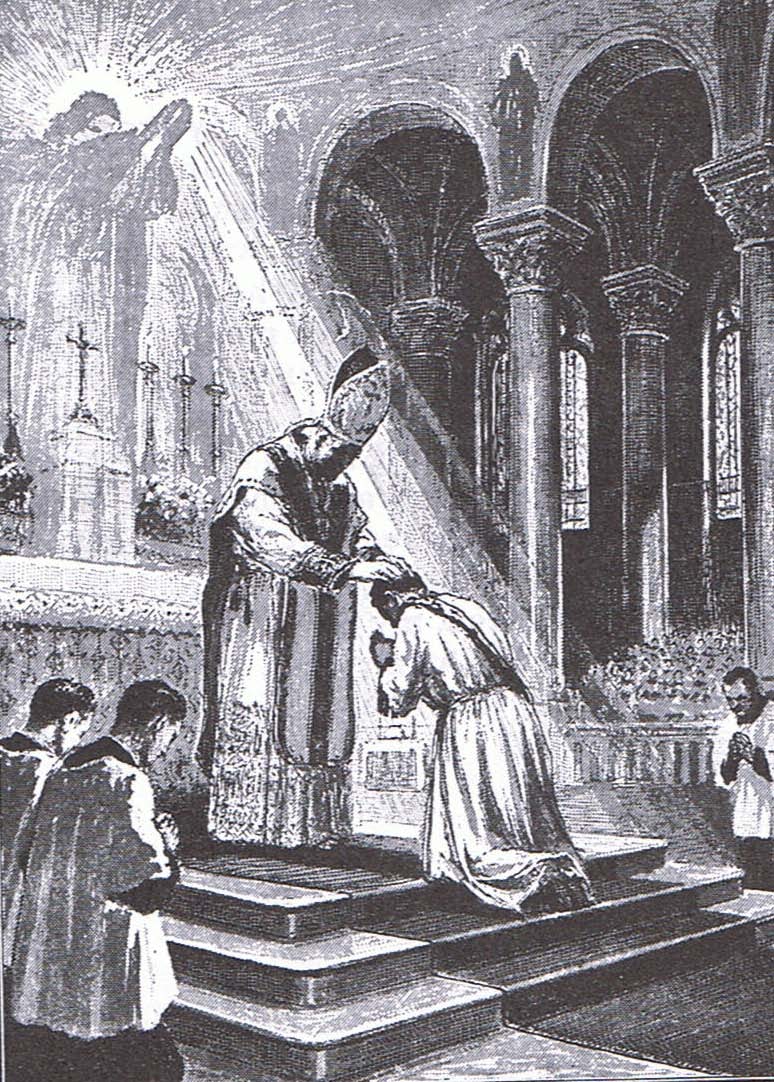
This is what is really happening at the conferal of Holy Orders. A young man joins a noble and heavenly calling, begun by Christ, through His Apostles, to the present day. As he enters into that priesthood by which he was be Christ in a very special way for others he must also be willing, like Christ, to give his life for his sheep.

 It is truly fitting we have such a high priest who, at the right hand of the Father, offers an eternal sacrifice and intercedes for us. As both victim and priest he not only reigns eternally but, by equal amounts of his love and humility, gives His Body and Blood for eternity as a blameless sacrifice. For if the priesthood is established in that eternal high priest, then sacrifices of those in the order of that priesthood do not offer temporal sacrifices, like the blood of bulls and rams, but an eternal and acceptable sacrifice. Indeed the Eucharist is rightly considered a sacrifice of praise. And although this spiritual and perfect sacrifice is offered by all we must recall to our hearts once more that we are the Body of Christ. As a Body of many parts we also recognize that although our whole being prays only the lips can speak praise, only the legs can kneel, only the head can bow, and only the hands can raise the sacrifice. But all together give thanks by their unique actions. So too do the laity and the priest, though different, give thanks for that same sacrifice for which they share and are beneficiaries.

So heed these words which I write, especially those who disbelieve of the order of priests and an eternal sacrifice. Christ's sacrifice was truly "once for all" in that He is the acceptable sacrifice to the Father. But if we do not connect this with the other truths of Scripture we live a lie and we drink poison. For when I and my brethren are confronted with the usual quotes, our detractors, when responded to, will simply say that one bit of Scripture trumps the other (in essence). We accept a universal priesthood as we all should, but then some of you deny the very Scriptural, prophetic, necessary, and authoritative priesthood promised by the prophets, fulfilled by Christ, and enacted through His Apostles and their successors. Do not turn Scripture into a book of mere opinions but see the coherence within. The presence of two truths, even truths that seem to contradict one another, sometimes leads to an even greater, hidden truth not readily seen. We must look to Scripture and the Tradition that gave it to us if we are to passionately search for truth and, with equal love, hold onto it.

______________

Special thanks to God, of course, but also his servant Padre Cristobal for his inspiring, wonderful, and beautiful homily about the need to work hard, as Catholics. The need to study, work towards virtues, work at ridding ourselves of vices, using the sacrament of Confession, and seeking spiritual guidance from your priests. "No es facil, pero nececitamos trabajar duro por Christo y su iglesia." (It's not easy, but we need to work hard for Christ and His Church). He spoke for 30 minutes, I could have listened 90 more.

Pray for our priests, pray for your priests, and for the love of God seek his guidance in Spiritual things if you find him to be trustworthy and hard working. And if you don't know yet....get out there and find out--make him better by your own desire to be better. That is (but one) beauty of the Church