Showing posts with label theology. Show all posts

Friday, January 16, 2015

Against those who Call Religious Art Idolatry and Blasphemy

Often times Catholics are called pagans and idol worshipers for depicting Christ, expressing him in religious art, and expressing him in statues. This is true in depicting the saints, angels, and the like.

I find these arguments very strange. The most commonly cited “proof” is from Ex 20:4 and similar passages: “Thou shalt not make unto thee any graven image, or any likeness of any thing that is in heaven above, or that is in the earth beneath, or that is in the water under the earth” (KJV).

This is certainly true, especially when considering that the Israelites fashioned for themselves a golden calf and, in various ages, many other idols of Cannanite, Babylonian, and Assyrian gods. In these times God was without image. From Genesis and throughout the Old Testament God is not described as having proportions or form but rather as expansive, immense, and beyond comparison. Images, or more specifically similes and metaphors, were used to describe the power, love, and greatness of God, but no images were fashioned.

At a time when images were routinely fashioned in order to depict one's gods, it makes sense that God would forbid such a practice to move people away from regarding wood, stone, and gold as an actual deity.


Moreover John the Apostle attests that “no one has ever seen God” (1 John 4:12 RSV). So why, then, do Catholics portray Christ as well as God the Father and God the Spirit?

There are logical proofs for such actions and dispositions, but they are logical proofs grounded in Scripture and the reality they portray.

It begins with the reality of Christ himself: that he is the Word and that he is God. This Word is the “image of the invisible God” (Col 1:15) and he “reflects the glory of God and bears the very stamp of his nature” (Heb 1:3). Similarly this all-powerful and glorious Word “became flesh and dwelt among us” (Jn 1:14). Thus God who was in former times had revealed himself in shadows and imperfect things, such as the prophets and the Law, now revealed himself in his perfect Son. The source of light is not seen in darkness, and we are all blind. But Jesus Christ, who gives sight to the blind, is “the light of the world” (Jn 8:12). We not only beheld him with our eyes but, as John said, we have also “looked upon [him] and touched [him] with our hands” (1 John 1:1).
Such art gives an example of an actual Biblical text and, more importantly, the New Testament relates the actual life of Jesus, even if Scripture can not simply be reduced to a historical text.

Jesus was truly God and truly man, something to which Scripture and faith attest. Jesus is in the Father and the Father is in Jesus (cf., Jn 17:21). All who believe in Jesus Christ have come to believe because they have heard about him from those who believe and who were sent out just as Jesus had been (cf. Jn 17:18). Similarly, the power of Jesus is described, just as the power of God had been described as of old, but now the power of God is expressed in image and flesh. This is how John the Baptist could say “Behold, the Lamb of God!” (Jn 1:29) and how Stephen could say “Behold, I see the heavens opened and the Son of Man standing at the right hand of God” (Acts 7:56).

Catholics depict Christ because he was seen both in his earthly flesh as well as his heavenly glory, both in Christ crucified and in Christ risen. Paul proclaims and preaches “Christ crucified” (1 Cor 1:23) and John looked upon the power and image of Christ the King in the book of Revelations. Thus not only was God seen but he was described. While, for example, his resplendence in heaven is described in metaphor and prophetic language the person of Christ is described as being who he is: a man who was humbled and humiliated on earth but now rules both heaven and earth in the fullness of power.

Thus, because we proclaim Christ and his life which was real, which was seen and touched, and which revealed the fullness of God and his plans. The Father has truly “made known to us in all wisdom and insight the mystery of his will” (Eph 1:9) through Christ Jesus, and the light Jesus provides is his life as model, truth, and guide.

As such, when Catholics express Christ in stained-glass, in a crucifix, and in various media, it is because we are expressing the truth that Christ, in his very reality and image, reveals God to us. It was once blasphemous to portray God with graven images since no one had ever seen God and God had not yet revealed himself to the nations. Similarly it was contrary to the law to eat certain foods until Christ had made them clean. Yet in these last days God has revealed himself by his only-begotten Son and his Son showed us the way we should go in power and in truth.


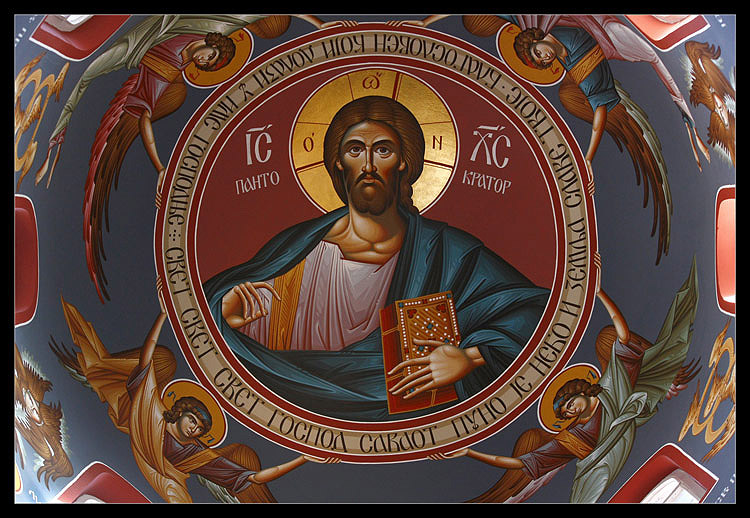
The images we fashion of Christ, of the Spirit (as dove and fire), and the Father (similar to the Son) are expressions of the reality of Christ. In the eastern traditions of Catholicism and in among some of our Orthodox brethren only Christ is portrayed as a theological point that the Spirit and Father are both never seen or described, but that the image of Christ is also the image of the other two. I think the iconography of the east also has powerful and rich meanings behind it. Catholics too express the reality of God revealed through their art. Calling it blasphemous and idolatry is not only ignorant but foolish in light of the Gospel.

Christ the All-powerful (Pantokrator)

Friday, November 14, 2014

Private Values and a Public Faith (Part I)

Do Religious Values have any Place in the Public Square?

The general consensus among those of faith and without seem to be “no.” Religion is a personal preference and conviction. Personal convictions, while good for me based on various experiences and reasons, are not grounds for me to impose these convictions and others. I believe in God because (a) I was brought up to believe, (b) it gives me comfort, and (c) it makes me a better person. But someone else may have experienced religion in negative circumstances. Likewise a non-believer may not share feelings and values of religious pronouncements on reproduction, family, and (deeper still) premises that inform public action and (politically-speaking) policy.

A non-Christian, non-religious, non-believer also builds convictions derived from his experiences and holds onto them for various reasons. They too may have been brought up to hold certain values that give them comfort and in turn, according to those values, make them “better.” I use quotes for “better” insofar as anyone, when he lives according to values, wants to live up to those values he considers as good. No one, or more accurately, very few of us ever embody fully the values we hold dear—but the more we live our lives according to these values we consider ourselves “better off,” perhaps because we can decide on things more confidently or can discern and solve problems more efficiently.

None of us can escape our upbringing and no one is ever truly free to choose his own experiences. While we are active agents in our lives we are also passive—things happen to us whether we like it or not. We are just as informed by what we do out of choice and by what we experience with no say in the matter. We as humans, however, have a unique ability to reflect on our experiences. More uniquely, since other animals also have memory and learn from experience, human beings have the capacity to reflect on their values and culture. This is not only consistent with ancient wisdom but also modern science.

Man, by applying his reason to himself, may reject what he has been given in a nearly-complete way. Moreover some may even claim that we are unique among the animals insofar as we know how we came to be and that we are also aware of how we are wired (this imagery is by no means exhaustive). Because we “know” we may also reject our wiring in some ways—the example Dawkins uses is that we “rebel against our genes” when we contracept, i.e., that we actively deny the 'desire' of our genes to be replicated through propagation.

Thus both ancient sources, e.g., philosophy or theology, and modern sciences have agreed throughout the ages that man is unique. He is not unique according to his flesh, since his flesh and composition is not too different from other mammals. Perhaps one might say that his brain as an organ is the most impressive according to its construction and capacity. Man is unique according to his reason—formulated in antiquity as possessing a “rational soul”—because by his reason he can even master himself.

While our knowledge, scientifically-speaking, is still expanding on the subject of human cognition we can see that we form connections, both socially (e.g., mother and child) and intellectually (i.e., neural connections), in a way not dissimilar from other creatures. All but a few can recognize, however, that we are capable of understanding how we work and, by our own efforts, direct ourselves beyond mere instinct. While evolution has brought the structure of our bodies and brains to a certain point we also know that in the realm of human and child-development the manner in which we teach each other affects the way that our brain makes connections. In a manner of speaking we can intentionally affect how our brains are organized. This organization, in turn, affects how we act and interact. One may even argue that how we act makes us more fit. Fitness in the narrow sense is simply propagation. I believe that in a broader sense it involves more than just reproduction—fitness also includes well-being, productivity, and living in concord with fellow human beings. Thus how we regard one another, work with one another, and help each other to be our best is a benefit for both ourselves and for those around us.

These activities are achieved through “values” which is shorthand for those conceptions which influence dispositions, habits, and actions. Man, since he has been able to communicate with his fellow man, has discussed values—what is good and what is best—and likewise handed down those values. Values themselves are tested by time and experience. They are tested by hardships and challenges.

Reason and discussion, it may be said, are what make up the furnace of values. Likewise values are applied by different people and in different circumstances, thus their weaknesses are exposed and strengths refined. How those values are expressed are also important—do our actions actually mirror our values? It is foolishness to think that we automatically embody our values—living in accord with any value takes time, effort, and humility. We must always recognize our weakness. On the other hand when we do not attempt to live out certain values we do not actually express them.

In a manner of speaking values are physical and organic, both in their history and within an individual. Consider the image of a tree: when a tree is planted it needs the right circumstances and ingredients to grow. It may very well grow in weak or sandy soil, grow in competition with other trees, grow to be proud and strong, or simply die. Some trees by virtue of its light source will grow in a different direction. Others may be twisted, broken, and bent because of natural disaster. Nevertheless many of them survive in various conditions and amid various trials. Thus, while the tree may appear different in its external presentation each tree is from the same heritage, source, or family (e.g., an oak or a maple are still themselves despite their outward image).

Values themselves may die or they may die in the individual. They may also take root and flourish. Every generation is both the soil and the planter. We are the ones who, having grown up, decide where to plant and how. Values are, in some ways, of supreme importance for how we interact with one another as well as important insofar as they actually affect our physical makeup on the macro and even micro level.

With these in mind, we will proceed to the next part and talk more directly about values and the people who hold them.

Wednesday, September 3, 2014

Do We Need a New Language to Speak about Homosexuality?

Note: I apologize for my sporadic posting these past months. Big tests, traveling, and hospital ministry have taken me away from my writing. My hope is to start writing more soon, provided I have something interesting to write about.

I am also experimenting with using this spacing on my articles to make them a bit easier to read. No pictures this time either, sorry :(. I do hope we get some good discussion out of this, though.
Originally posted on Ignitum Today.
====
The first is “Always Our Children: A Pastoral Message to Parents of Homosexual Children and Suggestions for Pastoral Ministers” (1997). - See more at: http://www.ignitumtoday.com/2014/08/30/new-language-speaking-homosexuality/#sthash.iIaQ3CTM.dpuf

The first is “Always Our Children: A Pastoral Message to Parents of Homosexual Children and Suggestions for Pastoral Ministers” (1997). - See more at: http://www.ignitumtoday.com/2014/08/30/new-language-speaking-homosexuality/#sthash.iIaQ3CTM.dpuf
One of the more popular, misunderstood, and challenging problems Catholics face today is the topic of homosexuality. I think of the many great strides we as a Church and as a culture have taken in speaking about it. In the same way, neither side whether secular or religious, has spoken more clearly on the subject. Catholics, at the very least, have always been very good at making distinctions. The process of making distinctions is not just good philosophy and theology, but it also aids in our practical and charitable responses to what we experience.

When we respond to homosexuality we should know what it is. Moreover, when someone is homosexual it does us little good to categorize that person according to preconceived notions about their sexual activity, sexual purity, or moral state. In fact I've usually seen these reactions as one's own personal, moral blindness than as a useful discussion geared towards understanding something so as to respond to it more effectively.

That being said, I also see among many Catholics and (more understandably, perhaps) secular homosexuals a departure from language such as “disordered.” A great deal of language focuses on “natural” sexual desire. It should be granted that the word “nature” (or “natural”) is not as clear as it first appears, but some have achieved a greater sense of clarity about it.

Part of my worry is that even good, Catholic homosexuals have found the language of “disorder” offensive and disheartening. My worry is not so much their individual feelings about the word, but it does bring forth the valid question as to whether or not our language about homosexuality is unsound, invalid, or ineffective.

This is also not as easy to determine right away. Our language could be unsound it simply isn't true or because we are operating under false premises. It may be invalid simply because what we do know about the human person and human sexuality is not properly expressed (i.e., our conclusions may not be properly derived from our premises). Our language may be ineffective as a result. Effectiveness is not only a matter of truth but also rhetoric. Speaking ineffectively is just as damaging to an argument as it is to be untrue or be lacking logically. This also accepts that, like Jesus, some people simply will not accept what is true—but this should stop us from pausing and considering our own words.

Should we discard the use of the term “disordered,” then? I am inclined to say 'no' for the time being. I say this for a number of reasons, some of which I'll list:

(1) is that scientifically speaking we do not know what causes one to be homosexual or to what degree one is a homosexual. Furthermore, as part of our species, what function or role does homosexuality play?

(2) The notion of “disordered” is often improperly univocated. There can be disordered states of being and there can be disordered acts. An act whose content or purpose is “good,” such as sex, but which is realized improperly is disordered. Thus both homosexuals and heterosexuals can engage in “disordered” sex.

Something that is disordered, however, is both simple and complex. An eye that cannot see is “disordered” insofar as it can not operate according to its purpose. A keyboard whose keys work except the “t,” “h,” and “e” is unable to fulfill its function adequately.

Thus something can be “disordered” either in execution (i.e., how it's carried out) or through inability (i.e., it's incapable of doing what it should).

Catholics hold that the purpose of sex is unitive and procreative. The act of sex is reserved as an expression of marital love. This does not mean that sex must result in procreation. Marital sex must be open to the possibility of procreation lovingly, otherwise that act of sex is disordered. Thus to be truly married and have sex according to the order established by God, the couple must execute the act in an “orderly” way (i.e., they must be married, freely have sex, truly love one another, and be open to (one of) the natural consequences of sex) and both must also be capable of fulfilling these criteria in order to be “ordered properly” in the first place.

(3) We should not be afraid to label ourselves as “disordered,” homosexual or heterosexual. Sin itself is a disruption of “order” insofar as all sin is contrary to God's will. One who is addicted to masturbation acts in a disordered way. One who is prone to spreading rumors and gossip acts in a disordered way. Those of us who do not go to mass on Sunday act in a disordered way. Those who do not forgive others for their transgressions against us act in a disordered way.

Many of us, because of family history, genetics, or circumstance are also born into a state of greater probability for certain sins or vices, whether we want them or not. We are all born into an existence both ordered by grace and disorderly because of sin.

And so...?

My intention is not to “solve” the problem we have since I do not believe we have the full tools to solve it. I have some self-criticisms that I will briefly connect to my points above:

(1) Sifting through today's science (biology, sociology, psychology, etc.) on the subject is at times biased, confusing, and willing to promote certain findings for reasons that aren't always “scientific.” Nevertheless honestly engaging what we are discovering about human sexuality, along with their impulses, are necessary endeavors. Regardless of a lack of scientific clarity those of us who do minister to or interact with homosexuals (etc.) must recognize them as persons created in the imago dei.

(2) My hope is that there is still clarity and a lack of clarity in the term “disordered.” How do we call homosexuality, the state of being, “disordered.” For too long we considered someone who was openly homosexual as one who was by necessity sexually active and predatory to the same sex. This is simply untrue, otherwise we would have to bring the same complaint to heterosexuals.

Homosexuals, by virtue of their homosexuality, are still fully capable of practicing virtues, discerning right from wrong, and making rationally informed choices. Thus their homosexuality is not a disorder to their will and, perhaps one could even say with confidence, their souls.

Their biology is another matter. Their homosexuality does not affect their internal or reproductive organs. In fact we have seen cases of homosexuals who have a desire to reproduce yet, for obvious reasons, can not do so by means of their 'native' sexual inclination.

Sex has the ability to improve (or deteriorate) intimacy and trust, to procreate, and give pleasure. In what ways does our insistence on procreation cloud our understanding of sex. I remain, however, a firm believer in the premise that procreation is one of the biological purposes of sex, to which pleasure and intimacy aid in the realization of a new human life.

(3) Perhaps this is too negative a view of the current state which we live in. Some are more willing than me to speak of the goodness of the world/state/circumstance we live in. On the one hand any of us are capable of loving another and love is the only means to break the cycle of sin, since it is only love (according to Paul) that is eternal. Since we have the capacity to love does this mean we are more ordered than disordered? In many ways there is a greater confusion over the terms “evil” and “sin,” in my view, than terms such as “homosexuality” and marriage.

It would be good for all of us to consider more deeply the difficulties at hand with intentionality and patience. 

(Please consider these documents:

The first is “Always Our Children: A Pastoral Message to Parents of Homosexual Children and Suggestions for Pastoral Ministers” (1997). - See more at: http://www.ignitumtoday.com/2014/08/30/new-language-speaking-homosexuality/#sthash.iIaQ3CTM.dpuf
To that end I would suggest two documents by the USCCB for your consideration:
The first is “Always Our Children: A Pastoral Message to Parents of Homosexual Children and Suggestions for Pastoral Ministers” (1997).
The second is “Ministry to Persons with a Homosexual Inclination: Guidelines for Pastoral Care” (PDF, 2006).
- See more at: http://www.ignitumtoday.com/2014/08/30/new-language-speaking-homosexuality/#sthash.iIaQ3CTM.dpuf
To that end I would suggest two documents by the USCCB for your consideration:
The first is “Always Our Children: A Pastoral Message to Parents of Homosexual Children and Suggestions for Pastoral Ministers” (1997).
The second is “Ministry to Persons with a Homosexual Inclination: Guidelines for Pastoral Care” (PDF, 2006).
- See more at: http://www.ignitumtoday.com/2014/08/30/new-language-speaking-homosexuality/#sthash.iIaQ3CTM.dpuf
To that end I would suggest two documents by the USCCB for your consideration:
The first is “Always Our Children: A Pastoral Message to Parents of Homosexual Children and Suggestions for Pastoral Ministers” (1997).
The second is “Ministry to Persons with a Homosexual Inclination: Guidelines for Pastoral Care” (PDF, 2006).
- See more at: http://www.ignitumtoday.com/2014/08/30/new-language-speaking-homosexuality/#sthash.iIaQ3CTM.dpuf

Thursday, July 24, 2014

Redemptive Suffering

The fear of suffering, pain, and death seem like unconquerable mysteries. My time here at CPE has helped me to understand, via experience, that they are not necessarily things that need to be conquered. No amount of faith excludes us from experience pain, loneliness, and death. Money, power, and other earthly things makes these three experiences even worse. With this in mind, I began to wonder if the words of Qoheleth were not as negative as they appear: “Vanity of vanities! All is vanity” (Ecc 1:2). Earthly things will pass which also means these things, both good and bad, will pass. Yet this does not ease the blow of the mystery of suffering and death. Even if they pass away they still remain with us our whole lives.

For me, this mystery is one that is only solved by the Cross. The cross is, for me, the foundation of my theology the ministry I do. The cross is the Incarnational moment where love and suffering meet. Love because “God is love” (1 Jn 4:16b) and suffering because the human condition is deeply affected by sin and death (Gen 3:16ff). Christ took upon himself the entirety of our human condition. While this expressed itself in his person I believe it was brought to completion by his sacrifice. It was only in his death that he was able to “reconcile to himself all things, whether on earth or in heaven, making peace through the blood of his cross” (Col 1:20).

How does this inform my theology? First, if Christ chose to take on all of humanity he also took on pain, loneliness, and death in all completeness. He did not run from them but endured them and experienced them to the full. Thus any ministry inspired by Christ must be a ministry willing to encounter and experience all of the human condition. Secondly, did not Christ through His actions reconcile all things to himself? If this is the case he also reconciled what is lowly and base to our human existence. Thus in ministry encountering what is base, disgusting, and disturbing is an opportunity to encounter Christ in the same capacity as that which is lofty, beautiful, and joyful. There is no discrimination in what Christ assumed in our humanity. He became like us in all things but sin (cf. Heb 4:15).1

As such, in my mind and in my ministry I attempt to approach a Catholic theology of suffering. The primary way is the Catholic view of suffering or, more specifically, redemptive suffering. What do I mean by redemptive suffering? Only this: that our suffering when united to Christ shares in his mission of salvation. How is this so? Christ is married to the Church as his spouse and the “two [have] become one flesh” (Gen 2:24). Moreover “no man hates his own flesh, but nourishes and cherishes it, as Christ does the Church, because we are members of his body” (Eph 5:29-30, cf. Eph 5). We are by virtue of our baptism joined to Christ and the Church. We are joined to the body of Christ such that we are one with him. “This is a great mystery” (Eph 5:32). Yet Scripture proclaims that as Saul persecuted the "disciples of the Way" Christ himself said, “Saul, Saul, why do you persecute me? … I am Jesus, whom you are persecuting” (Acts 9:4, 5). Lastly, Paul himself says, “I rejoice in my sufferings for your sake, and in my flesh I complete2 what is lacking in Christ's afflictions for the sake of his body, that is, the Church” (Col 1:24).

Christ entrusted his disciples with his Spirit to carry out his mission of salvation to the whole world and to all ages. The Church was established as his bride and He himself is the head of the body. We are extensions of his body. We share in the sufferings of those to whom we minister (and we ourselves also suffer). Christ identifies with us, especially with those who suffer (cf. Mt 25:40), should we not also identify with Him in turn? Christ assumed humanity so as to redeem it, thus with confidence I say he also redeemed suffering. The suffering we experience can be joined to Christ who even after the Resurrection complained to Saul that He himself was being persecuted. Christ's suffering continues in His Body, the Church, because we live in a world redeemed but not yet saved.3 We too, in joining our sufferings to Christ, suffer for the sake of His Body (cf. Col 1:24). And indeed “he did this once for all when he offered himself” (Heb 7:27b). Thus we too “must present ourselves as a living sacrifice, holy and acceptable to God” (Rom 12:1). This means that the suffering I experience in myself and others can be effective in Christ's saving work for the one who suffers (and even myself). When I share in the suffering of another I attempt to share in the suffering of both Christ and the individual.

1“For we have not a high priest who is unable to sympathize with our weaknesses, but one who in every respect has been tempted as we are, yet without sinning.”
2In Greek the verb “antanapleiro” also has the sense of “filling up” or “making full.”
3For while this present age is passing away (1 Cor 7:31) it is still in the process of doing so. We await the “glory to be revealed in us” (Rom 8:18).

++
In a special way keep Grace Oliver, 23, in your prayers as she battles cancer in the face of a very difficult diagnosis. While my words may express a cognative struggle with this issue, my words are shadows compared her words in the face of suffering and death. Please pray for her and please read what she has to write: Grace Oliver and Dumb Cancer

Monday, December 30, 2013

Apologetics Online II

Please forgive my absence from posting more regularly. Some bloggers keep up with a better regimen and react to news more quickly. I'm beginning to feel as if I'm more in St. John's camp. At the end of his second letter he states that he wishes to speak with his brothers face to face. I'm perhaps the same way.

As I work on other pieces during my break I thought it would be nice to share with you some of my other encounters online doing apologetics. These are a few selections from a number of various topics selected. I give them to you all for your scrutiny and hope we can discuss similar questions together. If you have any additional questions, please ask away.

Much obliged.
As with last time, the person who asks me a question/makes a comment will be in italics. My responses will be in plain text.

[1]

 When someone slags off the church (IE calling them paedophiles) what do you say to them?

Well, it's upsetting because it's ignorant--not ignorant in that there are no pedophiles in the clergy (sad and regrettable)--but sometimes these people only want to be listened to.

The ones who say it as a joke or as slander don't want to be told anything. The best response is patience, really,

Others simply have been hurt by it and need to be heard. Other than that there are plenty of statistics to show that the rate among clergy, especially Catholic clergy, is lower and less frequent than nearly any other populations (e.g., fathers, teachers, etc.).


[2] Note: the wide area a simple question opens up to. It shows, I think, how ready we have to be to approach these subjects specifically and then see the larger picture. In this instance infallibility opens up to questions about truth, veracity, certainty, (Medieval) history, philosophy, and Church procedures. It goes on and on.

(I've done some editing and down-sizing)

Do you believe the pope's word is infallible spiritually or otherwise and how con someone who allegedly have a direct link to an omniscient being be wrong about one thing and not another?

First and foremost Papal Infallibility is limited to the Pope speaking authoritatively on matters of faith and morals to the whole Church, not just one part. His comments on local affairs or specific concerns in a field, while they carry weight by virtue of his authority, are not considered infallible.

The "direct link" to Omniscience is not like a phone call to God. The Holy Spirit works in the Church and ultimately Christ, rather, the Trinity, leads the Church. The Pope is the living authority of the Church who by virtue of His stature, is said to be incapable of error or deceit when it comes to the contents of faith.

This has been misinterpreted for centuries, even after clarification in the 19th century, and has been taken to mean that whatever he says is free from error. The pope has only invoked infallibility according to our definition about 30 times in our whole history. Likewise, as Scripture states "the one who is wise seeks council." Very rarely, if ever, has the pope just come out and said "I infallibly say..." In fact he never has. He consults with his fellow bishops on matters of faith that concern the peoples from all over the world and when conflict arises they discuss this conflict's subject matter and how it relates to the whole of the faith. It's a very long process and never done flippantly.

Again isn't he supposed to be god's mouthpiece on Earth; why would he need to do all that if he can contact the "all mighty" himself?

Well we would first have to examine any assumptions one would make about it. First, I don't recall us calling him "God's mouthpiece." It's not an official or even theological title.

It assumes how God speaks to men or through men. It assumes how men listen for God. I wish I could give you a formula for how it happens but it's not subject to human control (or invocation). The Pope is elected as leader of the Church by his fellow brothers because they see in him a spirit of governance. He is not perfect, he's human. By virtue of his position he is given great responsibility but also a great number of graces--should he choose to accept him.

Describing how the Holy Spirit works through men is not an easy task, nor is it one many Christians wish to reflect on or think through.

I know it might be hard for you to process but has it ever occurred to you that it's most likely all made up?
Of course, but then again how much effort have you dedicated to seeing if it's true?

Most of my adolescence and all of my early adulthood. There is a logical tool that is used to determine the veracity of a claim called Occam's Razor. I'm sure you heard of it.It is a line of reasoning that says the simplest answer is often correct. [someone else, atheist it seems, steps in to say, "Not quite. Occam's Razor is more like "the answer that makes the least amount of assumptions is often correct".]
I've also found that that's the extent of people's knowledge of Ockham.

Let use it in an example then!
Which is the simpler claim: that someone can truly be infallible or that it's a lie?

Asking if he's claiming that it's more probable to tell the truth than a lie he response, "No it is much more likely that someone is telling a lie; especially when making an extraordinary a claim as "selective infallibility". If we are to believe any claim we require evidence and extraordinary claims require extraordinary evidence." [I also ask if he's read Ockham]


Can you give me the probabilities on that? If you call what I described as "selective" you might as well call any truth claim "selective truth claiming."

As for evidence in general, who requires it and why? What makes a claim extraordinary? Likewise, are claims of logic, philosophy, or similar branches subject to the same criteria as the physical sciences, or are their various forms of demonstration according to their proper field?

I also like the notion of "extraordinary claims." Extraordinary has a very emotional ring to it, doesn't it?

You see, Ockham's Razor is very popular except people seem to have forgotten that he did believe in God--did he not follow his own rule? That, and his use of the "Razor" was more concerned with the discussion of universals than every time someone wanted to talk about God.
[Here it gets a bit more complicated:]


[1] Truth as most commonly defined as that which is in accordance with fact or reality.
What you are claiming is that the pope isn't just selectively telling the truth but as I was getting at that the pope is allegedly capable of selectively dictating without error the word of an alleged all powerful being that created the universe.

[2] A claim that is mundane or a commonly observed or experienced occurrence (like: I walked my dog) is an easily determinable as either true or false there should be no reason to doubt me and if you do I could present to you evidence that I have a dog. Simply by presenting my dog. That would be considered ordinary.
Extraordinary (despite your attempt to call me on an appeal to emotion) is something that is as the word describes extra-ordinary. Which is defined as going beyond what is usual, regular, or customary.
Infallibility would fall under the category of an extraordinary claim.
[3] Because just like Sir Isaac Newton, Ockham's scientific contribution is irrelevant to his religious beliefs. 

Ockham believed that  "only faith gives us access to theological truths. The ways of God are not open to reason, for God has freely chosen to create a world and establish a way of salvation within it apart from any necessary laws that human logic or rationality can uncover." His theism was based solely on private revelation and faith and that god was an ontological necessity. Which given the century he lived in there was literally no alternative theory of how things came to exist. Essentially Ockham granted god special pleading because when you apply the Razor to the claim of god it really does a number on it.
[I quote what I'm responding to:]
Truth as most commonly defined as that which is in accordance with fact or reality.

Philosophy is often quite good at challenging even these claims as being self-evident, but I won't argue semantics here.

But regardless of our views about the value of fact or the precise definition of reality you seem to be adding complications to it by your evaluations of a given pope's actions, i.e., I don't understand  "selectively dictating without error the word of [x]." It leads me to believe that you take his action to be some sort of prophecy or divination which it isn't. I can't really argue against things I don't believe or the Church doesn't teach/proclaim.

It doesn't quite answer my question about your comment about the probability of truth.
Extraordinary (despite your attempt to call me on an appeal to emotion) is something that is as the word describes extra-ordinary. Which is defined as going beyond what is usual, regular, or customary.Infallibility would fall under the category of an extraordinary claim.

Then again, given your dog example, you could claim that you've spoken infallibly about your dog. I only say it's "emotional" in that there usually is some wonder in confronting something extraordinary. The vastness of the universe, stellar motions, and the like can provoke wonder. Sub atomic structures, the formation of organisms from single cells, mitosis, etc. may also be extraordinary in a certain sense. Then again even the act of walking our dog or observing the harmony of an animal's motions can be very captivating. Even something as "ordinary" as ourselves--we are with ourselves most of the time after all--is subject to a great deal of contingency and wonder.

Perhaps this serves as a small example of how easily ordinary and extraordinary can sometimes be confusing, even emotional insofar as they cause us to wonder.

Infallibility is not so extraordinary when one is certain. People seem to infallibly claim things all the time such as:

-the universe is infinite
-the universe is only material (and thus finite)
-any evaluation of the Middle Ages seems to be very extraordinary and many non-historians/Christians/etc. claim many fantastic, infallible things off of weak/unfounded/biased/unhistorical evidence

I use that last example of the ordinary way everyday people speak infallibly about things much larger and more complicated than themselves.

Whenever the Pope speaks infallibly, however, it is not apart from a careful examination of the faith of the people, the content of tradition, and the content of revelation--claims rarely made (as I said) flippantly.

Perhaps you're introducing more extraordinary things into the process.
Because just like Sir Isaac Newton, Ockham's scientific contribution is irrelevant to his religious beliefs.

The thing is that Ockham's claim with the "Razor" was not scientific, but philosophical--a bit of a difference. Likewise Newton's physics (Paschal's too) were motivated by both genuine curiosity, genius, and their faith. It was their belief that creation was orderly, not chaotic, that inspired them to find that order in creation (that's how they would see it--how you see it for them is beside the point).

His theism was based solely on private revelation and faith and that god was an ontological necessity. Which given the century he lived in there was literally no alternative theory of how things came to exist. Essentially Ockham granted god special pleading because when you apply the Razor to the claim of god it really does a number on it.


Are you saying that as a scholar of this particular period of theology and philosophy or just an educated opinion?

Given that he was a member of the Catholic Church he believed in some capacity of revelation throughout history and also through the Church, not just privately. A private faith apart from the Body, the Church did not share clearly or accurately with revelation because a private faith alone is not a part of the Body.

As for alternative theories have you read Anselm, Aquinas, Bonaventure, Scotus, Nicholas of Cusa, or Ockham on their own terms to see if your purported truth claim is, well, true?


I thought the same when I started philosophy, that the Middle ages just said "God" was the answer without any real thought behind it. As it turned out I had to be humbled by my peers and by actual reading to find that, all along, I (me personally) had been the arrogant one and I was wrong. There's a richness and variety that we deny these men by assuming what their arguments are all about.
 [This is the conversation thus far....]

***

Reflection:

Apologetics is a task where one has to get to the heart of what one is asking. In matters of making a defense the first claim is the gateway into a number of further disagreements. If we can be civil and honest about such disagreements we can go a long way. Likewise, we have to carefully see how the other uses his vocabulary--eek out certain assumptions and premises. Very often philosophy is misunderstood, let alone medieval philosophy.

Humility always plays a role in evangelization; we don't know everything. Some people want to argue with us and compete while others simply are interested in how we process the many things that happen. I'm learning to approach both these moments with gratitude. God speaks through our enemies and detractors just as He does our loved ones.

Thanks for reading!

M

Sunday, September 29, 2013

The Experience of Translating

Foreign languages, I realize, are not for everyone. Many can go throughout their whole lives content to read Scripture in their native language. I certainly don't blame them for doing so. Translating Scripture can be like portaging through a swamp—a mire of depth, interpretation, and meaning. That being said, the ability to translate things such as Scripture offers valuable insight into the meaning and difficulty of the text that we take for granted. 

When the language is not our own (e.g., Latin or Greek) it forces one to scrutinize the grammar and the vocabulary and it forces one to reflect on the meaning of the text. Below, I'd like to share not only the experience of translating but also show how anyone, even those who just read English, can get more out of parables and texts that they thought were boring or easy.

I've been doing both ancient and koine [Biblical] Greek for some time. In no way would I consider myself a master of that language. For me, a master would look like some of my professors who can just look at the text, identify it, read it as if it were English, explain it, and teach it. Can I get there in 10 years? 30? I don't know. As it stands, I remain a beginner after almost 7 years. Learning the basics of a language and grammar are different than playing with the language, seeing how the language is used by various authors, and learning from context how certain words should be translated.

In order to translate well, in my opinion, the translator must do a few things: first, he must translate such that he puts the author in his [the translator's] own words, i.e., “Do I understand what I said, and do I understand what he said?” Secondly, the translator must write in such a way that his audience understands, both the author and the author in his transplanted language.

When I translate my goal is not never assume an idea is in the text—it tends to be more fun and accurate when what you expect out of the text is in now way what the text looks like. The words should be allowed to speak for themselves first, especially in Scripture. When the text is before us, however, we inevitably ask ourselves “What does this say?” and “Does it mean what I think it means?”

When interpreting and translating one might say, 'Jesus saved us from our sins and by his blood we are redeemed. Any work I do cannot aid me in my salvation. He died once for all, so when Paul talks about faith he must mean “you are saved by faith.” Moreover he means that we are saved by “faith alone.”'
No other way to look at it, right?

More complicated versions of this way of thinking can produce even more interesting thoughts and reasons for translating something this way or that. Catholics, Protestants, classicists, etc. can all enter in with some very grand ideas about how various phrases are supposed to look.


In the quote I offer below you can see how the same passage may be taken to mean something completely different. I've underlined sections where there is some significant difference, and made bold specific terms.

An example from Ephesians 1:3-6

King James Version
Blessed be the God and Father of our Lord Jesus Christ, who hath blessed us with all spiritual blessings in heavenly places in Christ: According as he hath chosen us in him before the foundation of the world, that we should be holy and without blame before him in love: Having predestinated us unto the adoption of children by Jesus Christ to himself, according to the good pleasure of his will, to the praise of the glory of his grace, wherein he hath made us accepted in the beloved.


New International Version
Praise be to the God and Father of our Lord Jesus Christ, who has blessed us in the heavenly realms with every spiritual blessing in Christ. For he chose us in him before the creation of the world to be holy and blameless in his sight. In love he predestined us for adoption to sonship through Jesus Christ, in accordance with his pleasure and will— to the praise of his glorious grace, which he has freely given us in the One he loves.


My Translation
Blessed be the God and Father of our Lord Jesus Christ, who blesses us in every spiritual blessing in the heavens in Christ, just as He chose us in Him from the beginning of creation to be holy and blameless before Him in Love, setting us apart for sonship through Jesus Christ in Him, according to His benevolent will, in praise of His glorious kindness which He freely bestowed on us in Him whom He loved.


Now I'll admit that even I made some mistakes along the way, and these other two translations corrected me. I had written the last phrase “whom He loved” originally as “in love” because I had simply forgotten to translate the participle. This little experience then caused me to reflect: the translators of other Bibles, typically, know their grammar and are careful. How, then, could such drastic differences emerge in translation?

The only key to understand such phenomena is “tradition,” both in the common and sacred sense.

When I translate which dictionary do I use? Oxford's Liddell and Scott or Walter Bauer's Lexicon—typically time period would tell me when, most of the time. Am I using the 1st, 2nd, or 3rd edition? Am I using something else? We as intermediate translators are subject to the texts we use, much like many students of many disciplines are at the mercy of the Encyclopedia they happen to trust.
What do you mean encyclopedias and dictionaries can contain errors or prejudice?

Then there's the matter of who taught you how to translate. Was he a strict grammarian or was he interested in making a readable translation? In all these things, “predestined,” as used by these two translations on Ephesians, is not evident from the text itself, but rather it is an interpretation on the text.

The Greek, in many cases, is a simple phrase or a mixture of concrete images that, over the course of time, became proper and specific terms. How does one determine what these simple terms mean? The truth is that it can only come out of a tradition that lives the faith, struggles with the content of revelation, and then tries their best to pass it on to the next along with all their wisdom and experience.

The tricky part becomes “Which tradition do I follow?” For many Protestants, this doesn't enter their theological reasoning, let alone their historical one (though, sadly, this is true for far too many Catholics). Tradition requires as much investigation and scrutiny as Scripture does.

Tradition is seen by some as only a “man-made” thing and never a thing concerning God. For man, God comes to replace human ingenuity, human thought, and human actions. God either “covers up” our humanity or “puts it aside.”

The Catholic Church teaches from her sacred Tradition that God has always been interested and involved in mankind, existing in human history, never more strongly than when He sent His only Son to live among us. God, for us, “lifts up our humanity” and transforms it by grace, thus restoring our human nature to be as God intended.

The act of translating, and sometimes disagreeing on what the passage means, is not human folly. One word may carry with it a variety of meanings. One phrase may carry with it a variety of effects. Those who are attentive to God's will and who are humble will still hear the same passage differently. Is this wrong, a fault of the listener, or a fault of the text? God gives to each of us what we need. “Give us this day our daily bread” (Mt 6:11). For one his bread is a consolation and for the other a reproof.

The Word of God is not only text, but a voice that permeates all dispositions, lives, cultures, and ages. Translating allows the words to speak more clearly, or less so, depending on what God intends. Indeed “you have hidden these things from the wise and understanding and revealed them to infants” (Mt 11:25).

The first principle of reading or translating Scripture, friends, is humility at the greatness that stands before you. Never be content to read Scripture once or understand it in only one way. “I sought wisdom openly in my prayer … I inclined my ear a little and received her, and I found for myself much instruction. … My heart was stirred to seek her, therefore I have gained a good possession. The Lord gave me a tongue as my reward, and I will praise Him with it” (Sir 51:13, 16, 21-22).

Monday, July 15, 2013

The Early Church III-1: Introduction to Christology

Enjoy learning about the early Church? See parts I here and II here.

Prologue

The study of the person, actions, and significance of Christ can be a daunting task. The number of opinions out there about Him, whether one believes or not, are so numerous it seems as if there could never be a consensus on who Jesus actually was or what He actually did. This problem is not a new one, however, but a very ancient one. We see that even when Jesus performed His earthly ministries many were unsure as to His true identity. When Jesus asked his Apostles who others said the Son of Man was they told him, “Some say John the Baptist, others Elijah, still others Jeremiah or one of the other prophets” (Mt 16:14). When Jesus addressed them, those who had witnessed him firsthand, Peter took charge and said, “You are the Messiah, the Son of the living God” (16:16).

Our difficulty is twofold at this point. First, Jesus claims that “flesh and blood has not revealed this to you, but my heavenly Father” (16:17). Knowledge of Christ is ultimately subject to revelation, experience, and grace. Secondly, when Peter got it right he showed us how we can still get it wrong.

Peter spoke truly and in the Spirit, but when he heard Jesus say that He must suffer and die at the hands of wicked men Peter was taken aback. He rebuked Jesus—how could the Messiah suffer? How could God Himself die? Jesus called Peter 'Satan' because he is acting as a deceiver. Recall Genesis in this instance, where the serpent says “You certainly will not die!” (Gen 3:4).

Peter only understood so much, as we might expect. Christ's mission was not yet complete. He had not yet suffered, died, risen, and ascended to the Father. In the Gospel of Mark, for example, no man declares that Jesus is the Son of God until he dies on the cross. Even if we come to believe in these things they still remain a great mystery. We may ask “why did Christ have to do it this way?” but it stands that this was the manner God chose to redeem us. There is always something that can be revealed about a person and his intentions when  he has a number of means and options open to him. That he chooses a specific way can teach us if we endeavor to accept it.

Much like the Trinity, the person of Christ is a mystery of the highest kind. The depths of God's love, mercy, power, and person all remain unplumbed. It takes time to rest in these mysteries and allow them to reveal their hidden truths to us. Much like Scripture, these mysteries are present to us in all of our emotions, affections, and states of being. They are ever-ready to reveal something new to us if we are willing to listen to them and trust in them. As Peter himself shows, sometimes that's difficult. One who experiences loss may find it difficult to believe God loves—but what if they were to believe this despite their loss? What would they learn of God's love? What would they understand from their loss?

We may not gain understanding of these things by our efforts—only the Holy Spirit can give us this—but we grow in wisdom by being with Wisdom. Wisdom is, after all, “the spotless mirror of the power of God, the image of his goodness” (Wis 7:26). Proverbs says it more directly: “The beginning of wisdom is: get wisdom; at the cost of all you have get understanding” (Prv 4:7). In order to understand, become wise, to know and be with Christ we must desire it. Christ says “follow me” and we decide to follow. Love compels us to follow, wisdom keeps us safe as we travel. Another way of looking at it is this: wisdom is the benefit, the reward, of love.


We learn from the imperfections He subjected Himself to for our sake. We learn that it's okay to be imperfect.

The purpose of the following is meant to be an introduction and in no way an academic analysis. I have purposefully kept this examination in the early Church in order to show the ambiguity and struggle that many holy men experienced. In the early 300s more articulate language developed in response to honest dialogue as well as heresy. The same is true of the Trinity.

In both cases, while I will focus on the subject at hand, I would like all who read to consider the collaboration, faith, and wisdom of the many bishops, theologians, and saints who made our present-day expression of faith possible. These were men who willingly walked into the darkness of many mysteries and avoided the guile of reducing such things to human and earthly terms. They deflected ideas which rejected the apostolic teaching or those claims which contradicted Scriptures—they were truly masters of both. Let us, in a small way, sit at their feet in order to correct and safeguard our own ways of thinking.

(See III-2 here!) 

Friday, May 3, 2013

The Early Church II-1: The Martyrs

(This is the extended, written version of a presentation I gave on 4/30/2013. 

This is II-1. If you haven't read "The Early Church I" yet, I would recommend it. All links are at the bottom of this article.)

Prologue

Last time we examined the message of Christianity and how it was presented to both Jew and Gentile. The message of Christ was a message of dignity, divine sonship and daughterhood, and a noble mission, namely the salvation of all in the name of Christ Jesus.

This, however, came with many difficulties. There were many who refused to hear the message. Others simply saw God as one among many appropriating what was profitable to them in the Christian message. Others reacted violently. Of these three, it may seem strange to hear that the second problem, corrupted teaching, was actually the most destructive to the Church. While there were those who were outside the Church who simply selected a few points and incorporated them into their pagan theology there were plenty of Christians who, because of culture, (both abundance and lack of) learning, and zeal, caused a great deal of trouble by their words.

In order to counteract these false teachings and bad influences the Church, beginning with the Apostles, established very quickly a structure of bishop, priest, and deacon in order to preserve and protect the content of the Apostolic faith. The bishop was a direct descendent of the Apostles, a relationship we'll explore later on. It was through the office of the bishop that we became known as “Catholic” and it was only around such a man that the Church was said to be. “Tradition,” likewise, properly understood was not only the words and actions of Christ but also the words and actions of the Apostles and their successors who were given a unique office (cf. Acts 1:20) by Christ (cf. Jn 20:19-23). Peter among the Twelve was given an important ministry and office. The title bishop means “overseer” and Peter was appointed overseer of his brothers. He exercised this authority clearly in Scripture yet, as Christ proclaimed, he did not lord over them (cf. Lk 22:25) but rather acted as a supreme example to his brothers and his flock (cf. 1 Pet 5:5).

Christians were likewise persecuted in waves of varying intensity from the Church's inception at Pentecost until 313 AD, after the persecutions of Diocletian. Christ, however, said it plainly: “If anyone wishes to come after me, he must deny himself and take up his cross daily and follow me … whoever loses his life for my sake will save it” (Lk 9:23-24). Peter said his disciples, “Since Christ suffered in the flesh, arm yourselves with the same attitude” (1 Pet 4:1) and “Do not be surprised that a trial by fire is occurring among you, as if something strange were happening. Rather, rejoice to the extent that you share in the sufferings of Christ, so that when his glory is revealed you may also rejoice exultantly” (1 Pet 4:13). Paul says it even more simply, “All who want to live religiously in Christ Jesus will be persecuted” (2 Tim 3:12).

This brings us to the opening of our discussion: the martyrs. In what manner did their witness to Christ shape the early Christians and the Church? Likewise, what problems did they cause for the Church moving forward?


II-1: The Martyrs

The word martyr literally means “witness” yet that witness is more than proclaiming Christ with our words or good deeds. This is the witness that testifies to Christ crucified in the most concrete way: by giving up one's life in the same manner Christ did. Christ died for love of us, the martyrs died for love of Christ and neighbor—even persecutor.

Death is something that was trivialized in the Roman Empire just as it is today. The delight in the fall of one's enemies, the desire to oppress those who fought but no longer can, to see those whom we hate suffer cruelly for their injustice are all forms of bloodlust. The Romans were desensitized to blood, perhaps more than we are, because their violence was very real and designed, at its worst, to humiliate and break their captives. 

Not to mention entertainment.

Imagine, now, a group of men and women who stood in the face of death proudly. Rather than cowering in fear and succumbing to cruelty they openly proclaimed Christ. They prayed for their enemies and would not let death itself keep them from the One they loved. They acted as if life itself was an obstacle to their ultimate goal and that the threat of death held no sway. To a people soaked in blood and self-centeredness this was a shock to their system. With such a sharp contrast to their way of life two responses resulted: (1) even greater and inflamed hatred or (2) a complete conversion of heart. Very few could stand by indifferent to the example of the martyrs.


Before we examine the martyrs we should keep in mind a few aspects: not every Roman leader hated Christians, nor did every governor or provincial enact laws of persecution—Christians were in many places model citizens, and in many cases Romans sought to dispel a sect or a cult by killing their leaders. There was little effect to killing scores of common men and women. Priests, bishops, deacons, and those admired by the community were sought above the laity (Courtesy of Sommer, We Look for a Kingdom, 222).

Let us examine in sort, then, how the Church viewed martyrdom. While we ourselves can say many nice things about the martyrs it is worthwhile to examine how our Church Fathers and Scripture regarded the power and significance of them. It will help us, in turn, understand how Christians of that period responded to and sought the martyrs.


Justin Martyr, an apologist and martyr of the Church was a well educated man with an extensive knowledge of philosophy. Justin cited one of the reasons for his conversion in his 2nd Apology: “I was delighted in the teachings of Plato, and heard the Christians slandered, and saw them fearless of death, and of all other things which are counted fearful, [I] saw that it was impossible that they could be living in wickedness and pleasure. For what sensual or intemperate person, or whoever counts it good to feast on human flesh, could welcome death that he might be deprived of his enjoyments[?]” (2nd Apology, sec. 12).

The common conception of Christians at this time (2nd century) was that they were atheists and cannibals. All manner of slander and myths were circulated about Christians so that they seemed to be enemies to humanity and to the state. For example: Tacitus, the famous Roman historian, said that Christians were “a sect that hates the human race” (Annals 15:44). Yet in the face of hatred many men and women showed love. In the face of cruelty is was the Christians who showed themselves to be civilized. It remains an important lesson for us today; the world will see us as enemies and fools and in these instances our words and actions should be as blameless as they can. When our adversaries comment on our faults, sinfulness, and errors accept them as a blessing. When we can present His message without fault—as best we can—the the words of others against His message are destined to fall. Time will reveal their lack of wisdom.
Modern examples exist in abundance.

Scripture likewise conveys this to us. The first martyr, Stephen the deacon, stands before a hostile crowd speaking in the Spirit. It says “his face was like the face of an angel” (Acts 6:15) and yet his words of condemnation to the wicked were like a sword. “You stiff-necked people, uncircumcised in heart and ears, you always oppose the holy Spirit; you are just like your ancestors. … You received the law as transmitted by angels, but you did not observe it” (Acts 7:51, 53). As the crowd raged toward him he looked up to heaven, giving thanks that he should suffer for Jesus' name. He forgave those who killed him and, after his death, “devout men buried Stephen and made a loud lament over him” (Acts 8:3).

Interestingly in this story is that Scripture says “I see the heavens opened up and the Son of Man standing at the right hand of God” and “Lord Jesus, receive my Spirit” (7:56, 59). Would there be any doubt his spirit was received? Christ on the cross proclaimed to the repentant thief “Amen, I say to you, today you will be with me in Paradise” (Lk 23:43, cf. Mt 37:45-56). If Christ said this at the request of the penitent sinner do you think he would deny the request of the one who, filled with His Spirit and dying for His name, would be refused any request?

To this effect, and to answer this question, I present a story relayed to us by Eusebius, the earliest 'historian' of the Church. Writing in the 4th century he was considered the “Father of Church History.” All histories written around this period and after him by other Christians begin at the end of his work as if to acknowledge his writing (cf. Penguin Classics version, xviii, 1989).

He writes many accounts of persecutions and martyrs, one which I think will be useful to consider in brief:

Potamiaena was a virgin and martyr who was condemned along with her mother for being Christian. She “and her mother Marcella found fulfillment in fire.” Her mother was killed and she was subject to a number of humiliations and tortures. A soldier in her midst, Basilides, seized her and led to her to place of execution. The crowd pressed around her seeking to strike her while insulting her but Basilides drove them back and showed this woman “the utmost pity and kindness.” Potamiaena, accepting his sympathy told him that “when she had gone away she would ask her Lord for him, and it would not be long before she repaid him for all he had done for her. … She face her end with noble courage—slowly, drop by drop, boiling pitch was poured [over her]. Such was the battle won by this splendid girl.”

Some days later Basilides was asked by his fellow soldiers to take again the military oath by which they all swore. He refused saying he was a Christian. They thought he was joking, but he asserted all the more of this fact. His comrades threw him in prison and those from the Church visited him there asking him the reason. He told them that “three days after her martyrdom Potamiaena stood before him in the night, put a wreath about his head, and said she had prayed for him to the Lord, had obtained her request, and before long would place him by her side.” At once those present baptised him and on the next day he was beheaded. It was said that in Alexandria, where all this took place, many other came to believe having seen this same girl in their dreams calling them to Jesus Christ. (see Eusebius, EH 6.5).

In this brief story that I've paraphrased we see a number of things: the courage of a martyr, her influence while living, and her power when she had life eternal. The martyrs were said to work miracles after their deaths and be catalysts to many conversions. Such interactions, that is saints speaking to others after their death, are not explicitly in Scripture, however, so how shall we consider this story?

We recall that in Revelations that there were those who “have washed their robes and made them white in the blood of the Lamb. For this reason they stand before God's throne and worship him day and night” (Rev 7:14-15). But it says later on that “I saw thrones and those who sat on them were entrusted with judgment. I also saw the souls of those who had been beheaded for their witness to Jesus and for the word of God … They came to life and reigned with Christ for a thousand years [that is, for this Age] … blessed and holy is the one who shares in the first Resurrection. … they will reign with him for [the] thousand years” (Rev 20:4-6).
Prayer to the saints is effective not because the saints have power on their own, but because in their total loss-of-self in martyrdom they were given a share of the throne of Christ in this Age. All of it is for our benefit.

The first thousand years is not a literal time but an expression of forever (or, for the duration of this Age). We remain in this period of the first “thousand years” whereas the new heavens and new earth is the Age-yet-to-come, the Resurrection of the Body. Indeed, while we remain as pilgrims here on earth there were those, as Scripture attests, who sit on thrones with Christ. The ones on thrones are the ones martyred in the name of Christ. That they sit on a throne means they have power, and their power is precisely their intercession with Christ on behalf of all souls on heaven and earth. For it was not Christ himself who converted Basilides, but rather Christ through a young girl who converted him. This story relates that the ever-living martyr did not desire power nor did she seek revenge on her persecutors. Like Christ who proclaims “Repent, and believe in the gospel” (Mk 1:15) she called others to do the same. All of us too are called to be witnesses to Christ—some will witness by our lives, others by our deaths.

Martyrs across the whole empire produced this effect. Perhaps one of the most famous martyrologies that has come down to us is the Martyrdom of Polycarp, bishop to the Church in Smyrna (which was a Greek city in Ionia at the time). He was an old man when he was martyred, perhaps 80 or 85 at his death.

This account, however, was written in the 4th century (perhaps 310 AD) while he is believed to have been martyred in the 2nd century around 155 AD). This account has been shown, over time, to not give us any real historical knowledge of Polycarp, but the story itself allows us to see a number of things: (1) the great character of the man written about, (2) the practices concerning such men and women by the faithful, (3) the pride communities took in such examples of their faith. Much of what we get about Polycarp can be gathered from the letter to the Philippians attributed to him, what Ignatius of Antioch says of him in his letter, of various fragments, most notably by his great admirer and fellow bishop Irenaeus of Lyons.

With this being said as an aside, I will select a few quotes that, while not strict history insofar as the exact events described are not historical, they are history insofar as they convey the attitudes of a Christian people. I think you'll see how it correlates with the story above.

Concerning Polycarp's martyrdom it says that the act was “certainly a mark of true and steadfast love, not only to desire one's salvation, but that of all the brethren as well” (Martyrdom, sec. 1).

Those who martyred Polycarp kept his body from those who sought it because “many … were eager to [lay hold of him] and have a share in his holy remains” (Martyrdom, sec. 17). This one indication of relics we have early on, but such an indication also comes from Scripture—that the articles of holy men and women, and that which touched them, had power associated with them. It says “So extraordinary were the might deeds God accomplished at the hands of Paul that when face clothes or aprons that touched his skin were applied to the sick, their diseases left them and the evil spirits came out of them” (Acts 19:11-12).

The reverence given to and practices concerning the martyrs is encapsulated nicely here: “[We] took up his bones, more precious than costly stones and more excellent than gold, and interred them in a decent place. There the Lord will permit us, as far as possible, to assemble in rapturous joy and celebrate his martyrdom—his birthday—both to commemorate the heroes that have gone before, and to train and prepare the heroes yet to come” (Martyrdom, sec. 18).

Of Polycarp himself it was said “Of the elect the most wonderful Polycarp was certainly one—an apostolic and prophetic teacher in our times, and a bishop of the Catholic Church at Smyrna” (sec. 16).
"Your life among the Gentiles must be beyond reproach; thus by your good example you will win praise for yourselves, and the Lord will not be blasphemed on your account" (Letters to the Philippians, sec. 16).

Next, we shall see how even with such courageous witnesses the Church faced problems as a result of their impact. We'll examine how such difficulties arose and the response, in brief, of the Church.


===

Links to "The Early Church I: "History, Morality, Being Called Catholic, and the Papacy"

I-1: Prologue and History
I-2: Organization of the Early Church 
I-3: Why are we called "Catholic"?

Friday, April 5, 2013

Peter at the Head: A Lesson in Leadership

 This was a reflection given today, 4/5/2013 on the readings from Acts 4:1-12, Ps 188, and Jn 21:1-14. They may be found here, though I tried to write in a way that you wouldn't necessarily have to read them--but they are recommended.


Peter is the leader of both these Scripture passages and present us with lessons about human leadership. Peter, because of his temperament, was a leader. Scripture, when it lists the Twelve (or any group of them) always names him first, and he teaches us by his example both positively and negatively. The way light is used, additionally, helps us to discern the meaning behind his actions.

In the Acts of the Apostles, Peter and John enter the temple because they are on their way to the 3 o'clock hour of prayer (cf. Acts 3:1-10). As they go on their way to pray with everyone else they encounter a man begging at the temple gate. Peter said to him first “I can neither give you silver or gold … but what I do I have I give you … Jesus the Nazorean” (Acts 3:6). Peter promised him nothing earthly. He did not promise him healing nor did he promise him a life of wealth. He rather gave him Christ and the crippled man became strong.

By his example Peter showed us how the weak and infirm are made strong through Jesus Christ. He also showed us that those of us who are strong now should look kindly on the elderly, weak, and sick and never deprive Christ from their presence. The moment the two encountered this man in the power of the Spirit, he entered the temple praising God.

This was after the Resurrection, after Peter had encountered Christ and had been instructed by Him personally. In the Gospel we see the process it took for Peter to get there.


In the evening Peter again takes the initiative by saying “I am going fishing” (Jn 21:3) and the others follow. The Evangelist John notes that they caught nothing and it was during the night. They labored in darkness and Peter led them into darkness. By morning they had nothing to show for their labors. This is the danger of any human leadership, that we might mislead them. All the same no one complained and no one abandoned Peter in his labor—they went out together and remained faithful to one another.
Dawn came, and the moment Peter could be sure it was Christ, he hurried to Him.
Then dawn came, can Jesus stood along the shore. He commanded them to cast their nets into the sea, the same labor they did in darkness, and immediately their nets were full. The one who loved Jesus, John, pointed out that it was Jesus who lead them. Upon hearing this Peter girded himself and ran towards Christ, jumping into the sea to get at him before anyone else. Peter, where he had misled his brethren now leads them again. He had been in error, but when the Truth had been pointed out to him he ran to it. Jesus commanded His disciples to bring him their catch, and again Peter was the first to bring all they had.

Scripture teaches us simply, brothers and sisters, that there will be those who lead us and that at times they will be in error. But if they preach Christ and know Christ they will follow after him first and foremost. Will we allow ourselves to lead when we find Christ? Will we allow ourselves to be led?

We know that we have much to give, but we must first give Christ to others. Labor in the light of Christ and bring all you have to him, then your work will be blessed and others will emerge from darkness and praise God.


***


There are many other rich meanings to these passages, especially the Gospel. I wish I could review them all, especially the parallels and differences between Lk 5:1-11 and this Gospel. Maybe I will in the future.

Please feel free to leave a comment on content, or a critique on style/presentation. Thanks again!