Showing posts with label Trinity. Show all posts

Monday, October 26, 2015

On the Power of Words

This is a portion of my homily, formalized and edited, from this past Sunday. The readings may be found here for your reflection, but and not exclisivly necessary for understanding this portion.

I admit that if you are not Catholic and if you do not attend mass this will be somewhat nonsensical. But I encourage you all, first of all Catholics, to attend mass with a new zeal. And of course for you non-Catholics to become Catholic. Nevertheless, I hope this reflection encourages reflection for you.
====

When we pray before the altar of God, it can be an easy temptation to grow weary through repetition. We can repeat the proper response week in and week out during mass. Likewise we hear similar words nearly every week, and so we grow distracted and tired.

But I ask that we look to our own experience to correct our behavior: when we see a loved one, a family member, or a friend we can say “It's good to see you,” or “I've missed you,” or “I love you,” and each time these words produce a similar (if not the same) effect. These words, coming from someone who means it, never fail to hearten us and comfort us. Likewise, when we mean and say these words we too hope that they will do the same for our loved ones.

Yet how could we not trust the sincerity of these words?

Take this, all of you, and eat of it. For this is my body, which will be given up for you.

Take this, all of you, and drink from it. For this is the chalice of my blood. The blood of the new and eternal covenant, which will be poured out for you and for many, for the forgiveness of sins.

Both times he proclaims, “Do this in memory of me.”

We ought to listen to these words anew and see them as coming from the heart of Jesus. He offers his very self to heal us, to reconcile us, and to raise us up to the Father. This is why the priest elevates the Body and Blood—it it not so that our mortal eyes might see it, but that our spirits might offer this perfect sacrifice to the Father.

Every prayer of our mass is an expression of God's love for us. Since God is love, it should not surprise us that the mass is that perfect expression of his love, because in it we receive both His word and His own Self.

Imagine, then, that the Father ever and always says “I love you” through his every action. Do we allow this to affect us as we stand, sit, and kneel before the Lord? Do our words of response express this same love? I hope they do, for God is always waiting and always listening to our response. Let our prayers, our actions, and out hearts speak in one voice at every mass, indeed every moment of it, and in our life.

In this way that which we hear and say will not leave us without having their intended effect.

Tuesday, May 26, 2015

Pentecost: The Fire of the Spirit

(Note: This was originally a homily given at Pentecost on May 24, 2015. I did not have a script and so the written version is a near-facsimilie, but lacking the timing and effect I went for when speaking publicly).

On this holy feast of Pentecost I would like us to reflect on the Spirit and His work in our lives, namely that there are two ways which we use one: we can use it to mean “alone” and we can use it to mean “together.”

How is it that we’re alone? Paul in Galatians tells us that the works of the flesh rip us apart and isolate us. The works of the flesh are envy, greed, immorality, immodesty, lack of chastity, wrath and anger, rivalry, and hatred (cf., Gal 5:16-19). We see this in our own lives and we’ve all had these feelings. But we must recognize that these acts are acts of power and control where we seek to impose our will on the world and others, taking from the weak, the helpless, and those we consider less than ourselves. These aspects gather all things to ourselves, but isolate us and make us one and alone.

But the Spirit is something better and greater. Humility, patience, gentleness, faithfulness, and love. Each of these acts, paradoxically, ask us to give of ourselves little by little, lifting the other up in charity and peace.

I find no better example of this notion of alone and together than in families. If a spouse, or even indeed a child, is greedy, jealous, domineering, ungrateful, or mean-spirited, it tears a family apart. But if all members of a family are patient, patient with each other’s shortcomings, humble, knowing that they are not perfect or always right, gentle in chiding them to a better life in Christ, and loving—that is, self-sacrificing—than that family will stand firm for generations, in life and in death. We all know of our weaknesses, whether they are sexual, or matters of pride, jealousy, envy, gossip, or laziness. We all share in these weaknesses of the flesh, but through grace we share in the strength of the Holy Spirit.

It is the Spirit that affords us these graces which God pours out so generously upon us. It is the Spirit that allowed the Apostles to speak many languages, so that all peoples and ages might hear one message. That one message is the love of the Father, the victory of Christ Jesus over sin and death—a victory we baptized share in, the presence of the Spirit of truth, and that the Church, the bride of Christ, shares the glorious work of God on earth.

One more image that I think is useful for us is the very bread that we bless and consecrate at the holy altar. The bread that we use is made of many grains, formed into one with water, and then finally baked by fire.

We too, because of the work of the most blessed Trinity, are made into one. We are gathered, all of us varied and different, by the will of the Father. He calls us together and, through the blood of the Son, we are prepared as one. Lastly, the Spirit, who is rightly symbolized as a holy flame, perfects us in love and grace so that we might become holy, that is like God. Thus we, brothers and sisters, are prepared as a bread pleasing to almighty God, but not merely for Him, but for the whole world. The blood and water that poured from Christ’s side on the Cross prepare us for this task, and the Spirit strengthens us along the way.

Like Christ, we are one Body and one Bread, prepared for the world and given up for the sake of the world. For everyone, not only us Catholics, but for all of our brothers and sisters. We are given up for their sins, their weaknesses, and the evil that they do, for we know that we too share in all the same weaknesses and faults. We, nonetheless, rely on the power of the Trinity to make us an acceptable offering for the whole world so that all of us, so many scattered and alone, may be one in Spirit and in truth.

Friday, January 16, 2015

Against those who Call Religious Art Idolatry and Blasphemy

Often times Catholics are called pagans and idol worshipers for depicting Christ, expressing him in religious art, and expressing him in statues. This is true in depicting the saints, angels, and the like.

I find these arguments very strange. The most commonly cited “proof” is from Ex 20:4 and similar passages: “Thou shalt not make unto thee any graven image, or any likeness of any thing that is in heaven above, or that is in the earth beneath, or that is in the water under the earth” (KJV).

This is certainly true, especially when considering that the Israelites fashioned for themselves a golden calf and, in various ages, many other idols of Cannanite, Babylonian, and Assyrian gods. In these times God was without image. From Genesis and throughout the Old Testament God is not described as having proportions or form but rather as expansive, immense, and beyond comparison. Images, or more specifically similes and metaphors, were used to describe the power, love, and greatness of God, but no images were fashioned.

At a time when images were routinely fashioned in order to depict one's gods, it makes sense that God would forbid such a practice to move people away from regarding wood, stone, and gold as an actual deity.


Moreover John the Apostle attests that “no one has ever seen God” (1 John 4:12 RSV). So why, then, do Catholics portray Christ as well as God the Father and God the Spirit?

There are logical proofs for such actions and dispositions, but they are logical proofs grounded in Scripture and the reality they portray.

It begins with the reality of Christ himself: that he is the Word and that he is God. This Word is the “image of the invisible God” (Col 1:15) and he “reflects the glory of God and bears the very stamp of his nature” (Heb 1:3). Similarly this all-powerful and glorious Word “became flesh and dwelt among us” (Jn 1:14). Thus God who was in former times had revealed himself in shadows and imperfect things, such as the prophets and the Law, now revealed himself in his perfect Son. The source of light is not seen in darkness, and we are all blind. But Jesus Christ, who gives sight to the blind, is “the light of the world” (Jn 8:12). We not only beheld him with our eyes but, as John said, we have also “looked upon [him] and touched [him] with our hands” (1 John 1:1).
Such art gives an example of an actual Biblical text and, more importantly, the New Testament relates the actual life of Jesus, even if Scripture can not simply be reduced to a historical text.

Jesus was truly God and truly man, something to which Scripture and faith attest. Jesus is in the Father and the Father is in Jesus (cf., Jn 17:21). All who believe in Jesus Christ have come to believe because they have heard about him from those who believe and who were sent out just as Jesus had been (cf. Jn 17:18). Similarly, the power of Jesus is described, just as the power of God had been described as of old, but now the power of God is expressed in image and flesh. This is how John the Baptist could say “Behold, the Lamb of God!” (Jn 1:29) and how Stephen could say “Behold, I see the heavens opened and the Son of Man standing at the right hand of God” (Acts 7:56).

Catholics depict Christ because he was seen both in his earthly flesh as well as his heavenly glory, both in Christ crucified and in Christ risen. Paul proclaims and preaches “Christ crucified” (1 Cor 1:23) and John looked upon the power and image of Christ the King in the book of Revelations. Thus not only was God seen but he was described. While, for example, his resplendence in heaven is described in metaphor and prophetic language the person of Christ is described as being who he is: a man who was humbled and humiliated on earth but now rules both heaven and earth in the fullness of power.

Thus, because we proclaim Christ and his life which was real, which was seen and touched, and which revealed the fullness of God and his plans. The Father has truly “made known to us in all wisdom and insight the mystery of his will” (Eph 1:9) through Christ Jesus, and the light Jesus provides is his life as model, truth, and guide.

As such, when Catholics express Christ in stained-glass, in a crucifix, and in various media, it is because we are expressing the truth that Christ, in his very reality and image, reveals God to us. It was once blasphemous to portray God with graven images since no one had ever seen God and God had not yet revealed himself to the nations. Similarly it was contrary to the law to eat certain foods until Christ had made them clean. Yet in these last days God has revealed himself by his only-begotten Son and his Son showed us the way we should go in power and in truth.


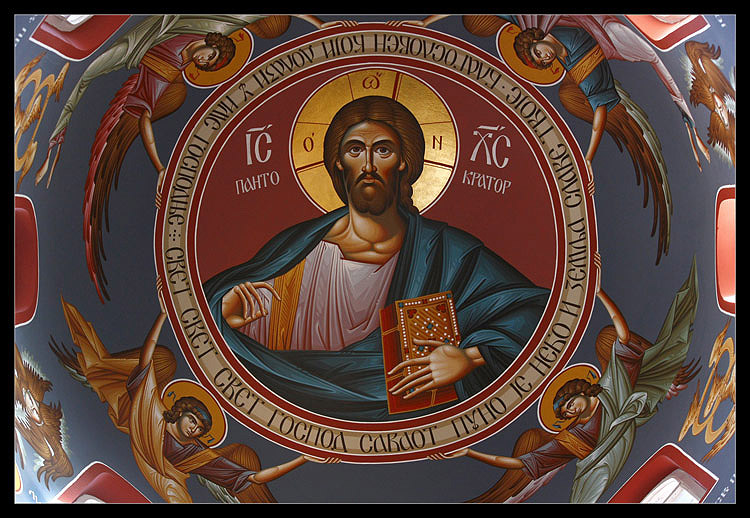
The images we fashion of Christ, of the Spirit (as dove and fire), and the Father (similar to the Son) are expressions of the reality of Christ. In the eastern traditions of Catholicism and in among some of our Orthodox brethren only Christ is portrayed as a theological point that the Spirit and Father are both never seen or described, but that the image of Christ is also the image of the other two. I think the iconography of the east also has powerful and rich meanings behind it. Catholics too express the reality of God revealed through their art. Calling it blasphemous and idolatry is not only ignorant but foolish in light of the Gospel.

Christ the All-powerful (Pantokrator)

Thursday, October 18, 2012

Faith and Works: Introduction

I. Introduction

For the average person, the debate of faith and works will change little in their lives with regard to how they live it out. Even still, I urge anyone who considers themselves a student of faith and of Christ to examine more closely the relationship of faith and works. The reason is not because I wish to change your faith or to suggest one good work over the other but rather that the way which we conceive a relationship between ideas affects those ideas.

I will give two analogies to help illustrate this:

A basketball coach conceives that defense wins games and because of this the offense of that team will proceed from the defense (e.g., turnovers lead to fast-break points, etc.). This is to say that the idea about defense builds the idea of the offense.

Tom Thibodeau, coach of the Chicago Bulls, prides his team on perfecting their defense first. The Bull's refined defense leads them to shutting down teams and winning even if they shoot 30% or score only 80-some points. Their offense depends on their (and the coach's) passion and vision for defense.
Likewise, when a man and a woman are married, one (or both) may have an image about what their marriage should look like, such as what a good husband/father/man does and what a good wife/mother/woman does. They make this image of what the relationship should strive for and they order their daily lives, thoughts, and actions to look like that idea and image—for good or ill.
Regardless of all the work that goes into the perfect photo, reception, and wedding, a couple gets married in order to live a full life together, a life of trials, periods of loneliness, difficulties, and disappointments just as much as they will experience joy, peace, and togetherness. The difficulty lies in the greater emphasis being placed on perfecting the beginning as opposed to perfecting each other along the way.

What I mean by these two analogies is that the way we look at faith and works are important. Where we may have an idea of faith and an idea of what (good) works are, the relationship between faith and works is a third idea added to these two. It is the nature of these ideas, so to speak, that I would like to write about for you.

As I considered the relationship between faith and works I found that the matter can be more difficult than it first appears because of the nature of faith. Faith can be a difficult subject for a few reasons. On the one hand faith is a very personal affair, for each one of us has experienced God in a particular way and we have grown in that relationship in various manners. On the other hand, the purpose of faith is unity, not just with God but with each other as well, for “I pray … that they may all be one, as you, Father, are in me and I in you, that they may also be in us, so that the world may believe that you sent me” (Jn 17:20, 21). Faith is furthermore described as “the realization of what is hoped for and evidence of things not seen” (Heb 11:1) which is related to ourselves as well as for the whole world. For why else would we pray, in faith, “Thy will be done on earth as it is in heaven” if it wasn't for the hope that all might be as one? In the Old Testament the covenant was for a people of God. Whether the king of Israel sinned or the people sinned the whole land was afflicted with injustice and many other evils. Faith in Christ is the new covenant. Through that faith we are all connected. Far be it from me to suggest faith is impersonal, but I hope to show in addition to faith being deeply personal that faith is at its core equally communal.
This depicts Moses speaking to the children of Israel. All of them are intently focused on him. They receive one word and one people which has come from one God.

When I reflected on works I found that whether or not one believes in the efficacy of works for salvation it nevertheless follows that good works are preferable to evil ones. Further still, whether good works are inspired by the Spirit or come about as a result of personal effort (or both) they are often considered a sign and expression of faith. Works point toward that supreme Good toward which all men strive to varying degree. I do, however, still plan to speak on works as they pertain to Scripture and how they pertain to faith in greater detail.

My overall goal is to elaborate on the relationship of faith and works in a manner that neither diminishes nor emphasizes one over the other. In short, how shall we understand this passage by James? “You see that faith was active along with his works, and faith was completed by the works … See how a person is justified by works and not by faith alone” (James 2:22, 24).

With these introductory remarks being said I will move onto my investigation in subsequent pieces. I shall begin by moving away from directly speaking about this matter and instead focus on love. Perhaps if we examine love more closely we will see more clearly the matter at hand.


For next time:

“To Speak of these Things We Must Speak about Love”