After I went to Confession this morning
I began to consider forgiveness. As I did, I returned again and again
to myself—but I don't mean egotistically. I reflected on the moment when we
sin, especially when it's that embarrassing, stupid, and every-time sin. And after we fall into that same sin (time and time again) we tend to get upset with ourselves, feel ashamed, and many
other things. For the one who has faith, however, he looks to Christ to
forgive him. This in itself is not bad at all.
I then began to wonder: We reach out to
be forgiven and we entreat God with sighs and tears. But the truest fruit
of that forgiveness (and mercy) is a conversion, a change of heart.
But I think that in order for a conversion of heart to occur we also have to allow
ourselves to be forgiven as well. If there is a gift that someone
gives it must also be received. And how do we receive a gift? With
gratitude, of course.
The gift of forgiveness, however, is no
mere gift. It is one of the greatest gifts.
We should consider how the Lord sees us
when He forgives us: he is like the bridegroom who rejoices in his
bride (e.g., Ez 16:6-14, 59-60; Is 54: 5-8). He is the father who
lovingly embraces his son (Lk 15:20-23). He is the shepherd who
sacrifices himself for his sheep.
But let's reverse the image. How ought
the bride, the son, and the sheep feel about themselves?
My friends, it is hard to forgive
others at times, even when they're truly sorry. How much harder is it
to forgive ourselves!
What I mean is this: we know God loves
us and is ready to forgive. We (laymen), sadly, lack the ability to
readily forgive sins in our ministry. We can, however, love and
forgive others. But how can we really practice this if we're not
prepared to love ourselves—to love ourselves as we are loved? There
are those who say that there is nothing good in man, but what they
are saying is that man is not worth loving. Man is, by his nature,
good—our bodies themselves are temples for the Holy Spirit! See
that “God formed man to be imperishable—the image of his own
nature he made him” (Wis 2:23).
 |
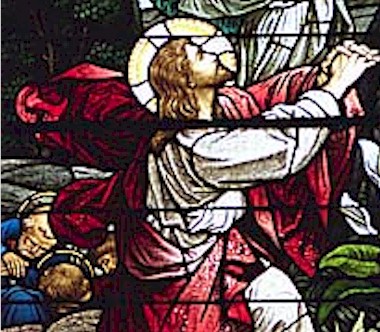
| Christ Himself prayed for us even as he trembled at the prospect of death. |
In this way if we are to fully
receive forgiveness we must learn to love ourselves as God loves us.
(Note that I do not say “truly” which would mean “we
won't be forgiven unless we love like this.” We need to learn
to love in this manner which is why I say “fully”).
God loves us, so he chastises us. We
must also chastise ourselves.
God has mercy so we must be merciful
with ourselves.
For remember that “you [God] taught
your people … that those who are just must be kind” (Wis
12:19). Even kind to ourselves.
As such, the full reception of
forgiveness is the reestablishment of a lost or damaged
relationship. Something wounded or broke that relationship and love, mercy, and forgiveness want that relationship
to be fixed. Yet, at the same time, though we can really want someone
to reconcile with us only that person (who betrayed our trust/love/confidence) can complete that
reconciliation.
You can see the difference that takes
place after someone is forgiven: it is just as when the crippled man
walked, the blind man saw, and the mute man spoke. There is a real
change. I'm not saying that every time we forgive someone the
mountains should shake, but if the person receives your forgiveness and is affected by a your constant love there
should be a change in the person. This is what brings that forgiveness to
completion—but note that this can be immediate or gradual.
 |
| Some journeys and climbs are difficult, but with patience and time we reach the end. So too with our souls and our bad habits--we have to attack them slowly and with patience. Be prepared for a climb. |
But how can we tell a change has taken
place in someone else (for the better)? How do we discern this?
The answer may rest within us.
With some introspection and self-reflection we can discern a few
things:
If we desire forgiveness, do we accept
it and love ourselves? If not, do we dwell on our shame or end up hating
ourselves? Self-hatred in this case is a form of self-absorption. We
care more for our opinion of ourselves than the love of He who gives
it freely.
 |
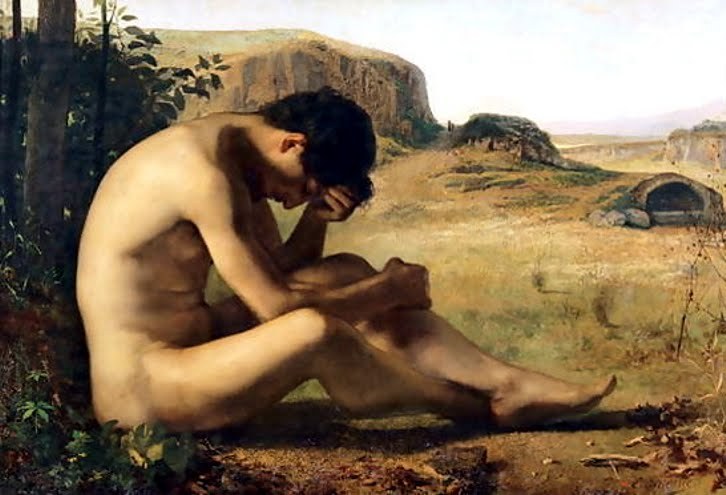
| We can end up in this state but do not remain in it. |
When one loves us they want what is
best for us. When we love ourselves with a holy love we want what is
best for us too. Those who dwell on their sins are a slave to that
sin. The one who hates himself is a slave to himself. As such, do you
change yourself in a visible way so as to get better? If your
weakness is pornography do you remove yourself from the situations
that lead you to view it? If your weakness is gossip do you avoid
situations where you can hear it? Do you make an effort to remove
yourself from the environments that lead you to sin with the
appropriate caution and care necessary for it? Or do you lament the
sin and, in effect, change very little except the bitterness with
which you hate the sin or yourself? Conversion occurs in little steps
and, over time, you will see change. Change for the better is a sign
of self-love and conversion.
Consider the parable of the Prodigal
Son: The father loves his son with love inexpressible and worries
for him with an anxiety that's unbearable. This alone does not make
the relationship whole, but the ground is fertile. It is not until
the son returns that the story is resolved. He expects only to serve the father—he knows the
weight of his guilt. But the father raises him up and rejoices. He
embraces him and prepares a feast. The son is transformed by his
desire to be forgiven. First he just desires to be under the father,
but when his father declares a feast for him he accepts it, not with
pomp or haughtiness, but with silent gratitude.
 |
| Consider the story, consider still the response of the son. |
This reconciliation should
be considered as a model for us with respect to others and with
special regard to the Church. Some are removed from the Church, but
as the Catechism of the Catholic Church (CCC) says, “There is no
offense, however serious, that the Church cannot forgive.
"There is no one, however wicked and guilty, who may not
confidently hope for forgiveness, provided his repentance is honest.
Christ who died for all men desires that in his Church the gates of
forgiveness should always be open to anyone who turns away from
sin”(982).
And so if we love ourselves we will be
changed. When we're loved by others and accept it more fully we will
be transformed. How much more will we be transformed when we learn to
love ourselves, allow ourselves to be loved by others, and allow ourselves to be loved by God? Love effects a
change in us, but only when we also realize that it will make us vulnerable and
humble.
Remember, then, that we cannot be
grateful for a gift we don't accept.
Peter denied Christ three times. But
three times Christ asked him “Do you love me?” With each “I
love you” came a command—when we respond to God's love he desires
both action and conversion. He said to Peter “Feed my lambs …
[and] follow me.”
And so, shall we truly say “forgive
us our trespasses as we forgive those who trespass against us”?
Do we truly believe that we should love
God with our whole heart, mind, being and soul and
“love your neighbor as yourself”?
***
As a side note, I'll be in Guatemala in less than 18 hours. Please comment and I hope to put up a lot of nice pictures while I'm there. Reflections too!
M
(Edit 8/9/2012: cleaned up some diction)