Showing posts with label forgiveness. Show all posts

Thursday, March 6, 2014

Holocaust Reflection : Reflection on Us

Visiting the Holocaust Museum is a difficult subject, especially in Israel. Unlike many museums which are houses of a people's history and triumph, this museum is a walk through a people's history and suffering. The Holocaust stands as a mark of identity for modern-day Jews just as World War II stands as a mark of identity for most Westerners of the past three generations (born 1910-1995).

We are now moving into the third and fourth generations past the Holocaust and WWII, where things such as “Nazi” and “Communist” and people such as Hitler and Stalin have become more of a byword than a warning for future generations. Many people are all too likely to associate government actions with the Nazi party and many people are just as ready to roll their eyes.

When visiting Yad Vashem (the site of the Museum) I entered with a reverent and somber silence, in my mind befitting such a chapter of our human history. I found it odd, then, to find teenagers in there laughing, boyfriend and girlfriend attempting to have an intimate moment in the shadow of child torture, or as some friends cited, a teenager goosestepping out of the museum.

This is our humanity: how quickly we forget, how quickly we stop caring.

As we all grow older and as time marches forward we find how chilling and correct these words are: “For of the wise man as of the fool there is no enduring remembrance, seeing that in the days to come all will have been long forgotten” (Ecc 2:16a).
Part of the ministry of Yad Vashem is to give some sort of remembrance to the names and people who were lost.

It's easy to blame these kids, but such is the time, era, and maturity we all came from. Some grow up to recognize immaturity, others grow into immaturity.

One important lesson I took from the Holocaust and the museum is prefaced by the following statements:

1) Ordinary men and women did horrible things out of fear, vice, coercion, and sometimes all three.

2)Both religion and science were used as tools to carry out this exercise; any blame of one or the other would be dishonest and folly.

The important lesson to take from such a chapter of our history is to see ourselves in that history. This is not to see you or I caused the Holocaust, but to see how, in the human condition, vice and sin caused it, as it causes the greatest tragedies.

Fear keeps us from doing good, but vice helps us to spread evil. Many will say, “I haven't killed anyone, I haven't stolen anything. I'm a good person!” History seems to say, “Just give yourself a chance.”

How easy it is to call ourselves enlightened, intelligent, and wise in the face of such things. It would be unwise to see the little evils we allow in our own lives as “good” just because they aren't “really bad.” The road to great evils begins with tolerating small evils. In my mind the easiest source of determining evil begins with the dignity of the human person.

In any era and in any place the first people to suffer, in good times or bad, are the ones who are despised and defenseless. This can be the unborn, the abused, the poor, addicts, or the mentally disabled. Furthermore they can be, in the right circumstances, those imprisoned, homosexuals, religious, or even a-religious.

Many evils are carried out for greater goods or ideologies that don't need wrinkles—and while it's easy to blame religion alone in this sphere, anything secular or otherwise would subscribe to folly if they thought it was true.

Even more evils are carried out because we lack the ability to forgive and seek forgiveness. An open wound festers, but a bound wound has a chance to heal. I find that this is the hardest thing to learn: forgiveness and self-forgiveness.

Humanity likes to see itself in great triumphs and accomplishments, but it's much harder to look in the mirror when it's something disfigured and horrible. But in looking upon it there is also healing. In accepting the evil we do and converting from it there is progress.

We rightly pray this Lent for mercy because we need it, and we know we do. “My sacrifice to God is a contrite spirit, a humbled and contrite heart you will not spurn” (Ps 51:17).
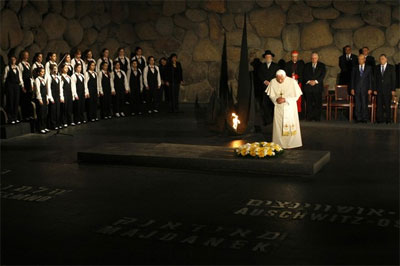
This Lent say a special prayer for the many families and lives ruined or lost by war and evil.

Saturday, March 23, 2013

Drawing all to Him

A reflection I gave at mass today. The readings may be found here: USCCB website
Please leave some comments below.


God, in his great love, wishes to gather all people to himself. In this grand campaign the Lord asks each of us to be conquerors. Greater still he asks us all to be living borders of his kingdom.

In the time of Jesus, a Jew could only seek forgiveness for his sins in the temple. The Jews considered the temple the center of God's kingdom and the borders of Israel the dwelling place of God. Jesus, when he proclaimed “Destroy this temple and I will raise it in three days” was speaking of himself. He replaced the temple of Jerusalem with himself. It is through Jesus that we are forgiven our sins and it is to Him all people should gather.

Truly, God's love is great because he gave the Jews a temple and a place to heal from their sins. His love is even greater because where many would not or could not go to the temple for healing, Jesus, the new Temple, came to them.

Jesus sends us forth, out of love, for those who do not know him. By our words and actions in this world we extend this holy place, this church, to all of those who are outside of it. We amplify the borders of this church in hope of drawing all to Christ, who is our sanctuary.

We are conquerors over sin and death when others return to Christ on account our words and deeds. Jesus, present in the holy Eucharist, is the temple where one finds pardon and peace.

Draw others to Him so that we may all rejoice in saying “We are his people, and He is our God.”

Friday, July 6, 2012

On Forgiveness


After I went to Confession this morning I began to consider forgiveness. As I did, I returned again and again to myself—but I don't mean egotistically. I reflected on the moment when we sin, especially when it's that embarrassing, stupid, and every-time sin. And after we fall into that same sin (time and time again) we tend to get upset with ourselves, feel ashamed, and many other things. For the one who has faith, however, he looks to Christ to forgive him. This in itself is not bad at all.

I then began to wonder: We reach out to be forgiven and we entreat God with sighs and tears. But the truest fruit of that forgiveness (and mercy) is a conversion, a change of heart. But I think that in order for a conversion of heart to occur we also have to allow ourselves to be forgiven as well. If there is a gift that someone gives it must also be received. And how do we receive a gift? With gratitude, of course.

The gift of forgiveness, however, is no mere gift. It is one of the greatest gifts.

We should consider how the Lord sees us when He forgives us: he is like the bridegroom who rejoices in his bride (e.g., Ez 16:6-14, 59-60; Is 54: 5-8). He is the father who lovingly embraces his son (Lk 15:20-23). He is the shepherd who sacrifices himself for his sheep.

But let's reverse the image. How ought the bride, the son, and the sheep feel about themselves?

My friends, it is hard to forgive others at times, even when they're truly sorry. How much harder is it to forgive ourselves!

What I mean is this: we know God loves us and is ready to forgive. We (laymen), sadly, lack the ability to readily forgive sins in our ministry. We can, however, love and forgive others. But how can we really practice this if we're not prepared to love ourselves—to love ourselves as we are loved? There are those who say that there is nothing good in man, but what they are saying is that man is not worth loving. Man is, by his nature, good—our bodies themselves are temples for the Holy Spirit! See that “God formed man to be imperishable—the image of his own nature he made him” (Wis 2:23).
Christ Himself prayed for us even as he trembled at the prospect of death.

In this way if we are to fully receive forgiveness we must learn to love ourselves as God loves us. (Note that I do not say “truly” which would mean “we won't be forgiven unless we love like this.” We need to learn to love in this manner which is why I say “fully”).

God loves us, so he chastises us. We must also chastise ourselves.
God has mercy so we must be merciful with ourselves.
For remember that “you [God] taught your people … that those who are just must be kind” (Wis 12:19). Even kind to ourselves.


As such, the full reception of forgiveness is the reestablishment of a lost or damaged relationship. Something wounded or broke that relationship and love, mercy, and forgiveness want that relationship to be fixed. Yet, at the same time, though we can really want someone to reconcile with us only that person (who betrayed our trust/love/confidence) can complete that reconciliation.

You can see the difference that takes place after someone is forgiven: it is just as when the crippled man walked, the blind man saw, and the mute man spoke. There is a real change. I'm not saying that every time we forgive someone the mountains should shake, but if the person receives your forgiveness and is affected by a your constant love there should be a change in the person. This is what brings that forgiveness to completion—but note that this can be immediate or gradual.
Some journeys and climbs are difficult, but with patience and time we reach the end. So too with our souls and our bad habits--we have to attack them slowly and with patience. Be prepared for a climb.

But how can we tell a change has taken place in someone else (for the better)? How do we discern this?

The answer may rest within us. With some introspection and self-reflection we can discern a few things:

If we desire forgiveness, do we accept it and love ourselves? If not, do we dwell on our shame or end up hating ourselves? Self-hatred in this case is a form of self-absorption. We care more for our opinion of ourselves than the love of He who gives it freely.
We can end up in this state but do not remain in it.

When one loves us they want what is best for us. When we love ourselves with a holy love we want what is best for us too. Those who dwell on their sins are a slave to that sin. The one who hates himself is a slave to himself. As such, do you change yourself in a visible way so as to get better? If your weakness is pornography do you remove yourself from the situations that lead you to view it? If your weakness is gossip do you avoid situations where you can hear it? Do you make an effort to remove yourself from the environments that lead you to sin with the appropriate caution and care necessary for it? Or do you lament the sin and, in effect, change very little except the bitterness with which you hate the sin or yourself? Conversion occurs in little steps and, over time, you will see change. Change for the better is a sign of self-love and conversion.


Consider the parable of the Prodigal Son: The father loves his son with love inexpressible and worries for him with an anxiety that's unbearable. This alone does not make the relationship whole, but the ground is fertile. It is not until the son returns that the story is resolved. He expects only to serve the father—he knows the weight of his guilt. But the father raises him up and rejoices. He embraces him and prepares a feast. The son is transformed by his desire to be forgiven. First he just desires to be under the father, but when his father declares a feast for him he accepts it, not with pomp or haughtiness, but with silent gratitude.
Consider the story, consider still the response of the son.

This reconciliation should be considered as a model for us with respect to others and with special regard to the Church. Some are removed from the Church, but as the Catechism of the Catholic Church (CCC) says, “There is no offense, however serious, that the Church cannot forgive. "There is no one, however wicked and guilty, who may not confidently hope for forgiveness, provided his repentance is honest. Christ who died for all men desires that in his Church the gates of forgiveness should always be open to anyone who turns away from sin”(982).

And so if we love ourselves we will be changed. When we're loved by others and accept it more fully we will be transformed. How much more will we be transformed when we learn to love ourselves, allow ourselves to be loved by others, and allow ourselves to be loved by God? Love effects a change in us, but only when we also realize that it will make us vulnerable and humble.

Remember, then, that we cannot be grateful for a gift we don't accept.

Peter denied Christ three times. But three times Christ asked him “Do you love me?” With each “I love you” came a command—when we respond to God's love he desires both action and conversion. He said to Peter “Feed my lambs … [and] follow me.”

And so, shall we truly say “forgive us our trespasses as we forgive those who trespass against us”?
Do we truly believe that we should love God with our whole heart, mind, being and soul and “love your neighbor as yourself”?


***

As a side note, I'll be in Guatemala in less than 18 hours. Please comment and I hope to put up a lot of nice pictures while I'm there. Reflections too!

M

(Edit 8/9/2012: cleaned up some diction)

Saturday, June 30, 2012

On Confession (and the Priesthood)


[This is an extended and more in-depth version of the one available on the Knights of Columbus,  Tonti Council's Website]


My dear brothers and sisters in Christ,

As I was praying with my rosary I began thinking about what it means to be a Knight of Columbus [an all-men group who dedicate themselves to fraternity, charity, support of their local churches, and support of priests and bishops]. I would similarly like you to think about what it means to be an adult and member of our Church. The qualities of loyalty, perseverance, and courage come to mind quickly. But as knights of our holy Catholic Church we are called to have an additional set of virtues which are faith, hope, and charity.
Check them out at their website: KOC

We and the Church by our efforts do a great deal of good, and I think we should be proud of that fact. Nevertheless we can also point to times when we're weak, forgetful, and sinful. This is where God comes in—he is our strength, our sword, and our shield. He gives us many personal graces but His greatest gifts are the Holy Eucharist and the other sacraments.

And the key word here is that they're gifts. We don't have to pay for them and sometimes we feel like we don't deserve them but, all the same, they are given for us to take.
The Sacraments founded on the Source of Life.

Now the sacraments Baptism, Marriage, Anointing of the Sick, Confirmation, and Holy Orders are not so much our concern here. What I want to focus on is the Eucharist and Confession/Penance/Reconciliation. Now, I trust all of us regularly attend mass—if not I encourage you wholly!— so my sincere urging this time will be to accept and embrace the gift of Confession.

Many of us readily accept the joy of Baptism and Marriage, and many of us stand before the altar to receive our Lord, but so many of us run away from the Sacrament that was central to Jesus' earthly ministry—that is to say forgiveness.

We all know the command that Jesus gave to His whole Church: go and baptize all nations in the name of the Father, Son, and Holy Spirit. In this commission we are all 'ones who are sent,' which is to say apostles and disciples.

But Jesus gave a command to His priests, his Apostles specifically chosen from among the people just as the elders of Israel were assembled by Moses (cf. Numbers 11:16-17). This time, however, it was not merely a prophet but the divine Word that selected these men.

For those who would doubt the priesthood of the Apostles, her special function, and the validity of their successive line, consider the following:

He chose twelve men, eleven who remained, to reveal the Word to all by their preaching and priestly ministry. For Christ told them at His last supper “whoever receives the one I send receives me” (Jn 13:20). He selected them from among the people to reveal the meaning of his teaching and to be leaders to those they gathered. As they spread the Word, they also laid their hands and selected from among the many communities men of sound character and true faith to carry on their work. They had the people assemble those from among their own who were “filled with the Spirit and wisdom” (Acts 6:3) so they might be “appointed” for a specific task. Then the Apostles “prayed and laid hands on them” (6:6). These men here were deacons but priests (and even bishops) were also selected from the line of the Apostles. For St. Paul tells Timothy (a bishop himself) to “stir into flame the gift of God that you have through the imposition of my hands” (2 Tim 1:6). That gift is the priesthood specific to the Apostles. Even Paul himself was “appointed [by Christ] as preacher and apostle and teacher” (1:11). Furthermore he praises presbyters [Greek word for priest or elder] who preside well. All the same he warns him, “do not lay hands too readily on anyone [so as to confer this priesthood on them]” (1 Tim 5:22).
The seven men first chosen by the Apostles, men whom they laid their hands upon.

A tradition which continues today.

Truly, let anyone who denies a specific and holy priesthood among the faithful consider these words.

As such Christ selected his Apostles from among the many others he met and set them apart. Christ commanded them: Go and forgive the sins of my people and lead them to me. Be to them as I am to you (and so share the burden of my mission in a special way), give them my Body and Blood and give them forgiveness of their sins.

The Apostles stand as both a representation of mankind in that they are and were like us: weak, fearful, and doubtful. But they stand apart in that they were raised by Christ to bear His name and participate in his royal priesthood. He “gave them authority over unclean spirits and every illness” (Mt 10:1) and to give this gift freely (cf. 10:8). Furthermore, when Christ forgave the sins of the paralytic those around him questioned him and accused him of blasphemy. Yet to prove that He could forgive sins he healed him as well. But, at the end of this passage it states: “But the crowds, seeing this, were awestruck and glorified God who gave such authority to men” (my translation from the Greek, Mt 9:8). A fuller treatment is necessary, but not here. For our purposes it is worth reflecting on why the plural was used by Matthew and that the authority in question was the forgiveness of sins.
All that effort and Christ decides to heal him of his sins first.

This is where Confession is so important. This is the sacrament of healing, the healing of one's sins. And this sort of healing was preferred to the healing of the body (cf. The story of the paralytic, Mt 9:1-8). My brothers and sisters, it is easy to be courageous against a shared threat and it is easy to be courageous against something from the outside. But even truer courage comes from recognizing the threat inside of us: the stain of sin and how we, at times, let the enemy into our gates.

Yet as knights, that is to say faithful Catholics, we are to protect our priests and protect those who are as “sheep among wolves.” We can only be strong when we are weak, that is to say that we must humble ourselves. We can only show others how to convert their hearts when we convert their own. By allowing Christ into our hearts through the Sacraments we are transformed by that grace. We allow, humbly and with joy, simple and concrete realities to effect a great change in us. For in the same way Christ effected a great change in the world by adopting our frail and small humanity—something we received with joy.

Jesus said that we should not fear those who harm our body but rather the Enemy who can harm our soul (cf. Mt 10:28). Confession is a gift that remains unopened and unused, especially here in the United States and Europe. If no one goes, no one cares or notices. I encourage you all to strengthen your soul by a regular reception of the Eucharist and an attempt to regularly receive this great sacrament.

As we walk before the altar we ask for the greatest gift ever given. In Confession we are prepared to stand before the altar, we are instructed by holy priests (find one you know and trust!) to recognize sin and our sinfulness, and we are given Christ's peace. How often is it that we believe we know our own hearts—yet it turns out we live in self-doubt, darkness, and ignorance. This is the true gift of friendship, of good people, and good priests! They will help you know yourself.
"Show me the way to Ars and I will show you the way to Heaven." ~St. John Vianney
A priest, one whom you can trust and one whom you can be honest with will do more for your soul than any personal prayers could accomplish. Personal prayer should never be abandoned, but neither should your priests—let alone the whole body of the Faithful!

Remember that “he who conceals his sins prospers not, but he who confesses and forsakes them obtains mercy” (Prov 28:13). How easy it is to 'conceal our sins' by keeping them to ourselves, saying them only in our head. Even this can be hard. How much harder, yet more freeing, is it to confess openly and in person? But the person you are confessing to is one completely and readily willing to forgive those who seek conversion and absolution. This is because he was commissioned by Christ, installed by His holy Apostles through Him, to help 'share the burden of the people of God.'

Stand up for those who are afraid and ignorant of their own sinfulness and confront your own. It is by the strength of all the Sacraments of the Church—gifts of God—that we will flourish!


Yours in Christ and a sinner like you,

M