Showing posts with label Augustine. Show all posts

Saturday, November 23, 2013

The Problem with the New Evangelization

God bless the effort of the New Evangelization. It encapsulates, I think, what many of us faithful Catholics have desired to see (more) publicly for years. Even in my youth I always wondered how so many faithful Catholics relied on their opinion as opposed to integrating the words of the Church, words I found as very beautiful. This is, of course, a reflection in my adult years on my youth. Here's what it may look like:

"Mom, we learned at school today ..."
She replies, "That's great, honey!"
"What do you think?"
"That's good, I just think a little bit differently."
"Why?"
She then proceeds to explain that her experience or ideas tell her that things are different.

It teaches kids that personal experience trumps teaching--an ironic parenting technique. Kids grow up and learn many good things but then there's the real world. Sex is a reality, contraception is a safe reality, etc., etc. They grow up, they use what they've been taught that's useful and the rest is their best judgment.

"And the beat goes on...."
There's always room for experience in life. Experience teaches us and forms us. Experience, however, and our experiences, are not principles of action. Experience tests the limits of principle. They help us gather data in order to form principles or see patterns at work.

If one says, "In my experience no one ever listens to you if you use the Bible" is an experience stated as if it were a principle. One who says, however, "With Protestants I've found Scripture is effective but with atheists and agnostics reasoning and philosophy are more profitable." This is experience that indicates a certain prudence. Prudence is a virtue and a sort of principle (Always act prudently) and experience helps us see what that looks like.

I. Witness

This digression aside, I am happy Catholics are coming out in droves to defend the Church, to be public with their faith, to yearn for clarity and understanding, to confront evil in society, to desire God through prayer, to (gasp!) read Scripture, and to dedicate their intellects for the search of a truth greater than all of us as opposed to opinions which are less than themselves. This is a good thing. Lord, give success to the work of our hands!

My concern, however, is that we progress like soldiers to a battlefield as opposed to progressing like lemmings toward a cliff.

What do I mean? The word for witness is "martyr." Being a witness to the faith is being a visible sign of Christ's saving love to the world. Witness is public, it's living in such a manner that what you believe is evident from your life. In many cases this is a powerful tool for conversion: one learns in the most concrete way, that is by example, that the faith is livable and it can make you happy (regardless of your state in life). This is evangelization in its simplest form, right? I'm not inclined to think so.

In my view witness attracts and evangelization holds onto. No amount of well-crafted, balanced words will make someone Christian. Only God can produce that sort of effect in our lives and only He can penetrate our stony and prideful hearts. Witnessing to the faith reveals God to the world. It shows those who look on, those who are doubtful, that God is active in the world and personally in our lives. Recall from the Gospel of Mark that Jesus is declared the Son of God by a man only when He dies on the cross.
"Jesus gave a loud cry and breathed his last. The veil of the sanctuary was torn in two from top to bottom. When the centurion who stood facing him saw how he breathed his last he said, “Truly this man was the Son of God!" (Mk 15:37-39)
Truly Jesus Christ was the perfect witness, the perfect martyr. The cross symbolizes many things: sacrifice, love, and rejection. It symbolizes much more. The cross stands as a strange image. It draws people to it, whether by disgust or hatred for it, for sorrow of it, or admiration of it. That's the life we're called to lead: a life that is a witness to the cross. "But may I never boast except in the cross of our Lord Jesus Christ, through which the world has been crucified to me, and I to the world" (Gal 6:14).

II. Evangelization 

Evangelization, however is different. Perhaps an image will illustrate what words cannot. Christian life is a fire. Witness is the light of that fire but evangelization is the warmth. We are drawn to a fire by its light yet we are compelled to stay by its warmth.

Evangelization contains with in it catechesis, apologetics, preaching, among other things. Various people have certain gifts given to them by the Spirit: some are able to teach and defend the faith while others are able to effectively convey the Gospel message. The USCCB has defined for us the goal of the New Evangelization:
In a special way, the New Evangelization is focused on 're-proposing' the Gospel to those who have experienced a crisis of faith. ... Pope Benedict XVI called for the re-proposing of the Gospel "to those regions awaiting the first evangelization and to those regions where the roots of Christianity are deep but who have experienced a serious crisis of faith due to secularization."


So many of us label our work, our millions of blog posts, and our efforts as "evangelization." This is simply not the case. There is always room for us to relay an experience of strength-in-crisis given to us graciously by Christ. There is room for us to lament insufficient theology, culture, or some offense, but it is not evangelization.

If we are to truly evangelize this culture we cannot simply propose a perspective or practice apologetics (i.e., defend the faith from attacks). We must proclaim the Gospel, that is proclaim the positive claims and truths of revelation, Scripture, and Tradition. If you want to evangelize you must study these things (studying history, science, philosophy, popular culture, etc. doesn't hurt either).


We would all do well to remember that "the wisdom of what a person says is in direct proportion to his progress in learning the holy scriptures--and I am not speaking of intensive reading or memorization, but real understanding and investigation of their meaning" (Augustine, On Christian Teaching, IV.para 7).

Likewise, "Eloquent speakers give pleasure, wise ones salvation" (Idem.)

Nothing will inflame our hearts quite like the Word. 
Not just in reading and memorizing, but penetrating, praying, and understanding.

Evangelization requires prayer, study, and reflection. It also demands a certain training in rhetorical arts, such as clarity of conveyance, force of images, and knowledge of what will speak to the listener.

So many of us, myself included, feel that we further the cause of evangelization by saying nice words about our experiences of grace and prayer. But this only serves as a light in the darkness. Without a serious commitment to Scripture we give a light without warmth.

The New Evangelization is, as many have pointed out, not new in its message. Rather, the "newness" of it all is perhaps best described as a new 'zeal' for the labor so badly needed.

So those who are attempting to try something new my recommendation would be: look to Scripture, look to prayer, and that beauty which is ever ancient, ever new. Thereafter look to Tradition, the Fathers, and the Church. In all this, being an active member of the Church is all the more important: support your local church, your priest, and make yourself a public witness there for our charge is to not only draw new souls to Christ but strengthen those whose spirit fails within them.

Continue to shine the light of Christ to the world by your witness and do not cover it with anything. But in order that they might say, Were not our hearts burning within us while he spoke to us? (cf. Lk 24:32) it is necessary that we begin with Moses and all the prophets, interpreting them what refers to Him in all the Scriptures (24:27).

We can do this in many ways. How you decide to do so is your task. Do not draw anyone to the light but leave them cold.

Our love will keep others close but those who struggle are not looking for us and we are not anyone's fulfillment. Rather we are like John the Baptist, a voice crying out in a world that denies truth and embraces the self.
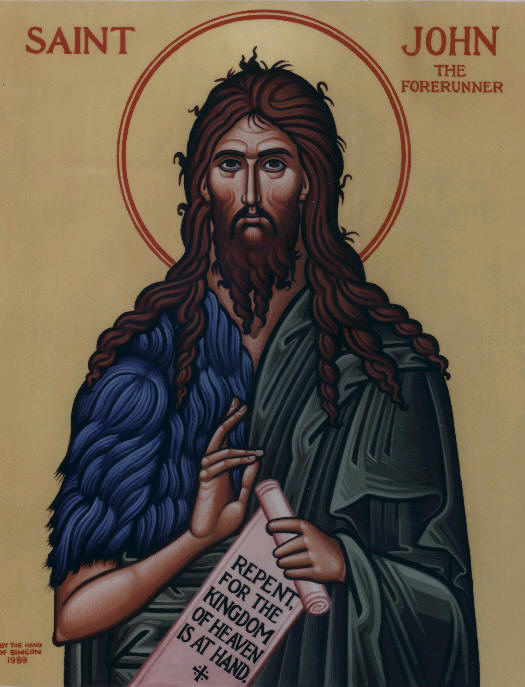
  

Rather, the Law of the Lord is their joy (Ps 1:2a) and O God, you are my God--for you I long! For you my body yearns; for you my soul thirsts, like a parched land, lifeless, and without water (Ps 63:2). Give them this. Do not show them that it exists, but say to them as John did, "Behold the Lamb of God" and do it in such a way that those who listen hear what you say and follow Jesus (Jn 1:36-37). Only then will our joy be complete (3:29-30).

Wednesday, February 20, 2013

The Temptation in the Desert, Part 1

Author's Note: This was originally given as a homily for my classmates, the main points at least. It was meant to be for last Sunday's readings (first Sunday of Lent). I was surprised by the positive feedback despite my own self-criticism. I decided to formalize this a little and organize it as I had originally intended. 

I also decided to split this up into two parts. First, because if I didn't it would be somewhat long, and secondly, because I felt that there might be too much information given out at once. Enjoy, and please leave comments and feedback if possible! ~Matt

===
Christ conquering the devil, putting Satan to shame, and his strength to resist temptation. We often associate the Gospel passage of Jesus in the desert with such notions and not incorrectly. What I propose, however, is to look at this passage in a different way. I will not take this passage as simply a display of Christ's power but rather show how this story in Scripture is a warning and a model for each and every one of us. The season of Lent is a time where we are led into the desert by the Spirit, if we choose to follow Him.

In order to understand Jesus' temptation we must better understand ourselves. In order to understand ourselves we must look at ourselves, not with eyes alone but with our hearts. I hope to facilitate this 'turning toward ourselves' with the following reflection.


The Desert

Some of us are often accustomed to believe that when Scripture or an early text mentions a desert that it's an uninhabitable wasteland. If a hermit were to go to an uninhabitable place, or Christ for that matter, he would surely die. A desert is, as part of the name implies, deserted. Another apt name that describes the desert is desolate, that is devoid of people. A desert was often considered a place apart from society, from community, and from people. It was here that Jesus went. He went in order to be alone.

The desert is a place of silence. When man enters the desert he has no one left to confront but himself. In silence, fasting, and prayer man removes everything that stands before him. The same is true with ourselves. We obstruct our vision of ourselves with noise, with indulgence, and with idle amusements. But, as Augustine said, 'Lord, you turned me around so I could look at myself in all my wretchedness and sin. Even when I tried to turn myself away from my faults you were there to constantly bring me back so I might look upon my sin and hate it' (cf. Augustine's Confessions, Bk. VIII, ch. 7, sec. 16).

Jesus went into the desert before he began his public ministry. He went into the desert to discern the Father's will for him. Here he was tempted, and here he teaches us.


Our Desert

In another manner the desert that Jesus enters is our own desert, the desert of humanity. Recall that the desert is not devoid of life but rather it is a place of simplistic life, straining to survive. Our humanity too is not devoid of goodness but on its own expresses goodness weakly and imperfectly. Christ, the fullness of creation and the wellspring of life, enters the emptiness of the desert.

The devil comes to tempt Jesus because he has put everything else aside in order to be with himself and the Father. The devil often contents himself on our own occupations: we distract ourselves from God and self with food, sex, television, friends, and an array of other things. The devil would rather have us distract ourselves. It is only when we grow closer to God that he visits that person.

The desert, furthermore, is an image of wandering. The famous example being Moses and the Jews wandering in the desert for a very long time. But reflect further that the Jews wandered in the desert so as to reach the Promised Land. The desert was a passageway. Many languished and perished in the desert, pulled equally by their desire to return to Egypt and reach the Promised Land (cf. Ex 16:3). Many did not want to reach the destination promised to them and thus wandered forever.

The devil desires that mankind wander in the desert of their own desires. The “Promised Land” is union with God. When our gaze is turned towards the eternal sun we transform our wandering. When we look to God, and the Cross, our time in the desert is a pilgrimage. When we satisfy ourselves merely with our desires we wander forever. We are all in the desert of our own desires, fears, and insecurities.

Is there a way out? The three temptations of Christ correspond to our the temptations we will experience in a life of faith. Though Christ is our example and strength, He calls us to emulate his actions—not in a literal-physical way, but a literal-spiritual way. For example: where Christ could go without food for 40 days, not all of us could. But if we have some attachment, some habit, or something that keeps us from God we are asked, as best as we are able, to give it up for these 40 days of Lent. Perhaps when Lent ends we continue the discipline we formed for ourselves.

Next time we shall look at the three temptations the devil presented to Jesus, what they mean, how Jesus overcame them, and the lesson we can learn from it.

Wednesday, June 27, 2012

On Tolerance

I'll begin with a jarring statement to most readers: it seems to me that the Catholic Church is really the most tolerant of anyone or anything.

This is because the Catholic Church has rightfully questioned everything and accepted what it must. It is derived from the fact that we see creation as good and, as such, there is nothing that exists separated from goodness—no matter how hopeless. We are tolerant precisely because we call things evil and because we call things good. These are like the actions of a wise gardener who prunes leaves and branches, allowing the good to grow properly and the bad to fall lifelessly.

Indeed, the history and hagiographies [lives of the saints] of the Church attest to this attitude. St. Martin of Tours, though he had the mighty pine tree cut he erected an altar in its place. He removed the worship of something false with the worship of something true—he did not remove worship.

St. Catherine of Sienna scolded and encouraged Gregory to return to Rome. She did not seek to rid the Church of the papacy but rid the Church of the errors of the papacy.

But it seems that others consider themselves more tolerant by virtue of their adherence to progress, equality, or some such idea. Secular-types may see themselves as tolerant because equality and liberty are good, even though many disagree as to what sort of good they are. Some see utility as good, others consequences, and others still tolerance itself as a good worth pursuing in its own right. I propose we step back for a moment and look at these matters in brief:

+Those who propose a sort of utilitarianism replace the notion of good with "useful" and "beneficial." These terms are often anything but permanent and subject to a great number of changes. This avoids the discussion of what is really good. It is also a disposition that lends itself to casting off one thing in favor of another, e.g., the old for the new. The old being "what doesn't work" and the new being "what does work." If anything, utilitarianism is almost always intolerant to things seen as obsolete.

I readily confess that this attitude can be adopted by those who espouse an objective good. For some, this is how they see Martin of Tours above: he replaced the old worship with a better one. But unlike this, with an objective good in place one may easily examine the means by which that good is achieved and why. And this is also why Martin of Tours did not act out of a desire for utility. He did not believe that it was more beneficial for Germans to believe in Christ, he believed that it was necessary.

+ Others still try to champion the idea of progress, but it is often without purpose or direction. Some try to give each human being everything but they often ignore what it means to be human. They often reduce human beings to mere biology and the human person to whimsical preference. That is to say there there is no purpose to life but happiness, whatever it may be.
But if one progresses without knowing from where or to where they are going, he might as well be going in circles, which is to say he isn't progressing at all.

Tolerance

Tolerance has been very watered down as of late. In reality we are all intolerant of some things. Even to the person shallow enough to believe tolerance is "I like X, but I'm not forcing you to like it [and other variations]" is intolerant of various things.

And yet the rubik's cube remains unsolved despite there being a solution.

So we must ask ourselves, 'Is tolerance really something that is self-evident? Or is it the case that the grounds for tolerance lies in something else?'

I would argue that without a proper discussion of what is good we can never truly discuss what tolerance is. And anyone who discusses tolerance has some idea of what is good, yet some have been foolish enough to suggest that tolerance is a good in itself. These ones really are the most confused of all on this subject. This is because they don't realize that in order to tolerate anything there must be something worth tolerating.

Toleration, as some have seen it, is to love the person regardless of who they are or what they do—within reason. They cite love as the key to tolerance, yet this in itself is a poor argument. When one examines love it is paradoxically the most freeing and oppressive of things.

Love is seen most powerfully between persons and less perfectly in things. Those who advocate tolerance (as a higher good than 'good') ask people to love others without a care for what they do. Yet, for one who is in love cares for nothing but what his beloved does.

When one makes tolerance a greater good than "goodness," what that person is really saying is that "since we cannot agree on what is really good, let us make peace, concord, and our personal happiness our aim. Let us allow what we both see as good to be determined by these things." This is all very good if we all lived alone but this is not the case nor is it practical.

Tolerance, I say, comes from an agreement on what is really good and not from an agreement that it is better to not pursue that answer. This is why I can tolerate the faithful and moderate (for lack of a better term) Muslim or Lutheran more than many others, since they agree that good must be pursued, defined, and lived.

But I believe that Augustine gives us great wisdom when he says "love the sinner but not the sin."

More specifically he says:

For this reason, the man who lives by God's standards and not by man's, must needs be a lover of the good, and it follows that he must hate what is evil. Further, since no one is evil by nature, but anyone who is evil is evil because of a perversion of nature, the man who lives by God's standards has a duty of "perfect hatred" (Psalm 139:22) towards those who are evil; that is to say, he should not hate the person because of the fault, nor should he love the fault because of the person. He should hate the fault, but love the man. And when the fault has been cured there will remain only what he ought to love, nothing that he should hate.

(Augustine, City of God)
The City of God, the glorious Church that awaits the day to truly proclaim "on earth as it is in heaven."


Some may decry what Catholicism labels as a fault, yet from her earliest days the post-apostolic fathers of the Church proclaimed that "no one is evil by nature." Rather, by sin man has perverted his nature and at times seeks what is temporary and whimsical as the truest good. One of the greatest tragedies of sin is that we do not seek our true and proper goods. One of the great graces of the condition of sin is that when we finally come to recognize the true good we love it and hate all else that tries to separate us from it. This is so that, by means of our own journey and will, we come to love God personally. And by virtue of that love of God we love and seek what is truly good and hate what is evil. Incidentally, hate has become a strong word whereas love has become a soft word. In reality love is an even stronger word than hate, for love makes us vulnerable since it calls us to change.

When others claim we are intolerant what they mean is that our value of good is not theirs, but this does not excuse those who are truly intolerant.

There is no exhaustive way of showing which Christians are tolerant, which are intolerant, and in the proper or improper means. But, as the old adage goes, "a tree is known by its fruit." One who engages in violence, coercion, and slander for "love of the person" ought to reconsider tolerance. On the other hand those who are apathetic, noncommittal, or lax should reconsider how tolerant they are.

For my own part I see tolerance in its truest form exemplified by Christ. As God readily desires to pour out his mercy he also directs and commands us to change our hearts.

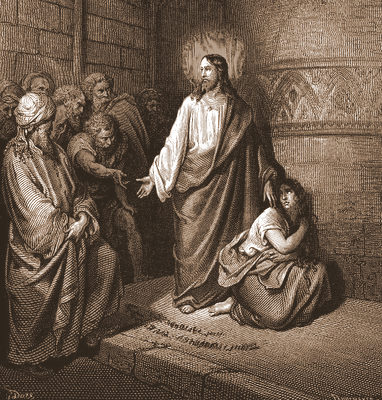
In this famous passage, an adulterous woman is brought forward both because she was an affront to the law and because she was being used to condemn Jesus. At its conclusion is our own lesson here:

"He was left alone with the woman before him. Then Jesus straightened up and said to her, 'Woman, where are they? Has no one condemned you?'

She replied, 'No one, sir.'

Then Jesus said, 'Neither do I condemn you. Go, and from now on do not sin any more.'"

(cf Jn 8:1-11, esp. 9-11)

Reflect for a moment on what has happened. The others, the scribes and Pharisees, stood her in the middle so as to shame her and do violence against her. Yet Christ stood in their midst without shame nor making the woman to feel any shame. He dismissed the crowd and then stood alone before the woman. He did not condemn her but all the same he commanded her to sin no more. She was caught committing adultery but was still pardoned.
The image of love. A lesson on tolerance.

Out of love for her Christ kept the woman but dismissed the sin. That is to say that by mercy, patience, and forgiveness he so loved the woman so as to both protect her and urge her to remove what was wicked from herself.

And here only lies, for some, the door to our discussion. This is because many see their actions as neither wicked nor perverted, but this too stems from what both they and we believe to be good—a subject worthy of discussing and a subject worth submitting ourselves to.

[Edit, 7:13am: some diction and syntax revised]

Wednesday, June 20, 2012

Wisdom is a Gift


I've gotten into some pretty rough conversations over the past week. What often happens is that I'll receive comments from people who like my articles. They'll say things like "this is nice" or 'well put' and so on. I agree and disagree with my personal friends on a number of things and we still have many-houred conversations which remain amiable—so don't be afraid to talk with me or disagree with me. It's actually much more pleasant to speak with others on topics where we act as friends as opposed to rivals.

Now, I won't complain about these others who disagree with me. That's the acquired taste of the philosopher, namely being told you're wrong. In another sense, that's the acquired joy of a Catholic and all Christians. Scripture seems to indicate this as well:

"The man of intelligence fixes his gaze on wisdom, but the eyes of a fool are on the ends of the earth" (Prv 17:24).

Now to the average ignorant Christian or the average ignorant non-Christian this may seem like a 'pay attention to God and those who don't are just fools.'
Only a foolish fool foolishly fools himself into thinking he understands Scripture by reading it once. (And seeing as I love the Phoenix Wright universe be prepared to see more of these from time to time)

Well, in one sense, maybe it is so. Don't be a fool, then, and follow with me here: perhaps we need to see that wisdom is a gift. In Scriptures it is not often the powerful or the strong who are wise, rather it is the poor and the humble. So how could the simple-minded be wise and thus 'intelligent'?

Simply this: that the wise realize that wisdom is a gift, which is to say that we're given wisdom. Aquinas likened wisdom to a hill upon which a man can see all that happens below. I might add that wisdom is thanking God for the gift of hills that afford us such a sight--if you're still following me.

So what are the ends of the earth that make us fools sometimes? I find that Chesterton put it well: “There is nothing which is so weak for working purposes as this enormous importance attached to immediate victory. There is nothing that fails like success” (GK Chesterton, Heretics). It may also be said that “lust indulged starves the soul, but fools hate to turn from evil” (Prv 13:19) means that when we desire something very temporary and hollow (such as a victory) we starve our souls and do not feed it with what is a most beautiful nourishment—reason. Yet we, like fools, when confronted or attacked feel that crushing our opponent will result in some sort of nourishment, but it's hardly the case.
Technically this meme is still popular but past its peak, so I'm still behind the times.

Perhaps this is why Augustine said “hate the sin but not the sinner.” In many ways we must conquer ignorance, ignorance to sin, and sin for they are 'lackings' as it were in an otherwise good person.

Now, does this mean that we should shrink from the truth when we've found it? Or even run from difficulty when confronted? No, the former becomes timidity and the latter cowardice. Conviction is not arrogance, but they are cousins. I recall reading in Étienne Gilson saying, though I can't find where exactly, that 'When we are confronted with the truth we are also confronted with a moral problem, that is whether or not I will accept and incorporate this truth.' Naturally, a great number of us don't agree on what 'truth is' and thus we hand the reins to the men who are philosophers--who are seemingly madmen.The problem sometimes is that many people think they're philosophers.

I have to laugh, though, when I'm confronted by those who say things like “Ah yes.... I would like to spar with you if I might.” Or “Let us see if Christianity is true” when their intentions are at times an attempt to strip credibility from anyone who could possible believe in Catholicism or Christianity. (We can see this in the recent conversion of Leah Libresco (http://www.patheos.com/blogs/unequallyyoked/, see comments).

But I do not fault them for doing this because this is how I am many times and certainly how I was when I was younger. I can attest first-hand the great power that perfectionism held over me and the years upon years it burrowed under my skin. I didn't have any major breakdowns, but I was prone to stress because I was also someone who wanted to do 25 different things—but perfectly. When you lust after perfection in whatever it is you want you're often left the fool. Luckily, and by His grace, people came into my life and were more patient with me than I ever could have been (we find that our weaknesses can be grounds for us to be both broken down, but rebuilt as compassionate to these same weaknesses we find in others).

Similarly, I do not fault them because often times these are well-meaning, well-educated individuals worth talking with and taking seriously. It forces me to stretch my intellectual muscles and consider propositions that aren't  necessarily problems (or hang-ups) for me but are for others. Not only is this attitude necessary for apologetics, it's necessary for Christians. Or did Christ not feel the full weight, death, and terror of suffering, sin, and death because he loved us? So too, we should take on the apprehensions, anxieties, and difficulties of our fair interlocutors out of love for them.
Aquinas contemplating the greatest gift and receiving the greatest wisdom, that is the say the Logos.

That's what I try to do. Sadly I can't say I always succeed, but young men like myself are moved by passion when attacked. Passion is in no way bad but it's a tool that must be used properly.

We all perhaps need to reflect on the matter that philosophy is properly called a love of wisdom because wisdom is something worth loving and not always something we really deserve, but get anyway.

Truly wisdom literature is a gift that keeps giving. I let this last quote be my prayer and my conclusion:

Wisdom 8:17-21

Thinking thus within myself, and reflecting in my heart That there is immortality in kinship with Wisdom, and good pleasure in her friendship, and unfailing riches in the works of her hands, And that in frequenting her society there is prudence, and fair renown in sharing her discourses, I went about seeking to take her for my own. Now, I was a well-favored child, and I came by a noble nature; or rather, being noble, I attained an unsullied body. And knowing that I could not otherwise possess her except God gave it-- and this, too, was prudence, to know whose is the gift-- I went to the LORD and besought him ...