Pacific Rim Movie Review (no
spoilers)
Before getting to the movie proper I'd
like to take a look at a few of the previews.
Preview Predictions
Elysium (coming Aug. 9, 2013)
A story about a overpopulated world
stuck in hunger and poverty and where a giant Halo ring hovers above
the sky full of rich white people who wear argyle sweaters and play
golf. Either the planet Earth is a world where the contraceptive
mentality failed or we get to see the failures of the
non-contraceptive mentality. Overpopulation seems to center around
that. The overpopulation becomes the MacGuffin Max (Matt Damon) needs
to infiltrate Elysium.
I could tell this movie would be
“great” when the previews show interviews of Jodie Foster, Matt
Damon, and Sharlto Copley (Kreuger) started explaining to us the
intricacies of the movie.
Jodie Foster told us she was the
antagonist.
Matt Damon explained to us how he is
the protagonist.
“Kruger” explained how the
antagonist brought him in to initiate conflict with the protagonist.
They explain how Kruger is “dragged into all of this” by the
actions of the protagonist.
The trailer then went on to explain
that there would be scenes of action of increasing intensity until
one scene was particularly intense. As a movie goer it's nice to know
the movie would follow a series of events from beginning to end.
Prediction at release: *
½ stars
2Guns (coming Aug. 2, 2013)
The charismatic Marcus Wahlburg
delivers lines almost like he memorized them. Denzel Washington acts
like an angry black guy when he's angry, which is most of the
trailer. They take away his wife 25 years his junior and he gets
really angry. The movie has Wahlburg and Denzel act as undercover
agents who blow things up. Eventually the mob gets involved and then
the CIA. The question that Tommy Wisseau asked is the one we ask all
these years later: Can you really trust anyone?
Prediction at release: **
(deserves less) Denzel, please do good/fun movies again.
Gravity (coming Oct. 4, 2013)
The camera spins around until you feel
sick as poorly times satellites and space debris hit the unluckiest
space mission ever.
Prediction at release: *
Pacific Rim Review
I won't waste your
time. As a theater experience and as a movie experience Pacific Rim
is worth it. I didn't bother seeing it in 3D and I'm glad I didn't. I
think the sheer amount of activity and energy of this film would tire
your eyes adjusting to 3D. In IMAX, however, I imagine this would be
even cooler.
The movie features
really cool set designs, a list of good actors (and above average
acting), enjoyable fights, and a story that is simple (monsters are
bad, we must fight them!) but enjoyable.
The Robots:
the robots, mecha, or whatever you want to call them are interesting
in their own right. The pilots are called Jaegers (hunters) who are
part of a global initiative to protect the Pacific coast lands from
the Kaiju (monsters). If you've ever played the old PS2 game “Ring of Red,” the robots there as well as here have a creaky, slow, and
intentional movements. They feel heavy, they punch hard, and they
look as realistic as you could expect for what you're looking at. I
suppose it's much like Robot Jox, a movie I've only seen in pieces.
The cockpits
themselves are real set pieces which adds to the realism, if you
will, of the movie. You can see the characters struggle with the
machinery, wind up their punches, and experience the effects of being
flung, punch, and whipped through the air. Real effects are hard to
come by these days, I appreciated them. There was a great deal of CGI
also but it was clouded by water spray, darkness, and other
additional layer-effects that help keep us focused on the action and
not the “fakeness” of what's happening. This, I believe, will
serve the movie well. The editing does a good job of focusing our
eyes on real effects and then moving back to CGI just enough so it
tricks us into keeping the two close together.
The robot designs
are different and attractive. While the main mecha was sleek, I
enjoyed the bruiser robot the Russians piloted. It's too bad it
didn't get more air time.
The Monsters:
somewhat neat designs. For me, they weren't particularly interesting.
They moved well, fought with a variety of styles, and felt as heavy
as the mechs. I perhaps could have used more color. I suppose it's
hard to be creative. The first monster, “knife head,” that opens
the movie was perhaps the most interesting.
The Characters:
Charlie Hunnam,
our main character Rakeigh, is a decent enough actor. He was never
too cocky, too emotional, too sulky. Confident in his abilities,
serious about his duty, but not a stiff personality. I didn't have
many problems with him at all.
Rinko Kikuchi, who
played Mako Mori, also acted well. She was an unassuming lead female
role who worked for me. Strong, but also vulnerable for much of the
movie, she struck a nice balance. She was the source of, I think,
some unnecessary conflict in the movie, but it wasn't her character's
fault, more so the writing.
Idris Elba, who
played the CO of the Jaeger operation, was perhaps the best actor in
the whole movie. A commanding presence who responded reasonably to
various situations in the movie. I enjoyed his performance.
Charlie Day, who
plays Charlie playing Dr. Newton Geiszler, will perhaps be one of
those actors who will never escape his identity in It's Always Sunny
in Philadelphia. He acts well enough. He's eccentric, a “wild card”
so to speak, and doesn't offer too much. I liked him in the movie,
but of all the actors and events he took me most out of the movie.
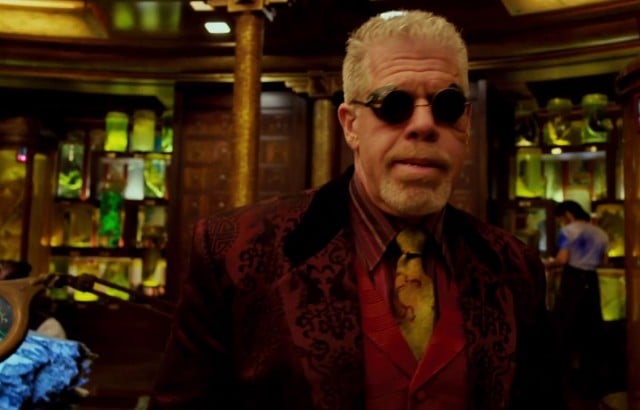
Ron Peralman, a
man who is not the one to be messed with, plays the over-the-top
Hannibal Chau. Unlike Charlie Day, I feel like Pearlman has enough
variety in him to pull off goofy characters while still being
identifiable as Ron Pearlman. We go to movies with Ron to see him act
like Ron. I think he puts himself into the setting well and I enjoy
the rapport he and Charlie Day had. Ron Pearlman, as my brother said,
may have been “too much ham” for the Kaiju. He's great to see on
screen, though.
Plot: I
won't bore you or spoil anything. There are a few aspects of the plot
that I enjoyed a great deal.
1) There was no
real internal conflict among humans. No countries tried to stab each
other in the back. No secret military plots. No stupid motivations.
Human beings came together to work toward a common cause. Russians,
Chinese, American, and Australians working together in
almost-harmony.
2) They didn't force a pointless love story. I think the movie hints at a romance between Mako and Raleigh that grows somewhat naturally. It never gets sexual, it never makes itself the main focus, it's just something in our peripheral. Kudos to the movie for movies away from sex and explosions.
3) No ridiculous pyrotechnics. The fights are cool, having various effects. Explosions happen when they need to, blood flies when it's supposed to fly, but everything done in moderation.
4) The movie strikes a balance between characters personalities and their duty. No ones eccentricities get in their way of their duty or function. They don't ruin plans or get people killed because they go after what they want. The characters, for being so over the top, are actually pretty balanced.
5) Unlike most movies that try to see “both sides of the issue” this movie has a clear villain, a clear goal, and no ambiguity. The monsters are evil, and we must fight them. All without referencing Hitler, which is more than I can say for the Avengers.
A few complaints:
2) They didn't force a pointless love story. I think the movie hints at a romance between Mako and Raleigh that grows somewhat naturally. It never gets sexual, it never makes itself the main focus, it's just something in our peripheral. Kudos to the movie for movies away from sex and explosions.
3) No ridiculous pyrotechnics. The fights are cool, having various effects. Explosions happen when they need to, blood flies when it's supposed to fly, but everything done in moderation.
4) The movie strikes a balance between characters personalities and their duty. No ones eccentricities get in their way of their duty or function. They don't ruin plans or get people killed because they go after what they want. The characters, for being so over the top, are actually pretty balanced.
5) Unlike most movies that try to see “both sides of the issue” this movie has a clear villain, a clear goal, and no ambiguity. The monsters are evil, and we must fight them. All without referencing Hitler, which is more than I can say for the Avengers.
A few complaints:
1) The conflict at the beginning seems a bit manufactured. The world's leaders are disappointed in the Jaeger project and fund a crappy wall. The plot point gets dropped pretty quickly. Seemed like manufactured conflict to me.
2) It seems like the pilots weren't always prepared for things that they should have been prepared for (on their end).
3) The music, while fitting and unobtrusive, isn't really memorable.
4) While there is some tension, it's never really the edge-of-your-seat tense.
5) You may find the ending to be a bit rushed.
Final Remarks:
For a 2+ hour movie, it never seemed to overstay it's welcome. Characters were each given adequate screen time and development. There was only one scene where I felt like it dragged on, and it was only 3 minutes or so. We never get to see much from the Russians or Chinese, which is a shame, but they were cool.
The movie is
cartoony enough to make you laugh a few times, serious enough keep
you cheering for our heroes. The movie is a “spectacle movie”
where you get to see big robots fight big monsters. The movie never
forgets that premise. It's a well-balanced movie. It combines good
acting with enjoyable action. It mixes childish fantasy (like when
you would crash toys together) with adult attention. It rejoices in
large battles and the human spirit.
Guillermo Del
Torro delivers another interesting movie wherein I can't find enough
flaws to detract from its merits. I hope a sequel comes out someday.
It's disturbing to see Grown Ups 2 somehow pull more in. Your money
is better spent here.
Verdict: ***
 |
| Three nostalgic robots out of four. I also understand Megatron isn't a hero. |

